News Desk
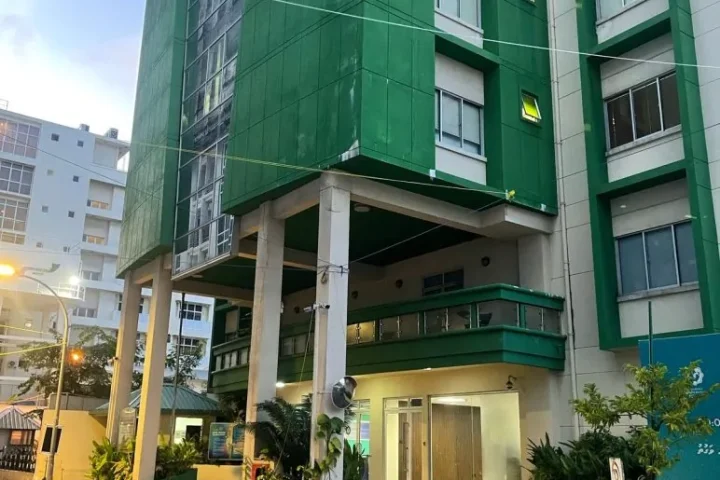
Outside the Ministry of Foreign Affairs, close to where the national flagpole now stands, there is nothing to suggest that this modest patch of ground once marked a turning point in the history of an entire nation. No plaque, no marker. Just a stretch of reclaimed land in a crowded capital, going about its administrative business.
Nine hundred years ago, this was the spot where the Maldives stopped being a pagan kingdom and became an Islamic one.
To understand why this particular plot mattered, it helps to understand what this part of Malé once was. Long before it was a government address, this stretch of coastline was the busiest beach in the kingdom. Fisherfolk from the islands of Giraavaru and Hulhulé brought in their catch here and cleaned it on the shallows, day after day, year after year, until the water ran red often enough that the practice gave the island its name. Malé, in the old tongue, translates roughly as a great pool of blood — not a violent history, but a fishy one. The same stretch of beach doubled as a boatyard, where dhonis were built, repaired and anchored, hauled up on the sand between voyages.
It was on a quiet stretch of sovereign land just behind this beach, so local tradition whispers, that a solitary tent was raised once each month, always under the soft glow of the full moon. And it is here that the story turns dark before it turns bright.
According to Maldivian folklore, a virgin girl from the island was chosen each month to spend the night alone in that tent. No one saw her again after. The story that circulated was that a sea demon rose from the ocean, entered the tent, and took her. History does not linger on what actually became of these girls; it has left that part to legend, and remembered instead what came after.
One spring night nine hundred years ago — the moon riding high and near full over a Malé that would have looked, in outline, much as the postcard Maldives does today, all lush palms and close horizon — a traveller from Morocco was staying as a guest in the home of a local family. He is remembered by Maldivians as Abul Barakaath al-Barbari: al-Barbari for his Berber origins, and Abul Barakaath—a name the locals may well have given him, rather than the one he arrived with—meaning “Father of Blessings.”
That night, he woke to weeping in the house. The family’s own daughter had been chosen as the month’s bride for the tent.
Abul Barakaath offered to go in her place. He recited scripture through the night. What passed between him and whatever came to the tent that evening is not part of the documented record, only that after that night, nothing from the sea ever came for a Maldivian girl again. By morning, the king had converted to Islam, and his subjects, as subjects tended to do, followed him.
That is the story as it has come down, at any rate; part history, part inherited legend, the join between the two long since worn smooth by repetition.
What followed is better documented. The Maldives became, and remains, one of the more isolated pockets of Islam in the Indian Ocean world. It sits among the seven founding nations of the South Asian Association for Regional Cooperation, a bloc sometimes referred to regionally as the seven sisters; grouped, however loosely, as custodians of spiritual tradition even as the world beyond them has grown steadily more secular. Maldives kept a version of Islam that owed comparatively little to the subcontinent next door. Like most places shaped by trading dhows rather than land armies, Maldives followed the Maliki school common to Morocco and North Africa before shifting, generations later, to the Shafi’i tradition that eventually took hold across the coastal Indian Ocean.
What is perhaps most striking about Maldivian Islamic history is how little of it has been marked by the extreme and sectarian religious friction familiar elsewhere in South Asia; the daily negotiations between mandir, mosque and meat, between one reading of the faith and another. For most of its history, the Maldives has had a straighter road.
The decades since have not always been so calm. The country’s more recent turn toward democracy, and the years of upheaval that came with it, are a separate story, one we are setting down at length in a manuscript still taking shape, The Dawn of Democracy, which runs up to the rule of President Muizzu. His years in office, we have chosen to document separately, under the working title The King of Ras Male’ , a manuscript still in the making, named for the old style of Maldivian kingship it borrows for its own purposes.