News Desk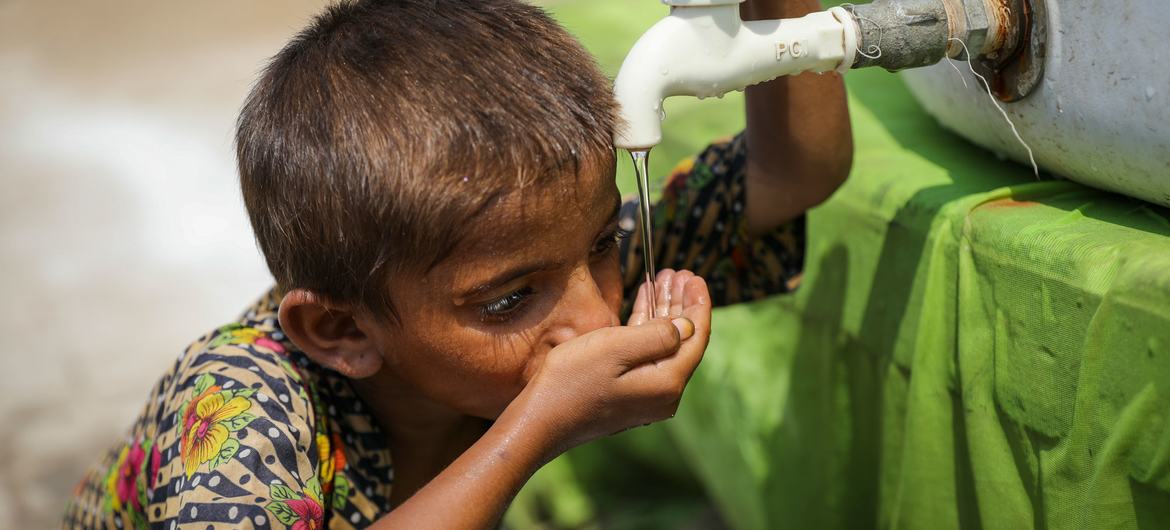
Sindh’s water crisis has moved beyond the language of allocation and into the territory of power, survival and state conduct.
As temperatures rise, canals run thin and protests sharpen, the dispute over the Indus has become one of Pakistan’s most charged internal fault lines, with Punjab’s political weight, federal inertia and a worsening climate crunch all feeding the same downstream misery.
The core of the dispute is not mysterious. Pakistan’s 1991 Water Apportionment Accord was meant to distribute Indus waters among the provinces, but Sindh has long argued that the lower riparian receives less than its due, especially during low-flow periods.
Recent reporting shows that Sindh officials again protested in 2025 over what they described as unequal cuts, while Punjab faced no reduction in supply in the same period.
That grievance has persisted because water in Pakistan is not only an agricultural input; it is also a political instrument.
Sindh’s leaders have repeatedly accused federal institutions of failing to apply the accord evenly, while provincial anger deepens whenever link canals are opened, or water is diverted upstream at the expense of downstream flow.
A province under heat stress
The humanitarian strain in Sindh is intensifying under extreme weather.
Reports in May described an acute shortage across many areas of the province during a severe heat wave, with Dadu recording 51.5 degrees Celsius and ponds drying up across the region.
In such conditions, the shortage is not abstract: it affects drinking water, household survival and the ability of farmers to keep standing crops alive.
This is where the water dispute becomes visibly human. Sindh has already warned that its crops face serious damage when supply falls short during Kharif, and local complaints have linked dry canals with agricultural losses and rising stress in rural communities.
The issue is no longer confined to irrigation boards and cabinet rooms; it is now tied to livelihoods, food supply and displacement fears.
The canals and the downstream cost
One of the most contested points remains the operation of link canals and the downstream release at Kotri.
Sindh has argued that water diverted through the Chashma-Jhelum and Taunsa-Panjnad link canals reduces the volume available to the lower province at precisely the time it needs it most.
In 2025, Sindh leaders said that water releases into those link canals continued even as their province faced a shortage.
The downstream impact is broader than one season’s harvest. Environmental reporting and long-standing research on the Indus basin have shown how reduced freshwater flows accelerate seawater intrusion into the Indus Delta, worsen salinity and degrade fertile land.
That process damages fisheries, weakens embankments and pushes coastal communities closer to forced migration.
Punjab’s dominance, Sindh’s grievance
The political language around this crisis is blunt because the imbalance is real in perception, if not always in the exact form claimed by each side.
Punjab is Pakistan’s most powerful province in population, administration and political influence, and that dominance shapes how Sindh views every water decision.
The accusation from Sindh is not only that it receives too little water, but that the structure of decision-making itself allows the upper riparian to dominate the lower one.
This is why the debate has acquired an ethnic and regional edge. Water scarcity is being read through history, not just hydrology.
Sindh’s political memory includes repeated complaints about centralisation, from past federal arrangements to present-day water boards, and each new shortage strengthens the belief that the province is paying the price for decisions made elsewhere.
Violation of water rights
Under United Nations standards, water is not a privilege granted by the state; it is part of the right to an adequate standard of living and an essential condition for health and dignity.
The UN Committee on Economic, Social and Cultural Rights recognised the human right to water in General Comment No. 15, and the UN General Assembly later affirmed the right to safe and clean drinking water and sanitation.
That matters because when a population is denied safe and sufficient water, the harm is not only economic. It affects life, health, food security and dignity, which is why chronic deprivation can be framed as a human rights violation.
In the Sindh context, repeated shortages, dry canals and compromised drinking supplies make the right to water more than a legal principle; they make it a test of state responsibility.
Legal standards and rights language
The article’s rights framing can also be placed within broader civil and political protections.
The International Covenant on Civil and Political Rights protects the right to life and freedom from arbitrary interference, both of which become relevant where water deprivation threatens survival and basic human security.
The Universal Declaration of Human Rights does not mention water explicitly, but it protects life, dignity and an adequate standard of living, which are directly implicated when a population cannot access water.
At the level of international advocacy, such disputes often arise within human rights forums when access to essential resources becomes tied to discrimination or systematic deprivation.
In that sense, the Sindh case is not merely an internal administrative failure; it can also be read as a governance problem with rights consequences.
A crisis worsened by climate and misrule
Pakistan’s wider water stress has made the inter-provincial dispute more dangerous.
The country’s river system depends heavily on the Indus basin, and climate pressure, erratic rainfall and rising temperatures have made shortages more frequent and harder to manage.
Against that backdrop, every accusation of unfair allocation becomes more combustible because there is less slack in the system.
This is why recent incidents in Sindh have resonated so sharply. Farmers, local leaders and provincial officials have all described dry spells, falling releases and anxiety over the coming agricultural cycle.
Reports of water scarcity during the last two years show that the issue is not a one-off political headline but an enduring crisis that keeps returning in hotter, harsher form.
The larger meaning of the dispute
What makes the Sindh crisis so severe is that it combines the oldest kind of politics with the newest kind of pressure.
It is a dispute over who controls a river, but also over who is heard in the state, who bears the burden of scarcity and who gets to call an unequal system normal.
Punjab’s dominance, whether viewed as structural power or as deliberate overreach, sits at the centre of Sindh’s grievance.
The result is a humanitarian crisis that keeps unfolding in plain sight. Water scarcity in Sindh is no longer just a provincial complaint; it is a measure of how Pakistan manages justice, federalism and survival under stress.
When water becomes scarce by design or by neglect, the damage does not stop at agriculture. It reaches the household, the field, the delta and the law.