News Desk
In his latest media appearance, President Dr Mohamed Muizzu offered a sweeping vision for the real estate framework governing Ras Malé, proposing strict single-nationality ownership caps and a total ban on Israeli buyers. Yet behind the headlines lies a crucial distinction: these parameters are not yet law, but executive musings for a legislative draft that must still survive intense public debate and Majlis scrutiny.
Speaking on the President’s Office broadcast “The Pulse”, President Muizzu announced that the administration plans to introduce a Real Estate Act imposing a 25 per cent cap on property acquisition by nationals of any single foreign country within the $20 billion Ras Malé Waterfront and Marina project, developed by Dubai-based Eagles Hill. No such restrictions would apply to Maldivian buyers, who he suggested could easily afford units priced around $600,000 for 1,000 square feet. He further asserted that Israeli citizens would be completely barred from buying, selling, or acquiring property under the venture or any future developments.
However, as legal experts and opposition figures have quickly noted, executive rhetoric broadcast on state media does not carry the weight of statutory law.
The proposed Real Estate Act remains an administrative draft, crafted against a backdrop of growing public pushback and parliamentary objections regarding foreign land tenure and offshore investment privileges.
While the President framed the 25 per cent cap as a safeguard against foreign enclave dominance, transforming that policy vision into enforceable law requires navigating constitutional provisions and parliamentary oversight in the People’s Majlis. Closing off property rights on the basis of nationality—and implementing screening mechanisms to enforce individual citizenship bans—presents complex legal hurdles that lawmakers have yet to codify.
Until the People’s Majlis debates, amends, and passes the statutory framework, the announced ownership limits represent a policy intent rather than a settled legal boundary.
The administration’s restrictive posturing on Ras Malé stands in stark contrast to its approach toward other major mega-developments across the archipelago.
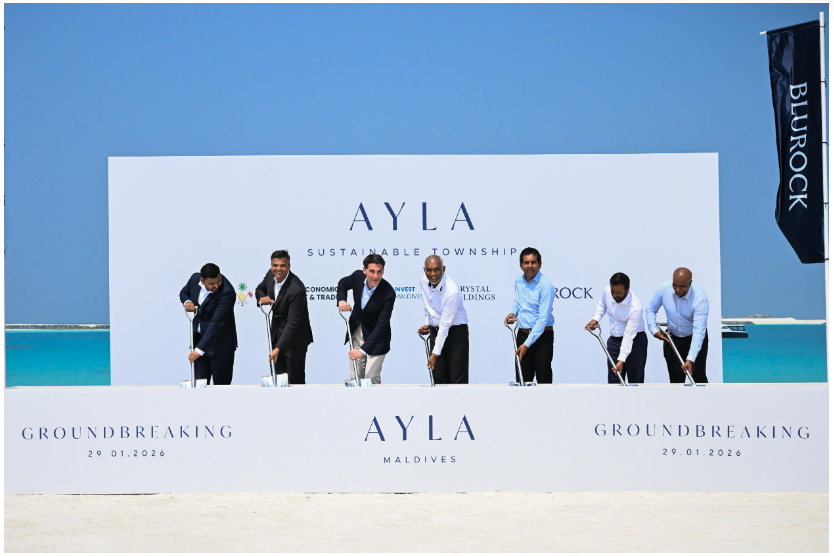
As eTruth.mv previously reported, President Muizzu earlier launched Project Ayla—a $790 million sustainable township in Noonu Atoll designated as a Special Economic Zone (SEZ) under an agreement with Crystal Holdings. Unlike the heated public debate surrounding land allocation and foreign acquisition at Ras Malé, Project Ayla encountered virtually no public objections regarding international ownership structures.
Crucially, the government has adopted no national ownership caps, quota systems, or country-specific bans for the Ayla township. The stark disparity between the open-door SEZ framework applied in Noonu Atoll and the tightly regulated, populist rhetoric surrounding Ras Malé highlights how politicised land rights have become in the capital region.
For now, as the government works to draft the legislation governing Ras Malé, the market and the public remain suspended between executive promises and the reality of statutory law. Whether the proposed foreign ownership caps and citizenship bans survive parliamentary scrutiny—or simply remain rhetorical talking points—will depend heavily on the legislative battle ahead.