News Desk

When Ahmed Shiyam took over the newly merged Ministry of Fisheries, Agriculture and Ocean Resources in April this year, the cabinet reshuffle was designed to streamline government administration. Speaking in Addu City’s Meedhoo to mark National Farmers’ Day last month, however, Minister Shiyam underscored the stakes behind the portfolio: for a country that imports almost everything it eats, growing our own food is a matter of national security.
Three years into President Dr Mohamed Muizzu’s term, food security remains a high-profile pledge, though the results so far point to a slow, steady climb rather than a rapid transformation. Small-scale training and financing programmes are gaining traction in the atolls, yet bigger ambitions—including large-scale reclamation for farming—have taken longer to get off the ground, leaving foreign partners to play a crucial supporting role.
Away from the political speeches in Malé, the most practical work has taken place in the outer islands. According to figures from the ministry, 1,062 farmers have now been trained in modern farming methods. This is backed by 12 demonstration greenhouses across Haa Alif, Haa Dhaalu, and Shaviyani atolls, with active hubs in islands like Vaikaradhoo, Hanimaadhoo, Makunudhoo, and Foakaidhoo.
Most of this training runs through the Maldives Agribusiness Programme (MAP), a joint effort with the UN’s International Fund for Agricultural Development (IFAD). Because open-field crops in the Maldives suffer from salt spray and unpredictable weather, these northern hubs focus on hydroponics and protected greenhouses. They teach growers how to produce high-import vegetables like cucumbers, melons, capsicum, and chillies. Down south, a new National Agriculture Laboratory in Fuvahmulah City has finally given local farmers access to soil testing and pest diagnosis without sending samples abroad.
Access to money has also changed. Through SME Digital, the Dhanduveri Nafaa loan scheme—which lends between MVR 500,000 and MVR 2 million—has paid out MVR 16.4 million to 29 applicants. More importantly, the scheme was converted into a Shari’ah-compliant Islamic finance facility earlier this year. That single change opened the door for many island farmers who previously refused interest-based loans. Alongside this, the Dhanduveri Manfaa matching grant scheme is giving out non-repayable funds for urban farming, poultry, and agroforestry, with new agreements signed last month across ten islands from HA. Baarah to GDh. Fiyoaree.
Land allocation has moved as well, though it comes with a warning. Over a four-month period, the government allocated five islands for agriculture, including a 20-year food security lease in the inhabited island of K. Kaashidhoo and commercial ventures in GA. Kondey, L. Gan, and HDh. Nolhivaramu. Yet at a recent Ahaa public forum, Minister Shiyam cautioned that handing out too many islands without strict production targets actually puts off serious foreign investors.
Because the Maldives relies so heavily on outside funding and technical help, foreign partners play a central role in shaping local farming. Look at where the money and equipment come from, and clear divisions appear.
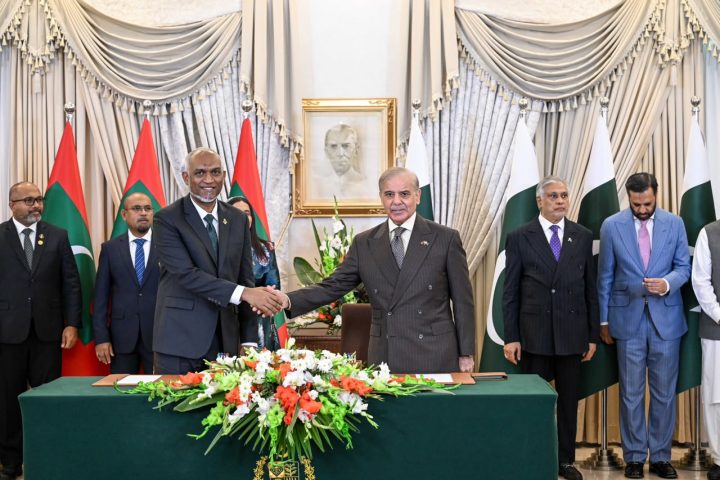
Beijing has focused on large commercial plans and direct material support. In July 2025, Malé and Beijing signed an agreement to fight the beetles destroying Maldivian coconut palms, including plans to set up a biological pest-control lab. Chinese authorities in Sichuan province have also shipped automated irrigation controllers, soil-testing kits, and heavy sprayers straight to local councils, while the Maldives National University has partnered with Yunnan University on research.
Such exchanges build on earlier Chinese technical assistance on the ground, including a Yunnan-supported project to improve mango and tropical fruit orchards in islands such as Sh. Goidhoo.
Early in his term, President Muizzu pledged to achieve near-total food self-sufficiency within five years by building a massive Agricultural Economic Zone. However, the biggest Sino-Maldivian farm project remains stalled—and caught up in wider regional politics. Early in his term, President Muizzu pledged to achieve near-total food self-sufficiency within five years by building a massive Agricultural Economic Zone.
The state-owned Maldives Industrial Development Free Zone (MIDFZ) signed a deal with China Harbour Engineering Company (CHEC) to reclaim 200 hectares at Uthuru Thila Falhu (UTF). Putting a major Chinese-backed project at UTF, however, created obvious friction: the lagoon is already home to the Indian-funded Ekatha naval dockyard and Coast Guard harbour. Following Malé’s diplomatic reset with New Delhi—and quiet sensitivities over placing Chinese infrastructure right next to an Indian-built naval facility—the government shifted the agricultural zone south to Fushi Dhiggaru Falhu (Rasmalé). Even at the new site, progress has been slow, with written disclosures from the Construction Ministry in August confirming that physical land reclamation for the agricultural zone has still not started.
While Chinese infrastructure deals grab headlines, Japan and major international agencies do much of the quiet funding that reaches everyday growers.
Through the Japan International Cooperation Agency (JICA) and the Japan Fund for Prosperous and Resilient Asia and the Pacific (JFPR), Tokyo is co-financing the USD 27.92 million Enhancing Climate Resilience and Food Security project alongside the Asian Development Bank (ADB). Running until 2030, it funds school greenhouses and urban farming in Greater Malé, Haa Dhaalu, and Addu. Maldivian and Japanese officials also held fresh talks in June to expand technical training in farming and fisheries. This modern assistance builds on a deep historical footprint: JICA has supported the agriculture ministry since the early 1980s, deploying volunteers when the ministry ran its core plant nurseries on B. Dharavandhoo and AA. Feridhoo.
Meanwhile, UN agencies remain the primary international funders working directly on the ground in agriculture. Alongside IFAD’s co-financing of the Maldives Agribusiness Programme—which built the northern demonstration greenhouses and trained over a thousand growers—the Food and Agriculture Organization (FAO) continues to support local value-chain studies, crop certification, and policy frameworks across the islands.
For all the talk of growing food locally, the Maldives still depends on India for basic daily staples. New Delhi’s primary role in Maldivian food security comes down to trade: maintaining the uninterrupted export quotas for rice, flour, sugar, onions, and potatoes that keep local shops stocked.
On the farming side, cooperation is still mostly at the discussion stage. In February this year, State Minister Ahmad Hassan Didi met Indian Agriculture Minister Shivraj Singh Chouhan and officials from the Indian Council of Agricultural Research (ICAR) in New Delhi. Both sides agreed to share research on livestock and island growing conditions, alongside ongoing talks over a bilateral Free Trade Agreement. So far, however, those meetings have yet to produce major new farm projects on Maldivian soil.
Even with more trained farmers and Islamic financing, the biggest problem in Maldivian agriculture has not been solved. Growers on outer islands still struggle to get their produce to resort kitchens or Malé markets reliably and at a competitive price. As Minister Shiyam noted in Addu last month, local small businesses are growing more food, yet they still lose out to imported produce that arrives in bulk on predictable schedules.
At the same time, there are clear limits to what a ministry in Malé can achieve on its own. True self-sufficiency will not happen unless local island councils step up—organizing empty community plots and encouraging households to use home gardens to grow their own everyday fruits and vegetables.
Under former Agriculture Minister Dr Mariyam Mariya, the ministry kept up a steady flow of practical public guidance on backyard gardening and pest control. Since the portfolios were merged under Minister Shiyam, that regular outreach has largely dried up, with his public schedule and overseas engagements—such as recent aquaculture and marine seed trips to China—showing a clear tilt toward the fisheries sector. Until both local councils and the ministry give everyday cultivation that same level of attention, island growers will continue to fight an uphill battle.