 News Desk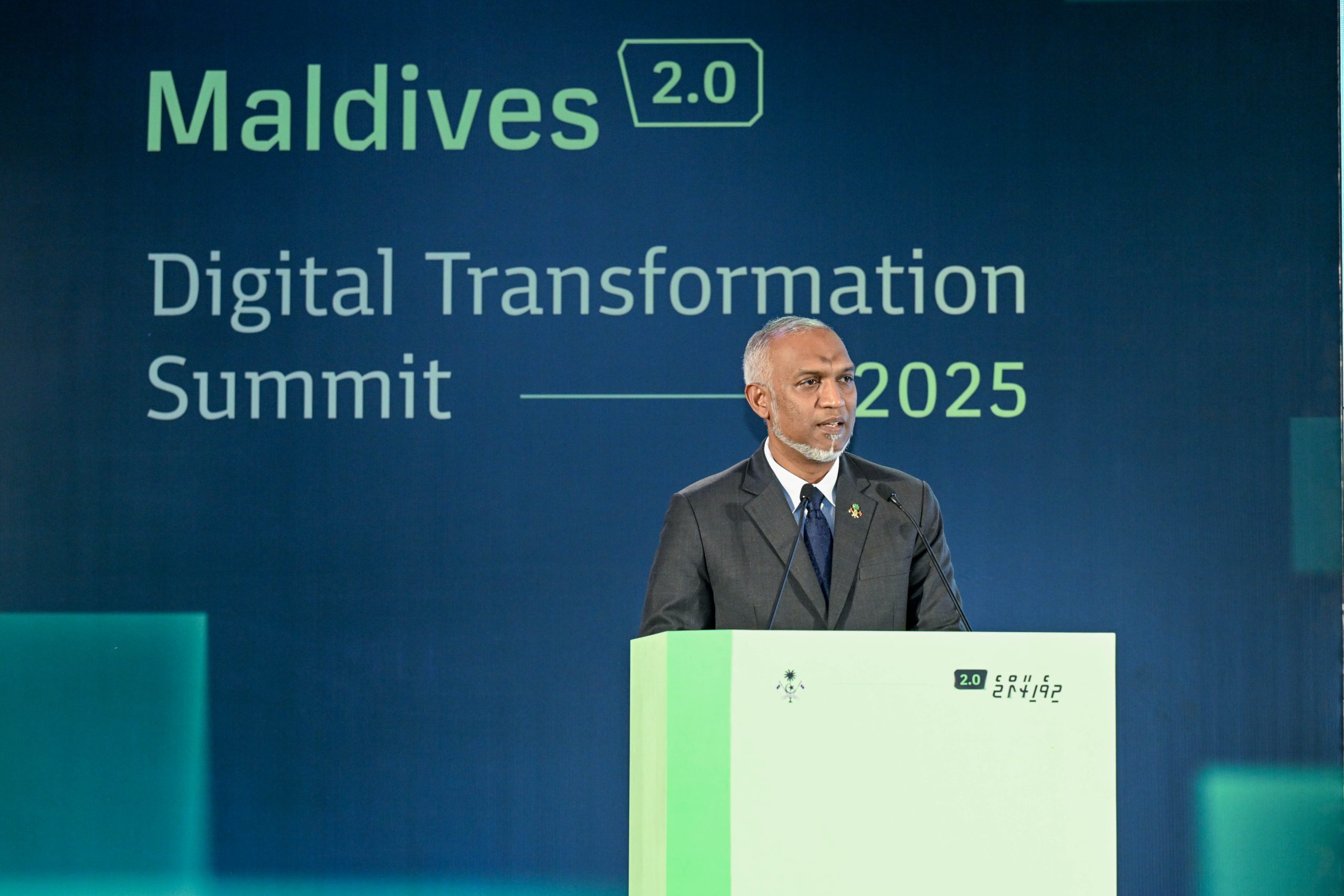
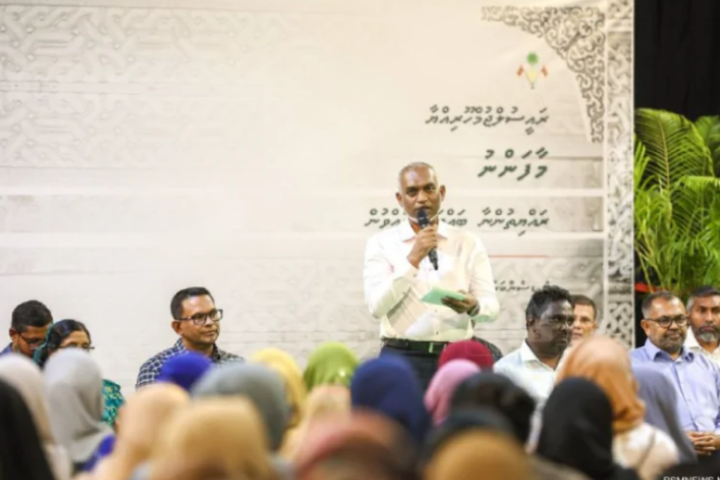
In the heart of Malé, President Dr. Mohamed Muizzu stood before a crowd of officials, foreign experts, and hopeful citizens. The air buzzed with anticipation at the Barceló Nasandhura Malé, where President Muizzu unveiled Maldives 2.0, a bold plan to drag the nation’s governance into the digital age. His voice, steady and earnest, carried a promise: this would be the biggest step toward eradicating the corruption that has long plagued the Maldives. “This is what the people want,” he said, his words echoing across a nation weary of scandal.
Since taking office in November 2023, President Muizzu’s administration has grappled with a wave of corruption allegations involving senior officials, underscoring the urgency of his reform agenda. In June 2024, two officials, Shamnaz Saleem and Adam Rameez, faced dismissal for allegedly attempting to influence the President through superstitious practices, a bizarre scandal that stunned the nation. And 13 Corrections officers arrested in Maafushi Prison corruption network. In December, Mohamed Fazul, a key figure in the Housing Development Corporation, resigned amid suspicions of illicit enrichment; police seized $90,790 in cash from his home and charged him with destroying official documents. Most recently, Controller General of Immigration Mohamed Shamaan Waheed was arrested on corruption charges.
These high-profile cases, while damaging, highlight President Muizzu’s willingness to confront misconduct head-on, a marked shift from past administrations. These efforts, extensive for an administration launched in November 2023, distinguish President Muizzu’s approach. By early 2025, many officials have been arrested or detained on corruption charges, and some have been fired or suspended.
To address this entrenched corruption, enter Maldives 2.0, a vision born of both ambition and necessity. At the summit, President Muizzu spoke of a unified digital ID system, one that would let citizens access services with a few clicks while stripping away the opaque layers where corruption festers. “Transparency is the enemy of corruption,” he said, gesturing to the Estonian delegates seated in the front row. Estonia, a global leader in digital governance, has climbed to second place on the 2025 World Press Freedom Index, a feat President Muizzu attributes to its seamless e-governance. He wants the Maldives to follow suit, with a system tailored to its island context, where 1,200 atolls are scattered across 90,000 square kilometers of ocean.
Beyond IDs, Maldives 2.0 aims to digitize public institutions, enable remote work for a third of the workforce by 2028, and bolster cybersecurity to protect sensitive data. President Muizzu points to the National Survey on Corruption 2023, released alongside the summit, which revealed widespread public frustration with systemic graft. A Corruption Risk Assessment Toolkit and an Anti-Corruption Trust Fund were also launched, signaling a comprehensive approach. “This is a system that empowers every citizen,” President Muizzu said, his voice rising with conviction.
In a surprising move, he extended an invitation to the opposition via a social media post, urging them to join the Maldives 2.0 effort. “Why do they come out every time we fight corruption?” he asked pointedly, framing the MDP as obstructionist. The opposition’s response has been muted, their stance unclear as they weigh the political cost of collaboration. Some MDP members, in their social media groups and posts, have openly criticized President Muizzu, accusing him of “sky-high corruption” and mismanagement. One MDP post claimed, “Digital promises can’t hide a government mired in scandal,” reflecting distrust. On social media, opposition voices amplify distrust, with posts calling Maldives 2.0 a hollow promise from a ‘tainted administration’.
For ordinary Maldivians, the stakes are personal. AM, a 34-year-old construction company owner, recalls greasing palms for quotas and permits and says it’s an established culture. “It wasn’t much, but it felt wrong,” AM says, speaking anonymously. He clarifies that it didn’t start with President Muizzu; it’s been a longstanding issue. “If this digital system means I don’t have to beg or pay under the table, I’m all for it. But I don’t trust the people running it.” His sentiment reflects a broader challenge: technology may streamline processes, but it cannot rebuild faith in the system.
President Muizzu knows this. At the summit, he acknowledged the legal framework for Maldives 2.0 is still being drafted, a nod to the hurdles ahead. He leaned heavily on Estonia’s example, citing its ability to deliver services while maintaining public trust. But the Maldives is not Estonia. Its economy teeters on the edge, with foreign reserves at $440 million in 2025, barely enough for six weeks of imports.
Corruption scandals, a medicine shortage, and a controversial Supreme Court trim have fueled accusations of authoritarianism. The opposition warns of “democratic backsliding,” pointing to President Muizzu’s supermajority in parliament, which has steamrolled legislation like the anti-defection law.
Still, President Muizzu presses forward. “We will stay close to the people,” he vowed, his words aimed at both supporters and skeptics. The three-year timeline for Maldives 2.0 is ambitious, promising revolutionary changes in how the state serves its citizens. If successful, it could elevate the Maldives’ global standing, as President Muizzu hopes, boosting its rank on corruption and press freedom indices. But success hinges on execution—and trust. For a nation at a crossroads, Maldives 2.0 is both a beacon and a gamble, a chance to rewrite an earnest story too long defined by past cover-ups and corruption.