 News Desk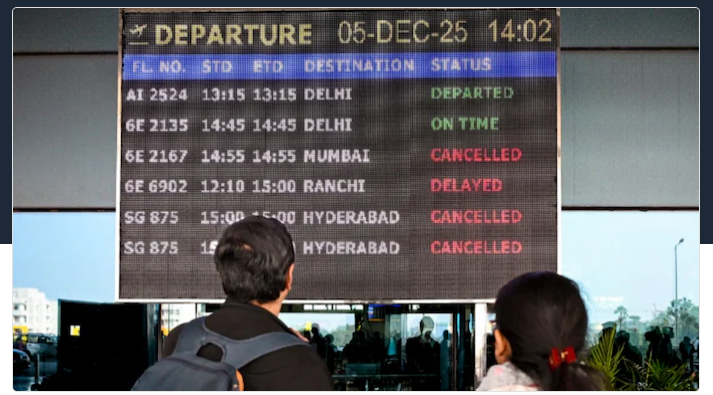
NEW DELHI — As India’s largest airline grappled with an unprecedented wave of flight cancellations, the government moved swiftly to reassure passengers and restore order, underscoring the country’s growing capacity to manage crises in its booming aviation sector.
In recent days, IndiGo cancelled more than a thousand flights, stranding thousands of travellers and sending ticket prices soaring. But within hours, the Prime Minister’s Office and the Civil Aviation Ministry intervened decisively: capping fares, mandating refunds, and summoning airline executives to ensure accountability.
India’s intervention unfolded with remarkable speed and clarity. Authorities ordered IndiGo to complete refunds for all cancelled flights by Sunday evening, ensuring that stranded passengers would not be left bearing the financial burden. To further ease the disruption, the government directed the airline to waive rescheduling charges, a move that signalled a new emphasis on consumer protection.
At the same time, regulators imposed caps on domestic economy fares, preventing ticket prices from spiralling out of reach. To counter the surge in ticket prices that followed IndiGo’s mass cancellations, the government moved quickly to impose caps on domestic economy fares. Short-haul journeys of up to 500 kilometres were limited to ₹7,500, while medium-range flights between 500 and 1,000 kilometres were capped at ₹12,000. Longer routes of 1,000 to 1,500 kilometres were set at ₹15,000, and the maximum fare for distances above 1,500 kilometres was fixed at ₹18,000. These measures restored predictability to the market and reassured passengers that affordability would not be sacrificed in the midst of disruption.
The intervention has been widely praised by industry observers as a sign of India’s maturing aviation ecosystem. Where once passengers might have been left to fend for themselves, the state’s rapid action demonstrated a new emphasis on consumer protection and operational resilience.
What Happened
On 5 December 2025, IndiGo was forced to cancel over 1,000 domestic flights in a single day after the DGCA strictly enforced new Flight Duty Time Limitation (FDTL) rules that had been announced in January 2024. The revised regulations require pilots to have a mandatory 48-hour weekly rest, but IndiGo failed to hire enough pilots during the 18-month transition period, leading to a severe crew shortage. As thousands of pilots simultaneously availed their pending rest, the airline’s domestic schedule collapsed, stranding lakhs of passengers during peak winter travel. International and code-share flights remained largely unaffected. Facing massive backlash, the government temporarily relaxed the rules until February 2026, while ordering a DGCA probe and mandating full refunds/accommodation for affected passengers.
Aviation experts note that India’s response reflects both its ambition to become a global aviation hub and its determination to safeguard public trust. “This is not just about one airline,” said a senior industry analyst. “It’s about India showing it can manage turbulence with confidence.”
IndiGo, for its part, has pledged to stabilize operations within ten days, citing crew shortages and new duty-time regulations as the root of the disruption. The airline insists it is working “determinedly” to restore services.
For passengers, the crisis may soon be remembered less for the chaos it caused than for the speed with which India acted to contain it. In a country where air travel is increasingly central to economic life, the episode has become a showcase of resilience — a reminder that India’s skies, though crowded, are being carefully stewarded.