News Desk
MALE’, Maldives — On the eve of a milestone anniversary, the United States Embassy in Male’ commemorated 60 years of diplomatic relations with the Maldives, a partnership that began in August 1965 and has since flourished through decades of cooperation in education, security, and shared interests. However, as the U.S. Embassy celebrated this enduring bond with evocative images on X, a historical correction from a local archivist has prompted a deeper exploration of the relationship’s origins.
The embassy’s post on August 11 featured black-and-white photographs of a formal credential presentation alongside a modern handshake between President Dr. Mohamed Muizzu and U.S. Ambassador Hugo Yon, who assumed his role as the first fully dedicated U.S. Ambassador to the Republic of Maldives in September 2023. These images highlighted the journey from the mid-20th century to the present.
“For six decades, we have stood together as partners in progress,” the embassy wrote, pairing images that juxtaposed a historic ceremony with a recent meeting, symbolizing the continuity of this alliance.

The post, notable for its nostalgic tone, referenced the initial diplomatic overture when President Lyndon B. Johnson congratulated Prime Minister Ibrahim Nasir on the Maldives’ independence, paving the way for formal ties established on April 9, 1966. However, the narrative took a scholarly turn when historian Naajih Didi responded, correcting a key detail.
The embassy’s historic image, depicting an ambassador presenting credentials to a figure in regal attire, was misidentified. “The image you posted does not depict the first U.S. Ambassador presenting credentials to His Majesty King Mohamed Fareed I,” Didi clarified, identifying the scene as the 1967 credential presentation by the second U.S. Ambassador, Andrew Vincent Corry.
Didi provided a contrasting photograph of the first ambassador, Cecil B. Lyon, posing with King Mohamed Fareed I after his 1966 credential presentation, offering a rare glimpse into the early days of U.S.-Maldives diplomacy. Lyon, a seasoned diplomat who began his career in 1931, played a pivotal role in formalizing relations when he presented his credentials as the U.S. Ambassador to Ceylon (now Sri Lanka) and concurrently to the Maldives, a nation that had recently emerged from British protection.
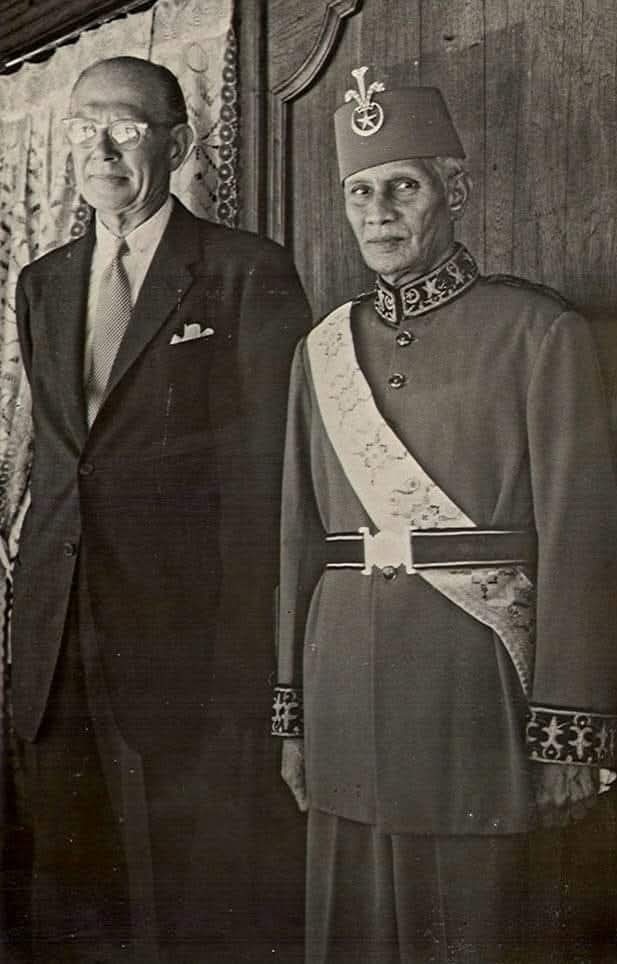
King Mohamed Fareed I, who reigned as Sultan until 1965 and then as King until his deposition in 1968, was a central figure during this transitional period. The U.S. Embassy remains optimistic, framing the 60-year milestone as a foundation for future cooperation.
The modern image of a handshake between President Muizzu and Ambassador Yon signals an intent to move forward. Yet, as Naajih Didi’s correction underscores, understanding the past—down to the precise moments of its early ambassadors—is essential for navigating the complexities of the present.
Today, the Maldives and the United States stand at a crossroads, their partnership tested by global politics but rooted in a history that began with a king’s handshake six decades ago.