News Desk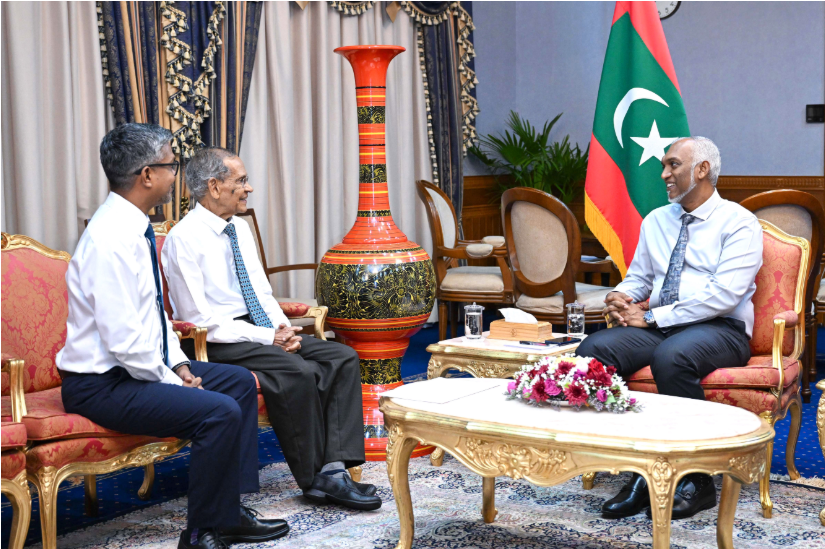
At a quiet hour in Malé, Dr. Mohammed Zahir Hussain walked into the President’s Office with the composed ease of a man who has spent half a century in the service of education.
Waiting to receive him was President Dr. Mohammed Muizzu, who rose to greet the country’s highest civilian honour recipient — the Order of the Distinguished Rule of Izzuddin — with the warmth reserved for a mentor whose influence has shaped generations.
Their meeting, though brief, carried the weight of history. Convened to formally thank him for his service following his decision to step down as Chancellor of the Islamic University of Maldives, President Muizzu used the moment to honour what he called Dr. Zahir’s “sincere and transformative work” in advancing the country’s education sector — a tribute not only to the man’s long career but to the philosophy that guided it.
Over the decades, Dr. Zahir has been a quiet architect behind some of the Maldives’ most foundational educational reforms: the expansion of community schools, the establishment of provincial schools, and the push to bring basic education to rural islands where classrooms once existed only in aspiration.
For Dr. Zahir, these were not administrative achievements but moral imperatives. His work, he often says, was shaped by the belief that a nation’s progress begins in its smallest classrooms.
During the meeting, he expressed gratitude to the President for the opportunity to serve at the Islamic University of Maldives — a role he carried out diligently. He also praised President Muizzu’s ongoing efforts to strengthen the Maldivian education system, noting that the administration’s focus on quality and access echoes the principles he championed decades earlier.
Dr. Zahir’s career spans 49 years and 9 months in state service, according to the President’s Office announcement, including more than 33 years in the Maldives’ education sector, where he helped shape policy frameworks that continue to influence the country today. His intellectual roots run deeper still: as a young scholar in Egypt, he absorbed early debates on environmental stewardship and social cohesion — ideas he later wove into the Maldivian curriculum.
By the mid‑1980s, under his leadership as Education Minister, Maldivian children were learning not only arithmetic and language but also the fragile ecology of their island home. He introduced Environmental Studies as a primary‑level subject, a pioneering move that predated global climate discourse and helped cultivate a generation of environmentally conscious citizens. His curriculum reforms were built collaboratively, drawing on voices from every atoll to ensure that the national framework reflected the lived realities of the archipelago.
His influence extended beyond classrooms. Through Haveeru, the newspaper he founded, Dr. Zahir became what many Maldivians still call “the nation’s memory keeper,” documenting the country’s political and social evolution until the paper’s controversial closure. His academic work — including a dissertation on Ibn Khaldun — infused his public service with a philosophical depth that shaped policy far beyond education.
Recognition has followed him late in life. On 10 November 2024, he was conferred the Nishan‑e‑Izzud‑Din, one of the nation’s highest honours. At the 2024 Republic Day celebrations, he received the country’s top award for service to education — a moment that President Muizzu described as “long overdue.”
Today, as Chancellor of the Islamic University of Maldives, Dr. Zahir remains a guiding presence in national life. Many of the country’s current leaders, including President Muizzu himself, were educated under the curriculum he designed — a legacy that binds the nation’s political present to its educational past.
As the meeting concluded, the two men exchanged a final gesture of mutual respect: the President acknowledging a lifetime of service, and Dr. Zahir expressing hope that the seeds planted decades ago will continue to bear fruit.
In a country where the tides shape everything, Dr. Zahir’s work has been a rare constant — a reminder that the most enduring nation‑building often begins with a teacher, a classroom, and a vision for what the next generation might become.