 News Desk
Cybercrime has tightened its grip on the Maldives, prompting a coordinated international crackdown that has exposed a sprawling web of digital fraud operating across the Indian Ocean archipelago.
According to figures released by the Maldives Police Service’s Anti-Scam Centre, law enforcement identified 847 suspects linked to online fraud rings between July and September 2026. During this three-month window, authorities froze 1,088 bank accounts and arrested 17 individuals as part of a concerted pushback against escalating digital deception.
The local surge mirrors a wider global crisis. The Maldivian police figures were published alongside the results of “Operation Confrontation Ghost,” a massive international sweep spearheaded by the United Arab Emirates Ministry of Interior in collaboration with Interpol, the Global Anti-Scam Alliance (GASA), law enforcement agencies from 30 countries, and 13 private technology and financial firms.
Between July 1 and September 30, the Anti-Scam Centre logged 544 scam complaints from the public, tallying a staggering financial loss of 5,256,101.97 Rufiyaa ($341,000 USD).
However, authorities highlighted a relatively high recovery rate. Through rapid interventions by the Anti-Scam Centre and partnering financial institutions, police managed to intercept and recover 3,104,075.38 Rufiyaa before it could be laundered or spirited out of reach—representing a 59.1 percent recovery rate of reported losses.
Police attribute this success to immediate asset-freezing protocols, which blocked 1,088 suspect accounts. Investigators say these swift measures are vital to cutting off the financial lifeblood of organized cybercrime syndicates targeting citizens in the island nation.
The data reveals a shifting landscape of digital trickery. While e-commerce fraud remains the most prevalent offense—accounting for 230 reported cases involving goods bought and sold across online platforms—fraudsters are diversifying their methods. Foreign exchange scams ranked second, with 107 cases recorded.
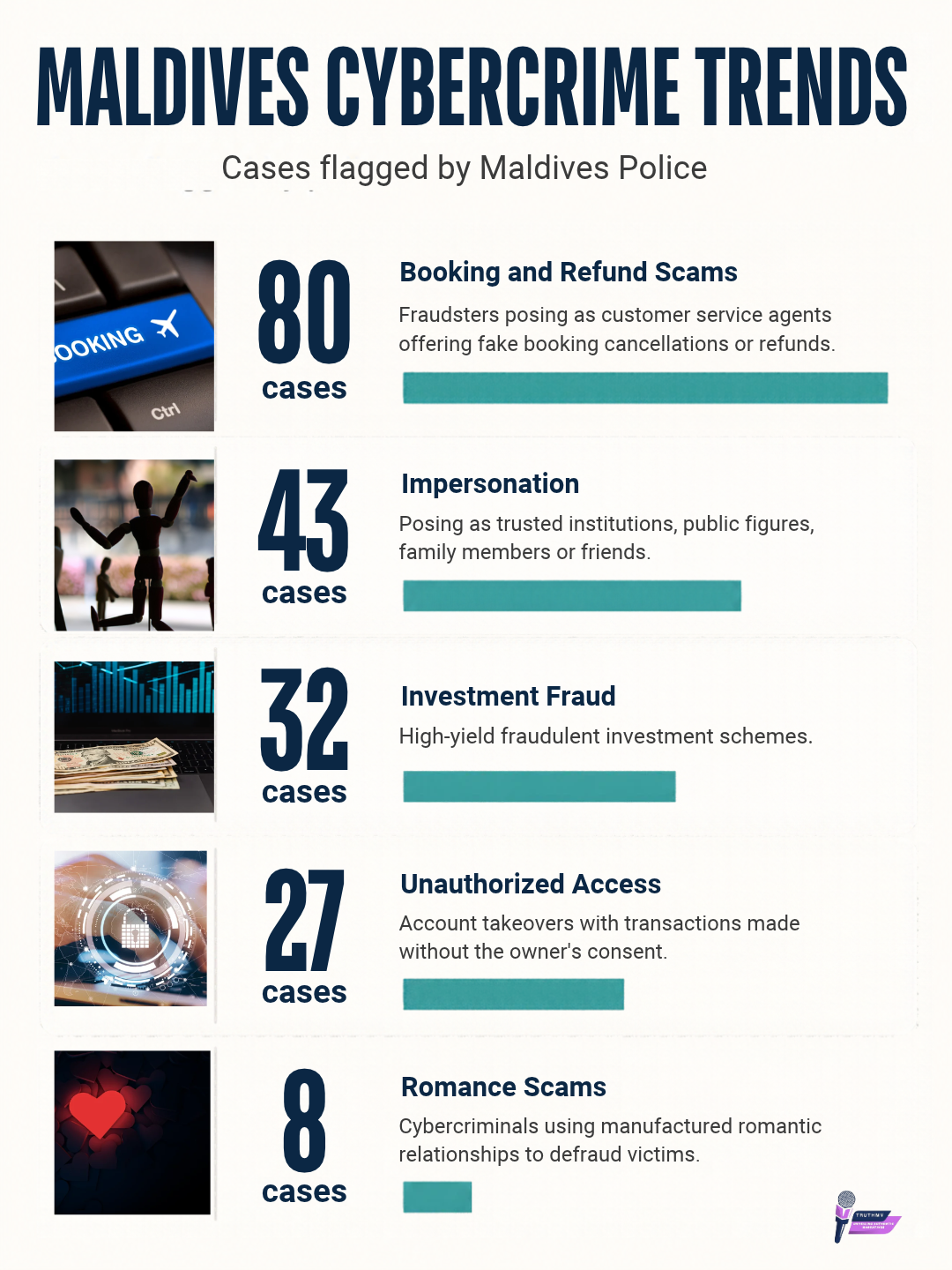
Police also flagged several emerging trends:
- Booking and Refund Scams: Fraudsters posing as customer service agents offering fake booking cancellations or refunds accounted for 80 cases.
- Impersonation: Posing as trusted institutions, public figures, family members, or friends made up 43 cases.
- Investment Fraud: High-yield, fraudulent investment schemes accounted for 32 cases.
- Unauthorized Access: Account takeovers where transactions occurred without the owner’s consent totaled 27 cases.
- Romance Scams: Cybercriminals leveraging manufactured romantic relationships defrauded victims in 8 cases.
A Global Scale of Deception
The local figures feed into staggering global statistics compiled during Operation Confrontation Ghost, the results of which were officially unveiled on the sidelines of the United Nations Conference on Transnational Organized Crime in Vienna, Austria.
On a global scale, the operation disrupted more than 123.7 million online fraud attempts and identified over $39 billion in suspected illicit funds and digital assets. International law enforcement agencies arrested more than 960 suspects worldwide, identified over 3,500 targets, and raided 29 illegal scam centers. Authorities also shuttered 4,126 bank accounts and more than 570 social media accounts used to facilitate online fraud, rescuing over 15,500 victims from ongoing exploitation.
As digital connectivity deepens across South Asia, the Maldivian authorities’ heavy reliance on cross-border intelligence-sharing highlights an evolving reality: combating borderless cybercrime requires an equally borderless defense.