News Desk
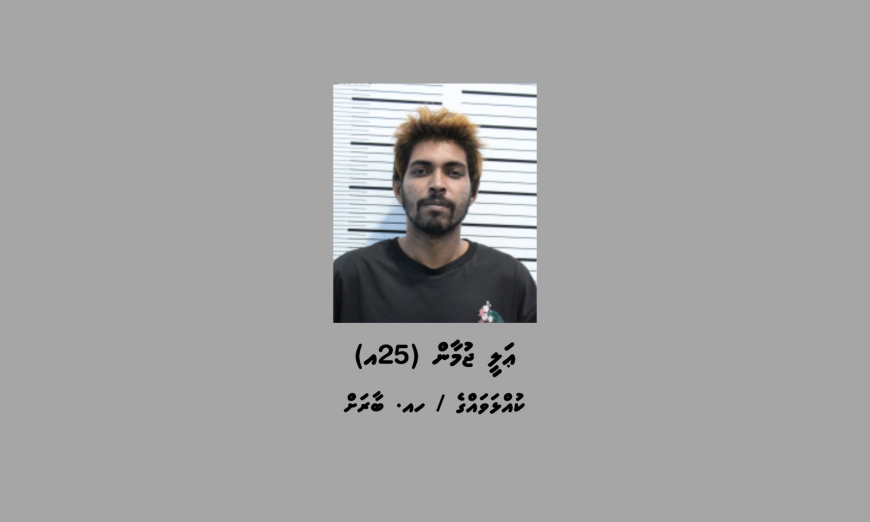
They call him “Death”. It is a ludicrously grave title for a 25-year-old grown under the coconut palms of Haa Alif Baarah, a sleepy northern outpost represented in the People’s Majlis by a bombastic career politician whose chief contribution to statecraft is roaring into podium mics with the subtlety of a foghorn.
Yet, on 22 October 2026, Ali Juman, known to his peers as “Death,” was dragged away in police handcuffs, suspected of attempting to ignite a very real fire across the archipelago.
According to official police statements, Juman—a resident of the island’s Kulhavahge —was taken into custody under a court warrant. The charges against him read like the blueprint of an urban insurgency: openly using social media platforms to incite arson against public and private buildings, encouraging the burning of maritime vessels and vehicles, and calling for the looting of commercial shops across the country.
To look at Juman’s background is to look into the quintessential Maldivian upbringing. Raised in a devoutly Muslim community, his childhood was shaped by the standard Ministry of Education curriculum—a regime of Dhivehi litany, Islamic studies, and standardized national exams. Nothing in his conventional schooling flagged an appetite for chaos. But beneath the calm surface of island life, fed by the quiet isolation of the outer atolls, a darker, digital radicalism has taken root.
Juman’s arrest is not an isolated incident; it marks the second high-profile case of digital arson incitement in the space of mere days, exposing a concerning pattern of political and social unrest spilling onto social networks.
Just days earlier, Hassan Zihan—a former Maldives National Defence Force (MNDF) naval architect and ex-Deputy Minister at the Transport Ministry from Fuvahmulah—was arrested and remanded for 15 days under similar allegations. Zihan, a former government insider who turned into a fierce online critic after being dismissed from his post, had allegedly used Facebook to call for arson attacks against key state institutions, including the Supreme Court, the President’s Office, and Parliament.
While Zihan represented the disillusioned political establishment, Juman—the young activist from Baarah—represents something arguably more dangerous: the disaffected youth of the outer islands, armed with smart phones, inflamed by grievances, and willing to turn online vitriol into calls for physical destruction.
The Maldives Police Service confirmed that Juman’s case is being treated as an issue of severe national security. In a country where geography isolates communities across miles of open ocean, digital platforms have become the virtual town square. But when that square becomes an incubator for mob violence and public destruction, the state’s response is swift and heavy-handed.
Whether Juman’s online calls were the reckless bravado of a youth intoxicated by his moniker “Death” or part of a coordinated push toward civil destabilization remains the central question of the ongoing police investigation. What is clear, however, is that the quiet tranquility of island life is increasingly haunted by the rage burning behind glowing screens.