News Desk
Political tensions surrounding the government’s flagship Rasmalé development project are sharply intensifying. Organisers of a surging nationalist campaign have announced a mass demonstration in the capital for 4 December, just as former President Abdulla Yameen issued a sweeping legal ultimatum to anyone supporting the controversial real estate initiative.
Yet, observers may note that such fiery ultimatums and threats of retroactive prosecution are a familiar staple of opposition rhetoric—warnings that have historically dissipated or failed to materialise once power is regained. While political figures frequently leverage nationalist fervor and vow to upend major development contracts upon taking office, the practical realities of governance and international legal obligations often blunt these maximalist pledges.
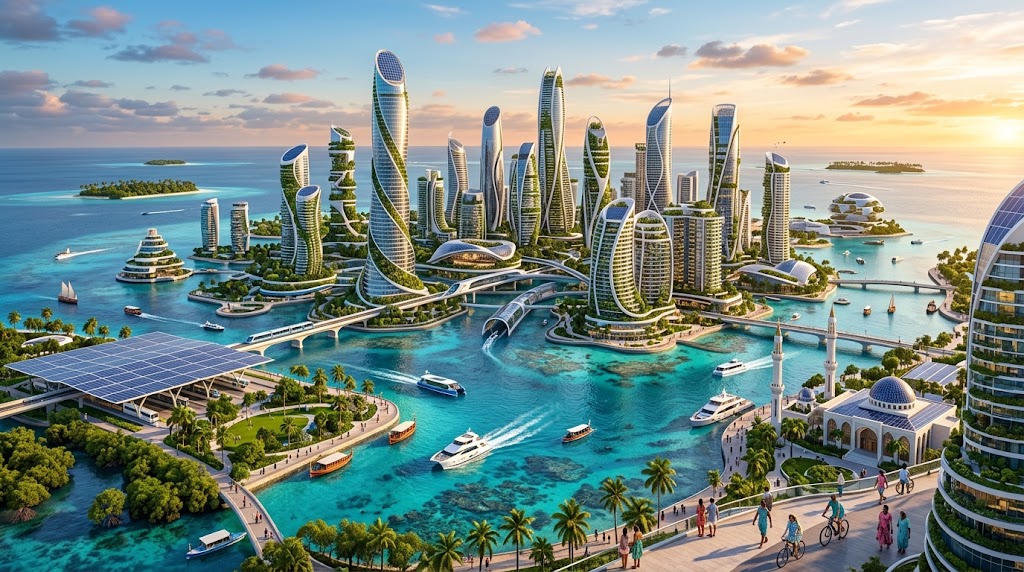
The escalating pushback centers on the administration’s partnership with Eagle Hills, an Abu Dhabi-based developer, to transform reclaimed land at Rasmalé. While the government has defended the mega-project as a vital engine for economic expansion and housing, opposition figures and civil groups have weaponised public anxieties regarding foreign ownership and geopolitical sensitivities.
Speaking on the trajectory of the movement, Sheikh Imran Abdulla—a prominent opposition figure with a long-established record of political agitation and high-stakes street mobilization —announced that the upcoming 4 December protest will take place in Malé, with coordinated logistical arrangements underway to transport demonstrators from outer islands.
Before the December showdown, the movement plans to hold another high-profile gathering this coming Friday evening. Titled “Red Lines” the rally is scheduled to take place in Phase 2 of Hulhumalé.
The announcement follows a robust turnout last Friday night at Malé’s Artificial Beach. Despite persistent heavy rain, organisers claimed that roughly 6,000 citizens rallied under the banner “Maldivian Land for Maldivians” (Dhivehinge Bin Dhivehinganah). Protesters used the wet-weather gathering to voice deep-seated concerns over the involvement of Emirati developer, alleging potential threats to national sovereignty and demanding a public referendum on the project’s scope.
The political stakes climbed significantly when former President Yameen addressed the demonstrators, adopting a severe tone against those championing or accommodating the Rasmalé venture.
Yameen declared that anyone who fails to oppose the project now shares culpability in what he termed the alienation of national territory. Looking ahead to the 2028 presidential election, he vowed that a future opposition-led government would forcefully repossess the land from Eagle Hills. Furthermore, he warned that all individuals currently facilitating or participating in the project would face criminal investigations, formal trials, and stern judicial penalties.
“This is not merely a policy disagreement; it is a matter of safeguarding the republic’s enduring integrity,” Yameen told the cheering crowd, calling on members of the People’s Majlis and state security forces to intervene in defence of national assets.
Such sweeping institutional reviews have a recent precedent in Malé: President Muizzu himself established a special commission to review the controversial International Tribunal for the Law of the Sea (ITLOS) ruling regarding the maritime boundary, providing a procedural template that a future administration could theoretically replicate to scrutinise contentious state agreements.
The fierce opposition rhetoric collides directly with repeated administrative defences from President Dr Mohamed Muizzu’s government.
In an effort to quell public unease—particularly unverified social media claims regarding potential demographic shifts and foreign settlement—the administration has offered explicit guarantees. President Muizzu has firmly stated that no property, housing unit, or land parcel within Rasmalé will be sold or leased to Israeli citizens. The government has further underscored that existing national travel restrictions and statutory prohibitions barring Israeli nationals from entering the Maldives remain entirely unaffected.
As both sides dig in—with opposition figures rallying grassroots anger and threatening retrospective prosecutions, and the administration pressing forward with its urban expansion agenda—the Rasmalé development has cemented itself as the defining ideological and political battleground of the current legislative term.