News Desk
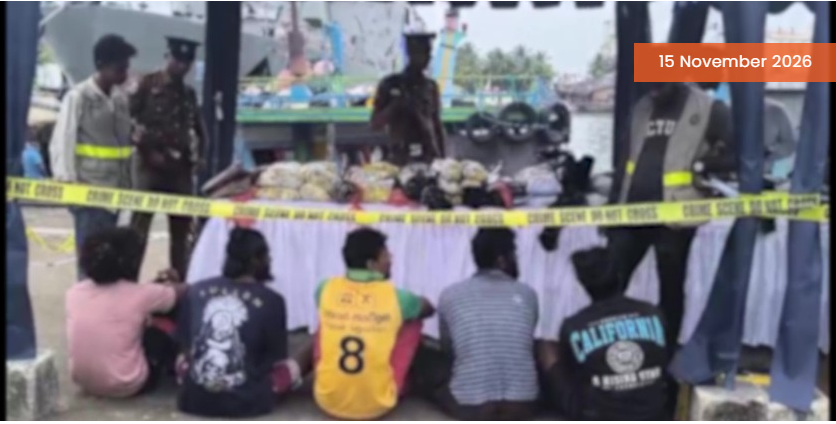
COLOMBO, Sri Lanka — When the Sri Lanka Navy boarded a battered multi-day fishing trawler in the deep waters south of the island early this week, they found no catch in the hold. Instead, tucked beneath six woven sacks, sailors uncovered more than 101 kilograms of heroin and crystal methamphetamine — a haul valued at roughly 1.5 billion Sri Lankan rupees, or about $4.5 million.
Five local fishermen were taken into custody. The men who actually bankrolled the shipment, however, remain well beyond the reach of the patrol boats.
The interception, carried out before dawn on Tuesday and brought into Galle Harbour on Friday, marks the latest strike in Colombo’s year-old maritime crackdown, an operation dubbed “A Nation United”. According to naval officials and the Police Narcotics Bureau, the trawler had set out from the southern port of Mirissa nearly two months earlier, on Sept. 21. After weeks at sea, it met a larger vessel on the open ocean to take on 58.7 kilograms of heroin and 43.1 kilograms of methamphetamine, known locally as “ice.”
For maritime security analysts across South Asia, the route is a familiar one.
Much of the heroin and synthetic drugs flooding Sri Lanka and the Maldives originate far to the northwest, along the rugged Makran coast bordering Pakistan and Iran. From there, deep-sea dhows carry the narcotics south through the Arabian Sea, skirting Indian waters before rendezvousing with local Sri Lankan or Maldivian fishing boats on the high seas. The smaller trawlers then slip the cargo past coastal patrols under the cover of legitimate fishing runs.
Sri Lankan authorities have leaned heavily on intelligence sharing with foreign partners to disrupt this pipeline. Over the past year alone, joint naval and coast guard patrols have seized narcotics worth more than 115 billion rupees.
Yet even as the seizures grow larger, the hierarchy of the trade proves stubbornly resilient.
In almost every major bust along this southern corridor, the arrests stop at the water’s edge. The five men detained in Galle are, by all accounts, low-level maritime couriers — fishermen recruited for a single, lucrative run. The syndicates orchestrating the shipments typically operate from safe havens in Dubai, Pakistan or elsewhere in the Gulf, using encrypted networks and layered intermediaries to insulate themselves from the crews they hire.
Sri Lanka’s deputy defence minister praised the navy’s vigilance this week, vowing to seal off every maritime entry point into the country. The Police Narcotics Bureau has taken over the trawler and its crew to trace the shore-based handlers who arranged the pickup.
For now, though, the pattern holds. Another boat has been impounded, another five men face years behind bars, and the architects of South Asia’s lucrative ocean drug trade are already looking for their next crew.