News Desk

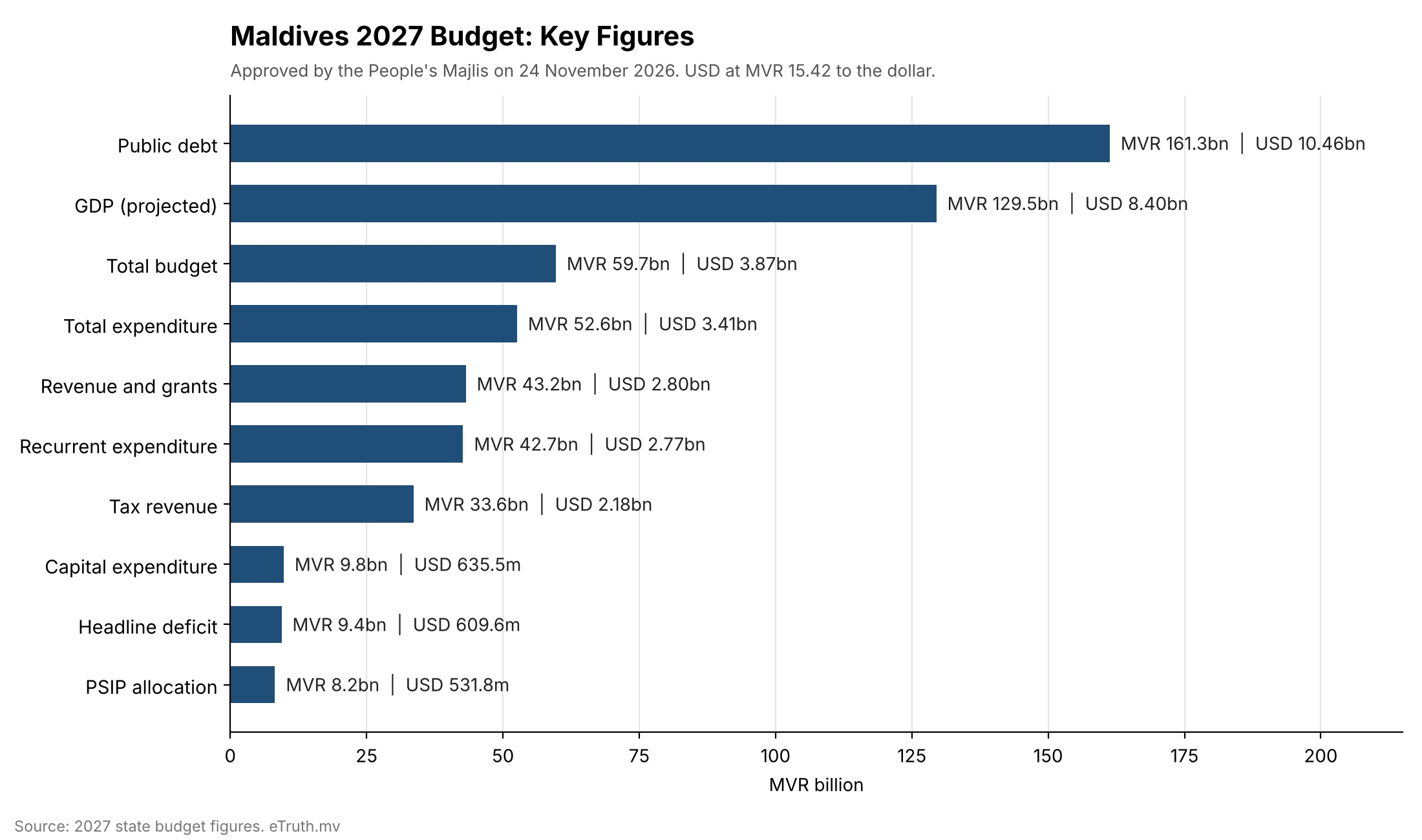
The MVR 59.7 billion (USD 3.87 billion) budget passed by the People’s Majlis on 24 November shows clearly where most of the money goes. It says far less about how the shortfall will be financed, what the largest spending lines contain, and how much room is left for anything new.
Lawmakers voted 65–13 to approve the budget without amendments. The plan had cleared the budget review committee on 19 November, and amendments from opposition members were rejected. All dollar figures here use MVR 15.42 to the dollar.
What the budget contains
The weight falls on running the state. Recurrent expenditure is MVR 42.7 billion (USD 2.77 billion), which is 71.5 per cent of the full budget and about 81 per cent of total expenditure of MVR 52.6 billion (USD 3.41 billion).
Capital spending is MVR 9.8 billion (USD 636 million). Of that, MVR 8.2 billion (USD 532 million) goes to the Public Sector Investment Programme.
On the income side, revenue and grants are projected at MVR 43.2 billion (USD 2.80 billion), up MVR 1.4 billion (USD 91 million) on 2026.
Tax is expected to bring in about MVR 33.6 billion (USD 2.18 billion), roughly 77 per cent of the total. Against expenditure, that leaves a deficit of MVR 9.4 billion (USD 610 million), or 7.3 per cent of projected GDP of MVR 129.5 billion (USD 8.40 billion).
Public debt is projected to reach MVR 161.3 billion (USD 10.46 billion) in 2027. By our calculation from the two stated figures, that is about 125 per cent of GDP.
What the available figures do not say
Start with the totals. Expenditure is MVR 52.6 billion, but the budget is MVR 59,704,440,795. The difference, about MVR 7.1 billion (USD 461 million), is not explained in the material available to us. Debt repayment is one possible explanation, but that is an assumption.
The deficit raises a second question. The figures do not say how the MVR 9.4 billion will be financed, whether through domestic borrowing, external loans or other sources, or at what cost. Nor do they give the interest bill on a debt stock of MVR 161.3 billion.
The recurrent line is the largest in the budget and also the least explained. There is no breakdown here of how much goes to salaries, subsidies or other operating costs. That matters because it is the part of the budget that any future restraint would have to come from.
Capital spending has a similar gap. The PSIP accounts for MVR 8.2 billion of the MVR 9.8 billion, so the remaining MVR 1.6 billion (USD 104 million) is unaccounted for in the figures. A list of the projects the PSIP will fund in 2027 is also absent.
On revenue, the MVR 1.4 billion increase implies 2026 revenue of about MVR 41.8 billion (USD 2.71 billion), so projected growth is about 3.3 per cent. Neither the tax measures nor the economic assumptions behind it are set out. With tax supplying about 77 per cent of receipts, any shortfall there would feed straight into the deficit.
Independent institutions told the committee their allocations were tighter than they had requested. The amounts they asked for are not given. Finance and Public Enterprises Minister Hassan Zareer said the figures are sufficient and that a contingency buffer exists for unexpected costs. How large that buffer is has not been stated.