 News Desk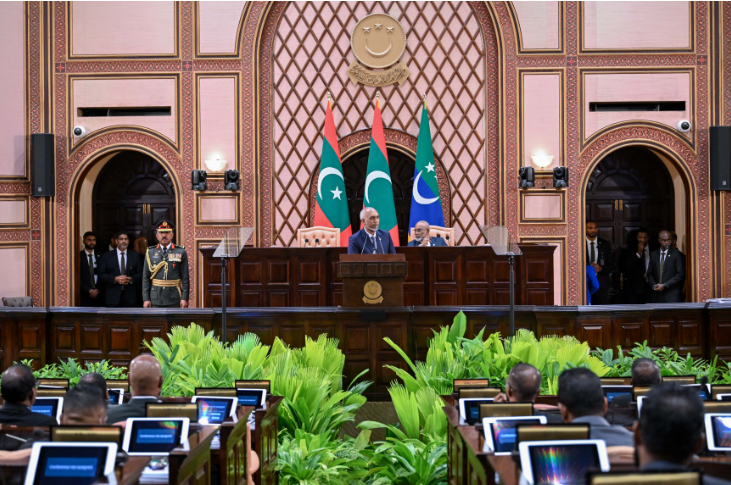
In a three‑hour presidential address delivered before the opening session of the People’s Majlis, President Dr. Mohamed Muizzu concluded his third Presidential Address at noon — marking the longest such speech in the Maldives’ 90‑year parliamentary history.
Every year, the Maldives’ People’s Majlis convene for an opening session steeped in ceremony far beyond everyday proceedings. Article 84 of the Constitution mandates this event, where the president delivers the Presidential Address to the nation through its lawmakers. The practice traces back more than 90 years to December 22, 1932, when the country’s inaugural parliamentary gathering assembled in Malé.
Muizzu used this year’s address to outline an expansive agenda spanning economic reform, tourism expansion, social policy, and legal action over the country’s maritime boundary dispute with Mauritius. He reiterated that the previous administration’s correspondence with Mauritius had undermined Maldivian sovereignty and confirmed that the letter in question had now been formally withdrawn. His government, he said, would pursue legal avenues to reclaim “lost territory.”
Tourism and Economic Growth
Tourism remained central to Muizzu’s economic agenda. Muizzu said the government aims to attract 2.5 million tourists this year — an 11.3 percent increase — after the Maldives recorded 2.2 million arrivals in 2025, the highest in the country’s history and a 9.8 percent rise from the previous year. According to the Maldives Monetary Authority, the industry generated $5.55 billion last year, up 13.8 percent.
“To achieve our target, we will promote the Maldives through an inclusive national initiative,” he said, announcing that 2027 would be designated the Year of Visit Maldives. The campaign will be organized jointly with domestic and international tourism partners. Muizzu added that 2025 was also the fastest year on record for the Maldives to reach one million visitors.
He noted that while no new resorts opened in 2023, more than 6,000 beds had been added over the past two years through expansions and guesthouse development. Seven new resorts are expected to open this year. The government also plans to develop at least 10 additional resorts over the next three years, with the aim of making “every Maldivian a shareholder” and ensuring foreign‑currency earnings flow directly to citizens’ accounts.
Under the scheme, every Maldivian with a national ID card would receive a share of the revenue once the investments begin generating returns in 2030. Each citizen could receive about 400 rufiyaa annually, he said, estimating that a family of five could earn the equivalent of roughly $2,000 a year.
Expanding Sea and Air Connectivity
Muizzu said the government would launch several major initiatives this year to strengthen both sea and air transport, describing an integrated national transport network as essential to improving mobility and economic opportunity across the Maldives.
He noted that speed‑ferry systems were established in three provinces last year as part of efforts to modernize sea transport. Over the next six months, speed‑ferry services will be expanded to eight additional provinces. The sustainability of the system, he said, will depend on improving rural infrastructure and forecasting capabilities.
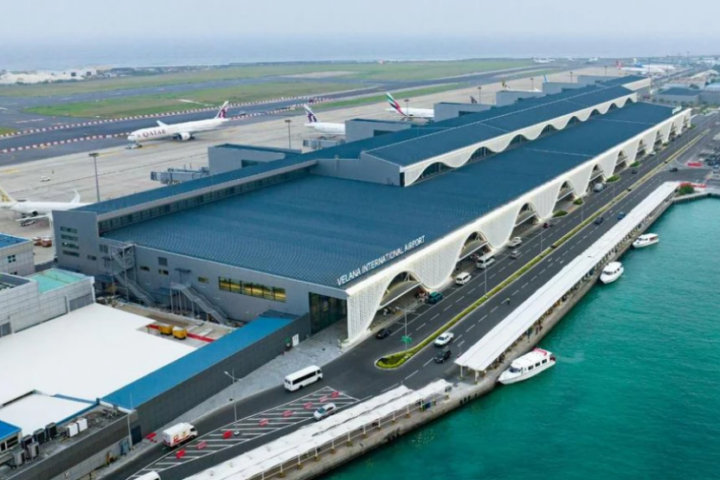
As part of the government’s push to enhance air connectivity, multiple regional airports are undergoing development or upgrades. These include facilities in Haa Alif, Haa Dhaalu, Shaviyani, Noonu, Raa, Baa, Lhaviyani, Kaafu, Alif Alif, Alif Dhaalu, Vaavu, Meemu, Faafu, Dhaalu, Thaa and Laamu atolls. Additional upgrades are underway at Hoarafushi, Kadhdhoo, Faresmaathoda, Kulhudhuffushi, Maafaru and other regional hubs.
Muizzu said that as a result of ongoing development, all operational airports in the Maldives have now been equipped for night flights. The transfer of the Baa atoll airport to Island Aviation will be completed by the end of this month, and construction of a second airport in Laamu atoll will begin later this year.
He added that four southern atolls were connected by air this month under the government’s Integrated Air Connectivity initiative, part of its broader sustainable development policy. A similar integrated development zone is planned for the northernmost atolls, including Hoarafushi, Dhidhdhoo, Kelaa and Makunudhoo. Once all airport upgrades are completed, he said, the full air‑connectivity network will come into operation.
Muizzu said the government’s long‑term goal is to build an integrated civil transport system that maximizes resources and improves daily life for citizens, with major sea and air projects scheduled for rollout throughout the year.
Infrastructure, Utilities and Fisheries
Muizzu said efforts to expand water production in the Malé region would increase output by 25 percent this year. He also pledged to address long‑standing concerns of large‑scale fishermen, announcing that construction of a 100‑ton fish‑packing facility would begin mid‑year.
Renewable Energy and Provincial Development
Highlighting progress in renewable energy, Muizzu said the Maldives previously generated 53 megawatts from renewable sources, but his administration had increased that capacity by 110 megawatts in two years.
He added that more than 100 healthcare infrastructure projects were underway across the provinces, describing them as part of a broader effort to improve services outside the capital.
Education and Social Policy
Muizzu said his administration’s policy was to “establish justice” in the education sector, arguing that past inequities had left many students behind. Teacher‑training programs launched last year to improve instruction for children with disabilities will be expanded this year, he said. Children with disabilities will also be allowed to continue homeschooling under specific circumstances, and parents working in the civil service will be permitted to work remotely.
Healthcare and Fertility Services
Turning to healthcare, Muizzu said a significant number of women had received treatment for endometriosis and polycystic ovary syndrome under expanded fertility programs. He noted that 30 million rufiyaa had been deposited into the national Fertility Fund.
A new program to train therapists will begin in March, he said, describing therapeutic services as one of the most understaffed sectors in the country. Until enough professionals are trained, therapists will be brought in from abroad.
Small and Medium Enterprises and Legacy Payments
Muizzu said one of the biggest challenges facing small and medium‑sized enterprises was the chronic lack of liquidity for goods and services, noting that the government had paid 6.3 billion rufiyaa to businesses last year. Delivering the Presidential Statement, he detailed the payments made both to private enterprises and to government‑owned companies.
In addition to the 6.3 billion rufiyaa released to businesses, the government paid 882 million rufiyaa to state‑owned companies to settle long‑outstanding legacy bills, he said. These payments were made only after verifying the validity of the claims and following guidance from the Auditor General. So far, 469 million rufiyaa in verified bills have been cleared, while a further 1 billion rufiyaa owed by state‑owned companies has been paid directly by the government.
Muizzu also highlighted earlier policy decisions aimed at supporting small and medium enterprises. He announced that the traditional 80‑hour clearance window for imported goods would be extended to 124 hours, the demurrage‑free period would be increased from five to ten days, and demurrage and freight charges would be payable in rufiyaa.
He added that, beginning in March, companies holding fewer than 20 foreign worker quotas would be exempt from paying the annual quota fee. The government will initiate the necessary legal amendments to implement the change, he said.
SME Financing, Reforms and Digitalisation
Muizzu said the government had disbursed 349 million rufiyaa to 595 small businesses so far, describing the support as part of a broader effort to strengthen small and medium‑sized enterprises. Detailing the initiatives in his Presidential Statement, he highlighted several reforms introduced over the past year to expand access to finance and modernize the SME sector.
He noted that a new Trade Mark Act had been enacted last year and that an Intellectual Property Office would begin operating from January 1, marking what he described as a significant step toward protecting local innovation. He also pointed to the success of last year’s Maldivian Expo, which he said had helped showcase local products and entrepreneurs.
Muizzu announced the introduction of the SME Award for small and medium enterprises and the establishment of SME Digital as a subsidiary of the Bank of Maldives. The platform, he said, has begun offering a range of financing schemes for tourism, agriculture, fisheries, start‑ups and existing businesses, helping transition SMEs into a modern digital banking system. Loans held by borrowers struggling with repayments have also been transferred to Islamic financing facilities, he added.
According to the president, 349 million rufiyaa has been disbursed through various SME schemes to date. He said the government’s broader reforms — including digitalisation, new financing tools and regulatory changes — were designed to create a more supportive environment for small and medium enterprises.
Housing Reform
Muizzu announced revisions to the previous administration’s joint‑allocation housing scheme. Groups who were collectively granted a single plot will be allowed to divide it into individual plots if all recipients agree. Applications for land will also be opened to individuals whose spouses already hold a residence. He said the government was committed to ensuring housing access for “every citizen,” through affordable flats and social‑housing programs.
Security, Corrections and Youth Development
The president said drugs, liquor bottles and cans worth 2.3 billion rufiyaa had been seized over the past two years — the highest volume confiscated in the first two years of any administration in the past three terms.
He also announced the country’s first “open‑prison island” concept, under which an entire island would be designated as a rehabilitation‑focused correctional community overseen by the Maldives Correctional Service. All prison cells have been electrified, he said, and a state‑of‑the‑art scanner to prevent smuggling at Maafushi Jail will become operational in April, a measure he said would curb scam calls originating from inside prisons.
Muizzu added that 344 young people completed government‑run training programs on December 28, with some receiving vocational training.
Governance and Transparency
To make the administration “as responsive to the people as possible,” Muizzu said a Citizens’ Complaints Bureau would be established in the President’s Office. The bureau will use an automated system incorporating artificial intelligence to register and manage public complaints, with agencies held accountable for addressing them.
He also announced that he would begin holding weekly briefings with journalists starting in March, meeting the media every Monday from 10 a.m. to 11 a.m. A cabinet minister will also hold a weekly press briefing.