News Desk
Former Attorney General Diyana Saeed has pushed back against comments by former Supreme Court Justice Husnu Al Suood, who argued that the government must justify its preference for holding the presidential and parliamentary elections on the same day.
Suood, who resigned from the Supreme Court bench earlier last year, questioned the government’s good faith, saying major constitutional issues remain unresolved while authorities appear focused only on holding the two elections on the same day. Diyana said she found no merit in Suood’s concerns.
In an X post, Diyana said the country’s most urgent need is a parliament capable of holding the government to account. She argued that the absence of such a parliament is one of the main reasons constitutional problems have lingered for years.
She outlined several points in response to Suood’s remarks, stressing that the current electoral structure has failed to produce an effective legislature.
Among her key arguments:
- The Maldives needs a strong parliament that can properly scrutinise the government.
• Constitutional reforms have stalled because past parliaments lacked the strength and independence to push them through.
• Maldives’ experience shows that separating elections by six months weakens political stability.
• The Maldives has not had an accountable parliament for nearly 15 years, which she attributes to the current electoral system.
• Testing a concurrent election model is necessary to explore better governance outcomes.
• Holding both elections on the same day would reduce administrative costs and limit opportunities for misuse of state resources.
“The current system of six months between two elections has not given us a single parliament in the past 15 years or so to hold the government to account. So this should be considered a failed system in the case of the Maldives,” she said.
Diyana added that the existing model has run its course and new options must be tested. She said concurrent elections offer a practical way forward, both in terms of cost and in reducing the risk of state resources being used for political advantage.
A nationwide public referendum has been called for 4 April to decide whether future presidential and parliamentary elections should be held on the same day. If the referendum is passed, the current sitting members of the People’s Majlis will lose six months of their tenure, as the amendment brings forward the parliamentary election to align it with the presidential vote.
Supporters, including the government, argue that concurrent elections would save millions in state spending, reduce prolonged political uncertainty and help avoid clashes between a president and an opposition dominated parliament. Opponents say the change is designed to let the ruling party secure both the presidency and a parliamentary super majority in a single campaign, concentrating the use of state resources and weakening checks and balances.
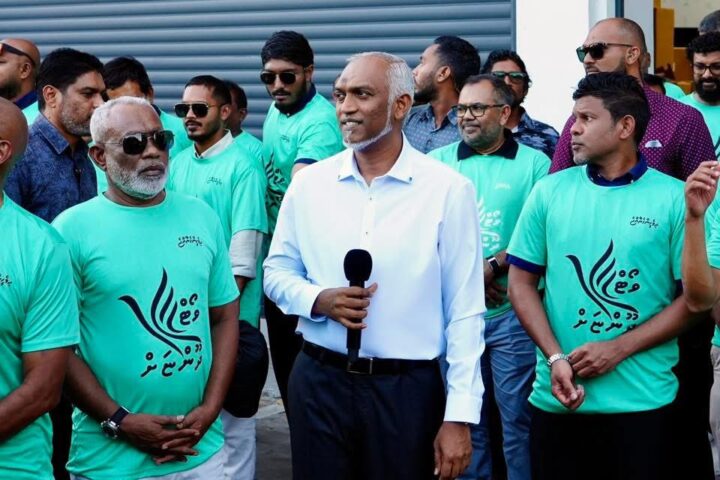
The ruling People’s National Conference (PNC) is spearheading a voter education campaign in support of a Yes vote, with smaller parties backing its position, while the opposition Maldives Democratic Party (MDP) is urging voters to reject the proposal, arguing that the referendum is an attempt to merge the two national elections, a claim the PNC says is a deliberate distortion of the facts.