News Desk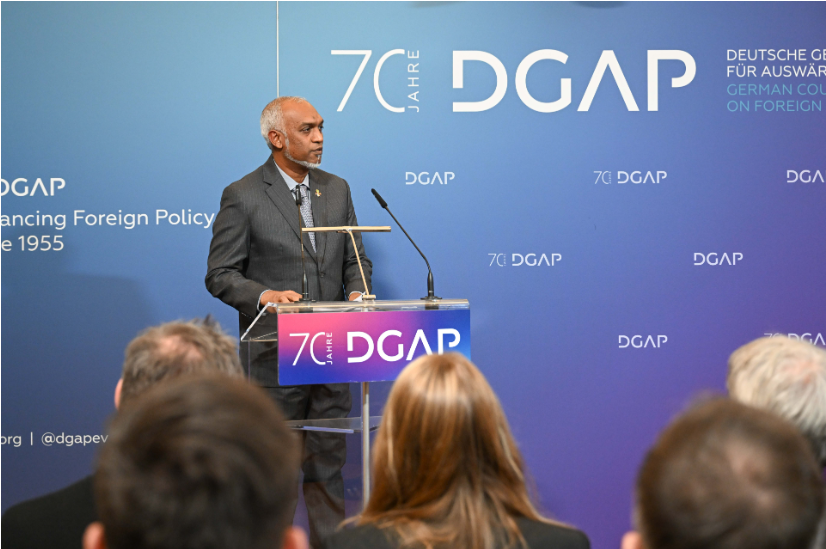
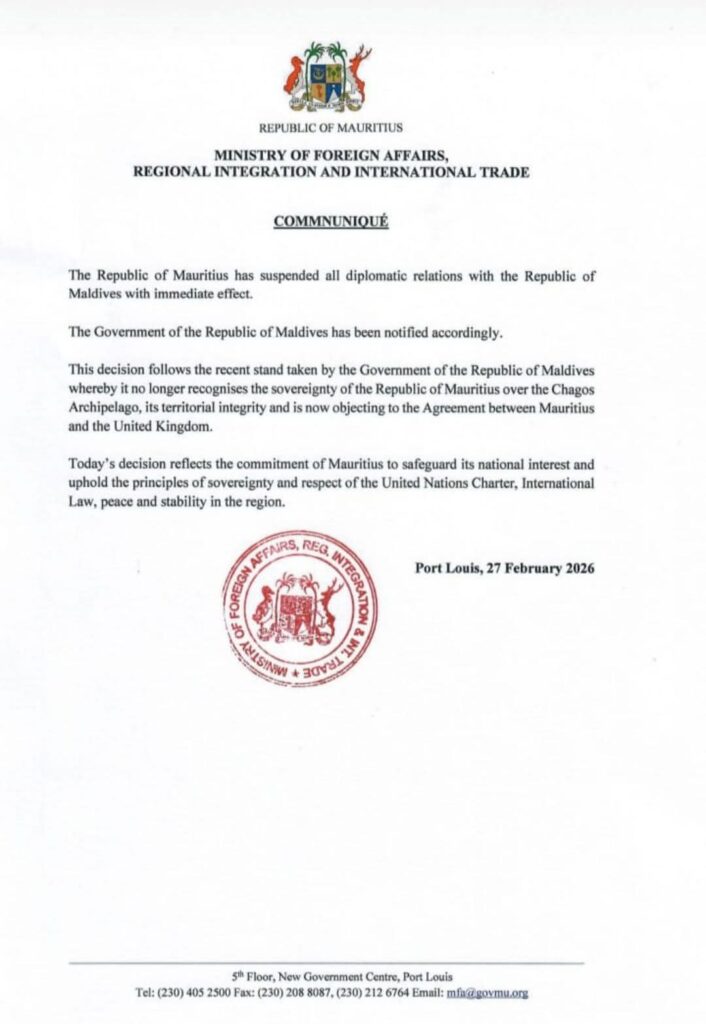
The suspension of diplomatic relations between Mauritius and the Maldives is more than an overreaction; it is a revealing display of how Port Louis allows symbolism to eclipse strategy. Rather than responding with measured diplomacy, Mauritius chose the most extreme option available — cutting ties with a fellow island nation — exposing a deeper insecurity at the heart of its foreign policy.
By severing relations overnight, Mauritius signalled not strength but anxiety.
A deeper historical perspective also underscores the imbalance in how the two countries frame their identities.
The Maldives is not a manufactured colonial construct of modern diplomacy, but a civilisation that has developed on its own terms for more than five millennia.
It is the only recorded civilisation in the world to have developed entirely without a river system, sustained instead by maritime ingenuity, island‑based governance and a continuous indigenous presence.
This is not contested mythology; it is globally recognised, documented history.
Mauritius, by contrast, has built much of its contemporary political narrative around a single sovereignty claim. That narrative may be emotionally resonant at home, but it cannot erase the fact that the Maldives’ statehood, culture and territorial identity are rooted in an ancient, uninterrupted civilisation — not a footnote, but a historical reality that commands respect in any regional discourse.
Mauritius government has invested decades in a singular sovereignty narrative around Chagos, and any deviation, however legitimate or reasoned, triggers disproportionate political alarm. Malé’s decision to articulate its own maritime interpretation was treated not as a diplomatic disagreement but as a threat to Mauritius’ domestic political storyline.
Three pressures appear to be shaping Port Louis’ behaviour:
- A dependence on the Chagos issue for political legitimacy, leaving little room for nuance or dissent.
- Stalled negotiations with the UK and US over Diego Garcia, which have generated frustration and impatience.
- Legal activism and court injunctions, complicating the government’s ability to demonstrate progress to its own public.
Rather than addressing these internal pressures, Mauritius redirected its frustration outward — towards the Maldives.
The Maldives’ position on Chagos is grounded in its maritime identity and national interest. For a country whose survival is tied to the ocean, maritime boundaries are not negotiable abstractions. Malé’s stance reflects a broader trend among small states: a refusal to inherit geopolitical preferences crafted elsewhere.
Mauritius could have engaged, debated or sought clarification. Instead, it chose rupture. That choice says more about Mauritius’ diplomatic temperament than about the Maldives’ position.
By escalating the dispute, Mauritius risks isolating itself at a moment when Indian Ocean cooperation is essential. Climate threats, maritime security and economic interdependence demand cohesion — not impulsive diplomatic exits.
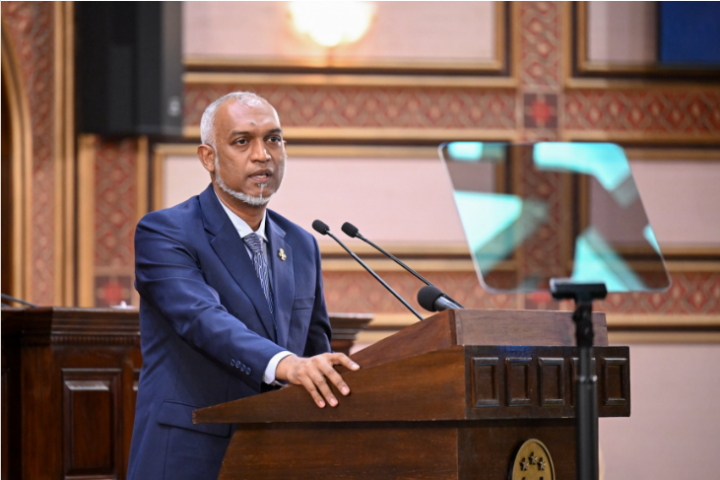
Under President Dr Mohamed Muizzu, the Maldives has articulated an Ocean‑Centred Foreign Policy, a point he emphasised during recent engagements in Germany. He underscored that the Maldives views international law as its strongest safeguard, particularly for small states navigating an increasingly contested global environment. Legal frameworks, he noted, are what ensure sovereignty is respected “regardless of size or power,” and peaceful dispute resolution depends on all states adhering to shared rules rather than pursuing unilateral interpretations. Selective readings of maritime law, he warned, undermine not only ocean governance but the trust that sustains the wider international system.
President Muizzu: For the Maldives, an Ocean‑Centred Foreign Policy Is a Matter of Survival
President Muizzu situated the Maldives within the strategic geography of the Indian Ocean, now one of the most consequential arenas of the century — shaping global trade, energy flows and security dynamics. His government’s vision is for an open, inclusive and rules‑based ocean, free from coercion and excessive militarisation.
He also challenged the long‑standing assumption that small states simply absorb the rules set by larger powers. The traditional portrayal of island nations as passive “rule‑takers,” he argued, no longer reflects diplomatic reality. Small states, particularly in the Indian Ocean, are increasingly influencing global maritime norms — advocating for stronger climate ambition, enhanced marine protection and a more inclusive multilateral system. He framed the Maldives as part of this emerging cohort of norm‑shapers, whose strategic relevance is reinforced by principled positions and consistent advocacy.
The Maldives, under President Dr Mohamed Muizzu, has shown a willingness to assert national interests while still valuing regional stability. Mauritius, by contrast, has allowed a single issue to dominate its foreign policy to the point of undermining long‑standing partnerships.
Malé has not closed the door to dialogue. The administration has signalled its readiness to engage and to reclaim what it views as a lost sovereign right. For the Maldives, the issue is a paramount question of sovereignty. But rebuilding trust requires Mauritius to recognise that:
- Its sovereignty claims cannot override the agency of other states.
- Diplomatic disagreement is not an attack.
- Regional solidarity cannot survive if dissent is treated as betrayal.
The Maldives has shown maturity by standing firm without resorting to theatrics. The next move belongs to Mauritius.
Maldives’ Sovereignty Claim Reshapes Chagos Debate as Britain Struggles to Clarify Its Position