News Desk
Forty days into the US–Israel war on Iran, the contours of the conflict look less like an aberration and more like the continuation of a long, familiar arc in American power: high civilian tolls abroad, enormous financial outlays, and mounting unease at home.
Since the Korean War, successive US administrations have framed military campaigns as necessary, time-bound interventions. Yet the record—Vietnam, Iraq, Afghanistan, and now Iran—shows a pattern of open-ended missions, shifting objectives and a widening gap between official rhetoric and lived reality, both in the Middle East and inside the United States.
In Iran, Washington is not acting alone. Israel, long the central US security partner in the region, functions as both ally and proxy—deeply integrated into US military planning, intelligence-sharing and weapons supply chains.
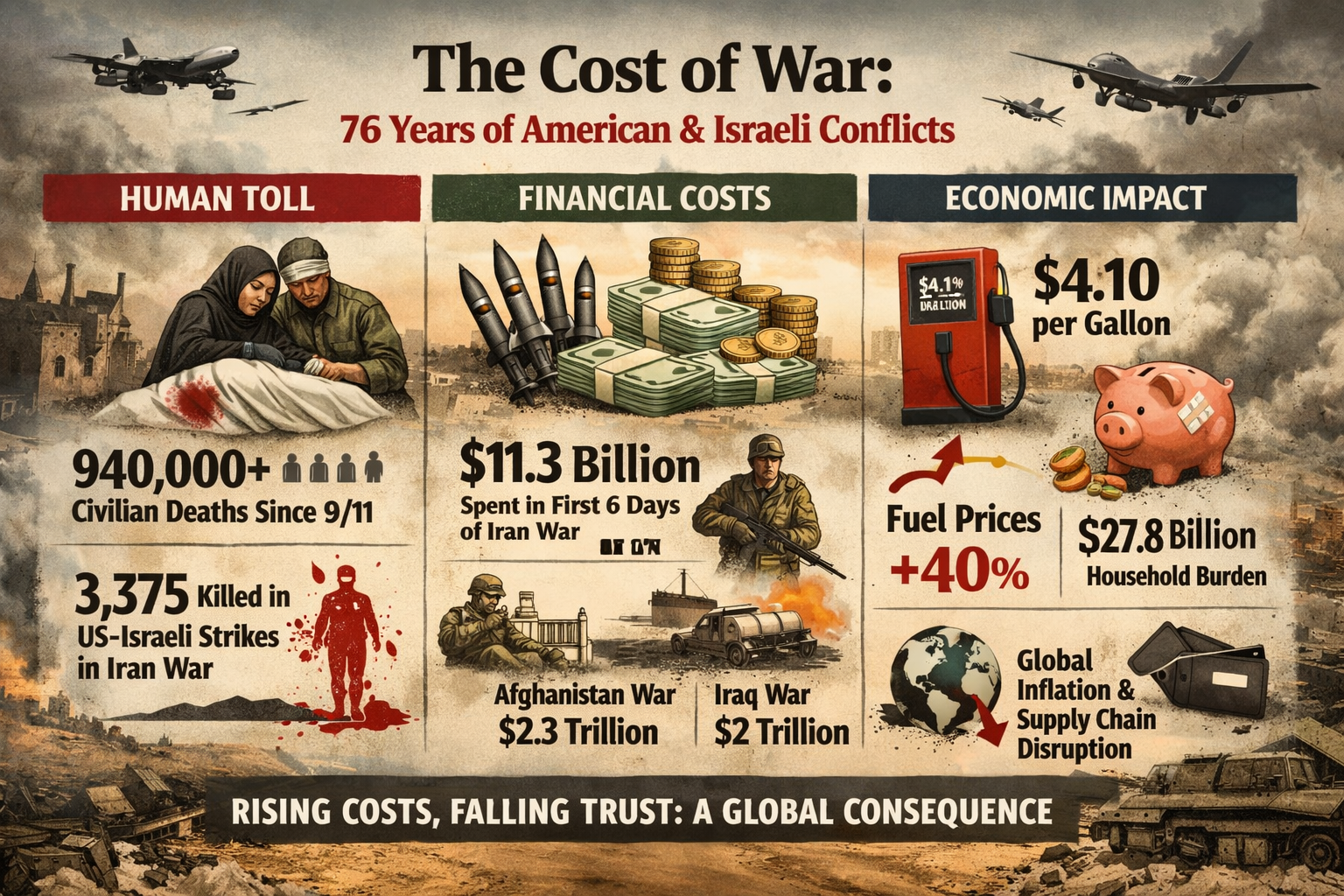
That architecture has enabled a style of warfare in which responsibility is diffuse but consequences are concentrated. Iranian officials say at least 3,375 people have been killed in US–Israeli aggression in just over a month. The figure is contested, as wartime numbers often are, but the pattern is not: from Gaza to Lebanon to Iraq, US weapons and diplomatic cover have repeatedly underwritten Israeli campaigns that leave civilian neighbourhoods in ruins and regional politics more brittle than before.
At times, the public‑relations machinery presents a temporary cessation of hostilities as evidence of restraint, even as strikes continue under the cover of ambiguity. In occupied Palestine and in Lebanon, these operations often proceed without meaningful international pushback, deepening the sense that declared pauses are tactical rather than genuine. The result is a collapse of trust on all fronts — among regional populations, humanitarian actors and even long‑standing diplomatic partners — leaving both Washington and its closest ally facing some of the lowest levels of public credibility in decades.
For Washington, this proxy system offers flexibility and distance. For people living under bombardment, the distinction between US and Israeli firepower is largely academic.
The Iran war lands on top of an already staggering ledger. Post‑9/11 conflicts alone have directly killed nearly 940,000 people in Afghanistan, Iraq, Syria, Yemen and beyond. That number does not capture indirect deaths from displacement, disease and the collapse of basic services.
Veterans of those wars now watch Iran with a sense of déjà vu. Many describe the familiar sequence: an initial rush of airstrikes, confident talk of limited objectives, then a slow recognition that the conflict’s political and human terrain is far more complex than planners in Washington or Tel Aviv allowed.
They also point to the long tail of war. Physical injuries, traumatic brain damage, moral injury and post‑traumatic stress do not end when the shooting stops. Families absorb the strain for decades. The projected $2.2 trillion cost of veterans’ healthcare over the next 30 years is not just a budget line; it is a measure of how deeply these wars reach into American lives.
The Iran campaign is extraordinarily expensive, even by recent US standards. In the first six days alone, the US spent an estimated $11.3–$12.7 billion on munitions. After that initial barrage, daily spending averaged about $500 million, now reduced to under $100 million during a fragile ceasefire.
Placed alongside Afghanistan—$2.3 trillion over 20 years, roughly $300 million a day—and Iraq—$2 trillion over eight years, about $684 million a day—the Iran war is among the costliest conflicts on a per‑day basis in modern US history.
Those figures are not abstract to American households. Fuel prices have climbed nearly 40 percent, from $2.90 to $4.10 a gallon. The resulting increase in petrol and diesel costs is estimated at $27.8 billion, or about $200 per household. For families already squeezed by rising rents, medical bills and student debt, another $200 is not a rounding error; it is a month of groceries, a utility bill, a prescription.
There is also a broader financial and economic cost borne by citizens far beyond the United States. Global markets have absorbed the shock of a conflict many economists describe as avoidable, with energy prices rising across Asia, Africa and Europe, supply chains tightening and inflationary pressure returning just as several economies were beginning to stabilise. Analysts note that a war initiated without clear strategic necessity has effectively imposed a tax on the world’s consumers — from transport workers in Nairobi to small manufacturers in Jakarta — who now pay more for fuel, food and shipping because of decisions made in Washington and its closest regional partner. The sense of frustration is palpable: a conflict framed as limited has produced global economic consequences that no electorate outside the US or Israel had any say in, deepening the perception that ordinary people everywhere are footing the bill for a war they neither chose nor control.
What is striking in this war is how quickly public patience has worn thin. A Reuters/Ipsos poll shows 60 percent of Americans now disapprove of strikes on Iran—the steepest disapproval trajectory for a major US war since the 1950s. The traditional “rally around the flag” effect has been muted, replaced by a more sceptical, sometimes weary, response.
Part of that scepticism reflects the accumulated memory of Iraq and Afghanistan: promises of quick victories, followed by years of occupation and insurgency. Part of it reflects a sense that the costs of US–Israeli strategy in the Middle East are borne unevenly—by civilians in the region and by working- and middle-class Americans at home—while the strategic benefits are increasingly hard to discern.
In Congress, criticism remains cautious and often couched in language of “oversight” and “accountability.” But outside Washington, the questions are more blunt: Why another war? Why with this partner? And why now, when domestic needs—from healthcare to climate resilience—are so visibly underfunded?
US officials continue to frame support for Israel as a cornerstone of regional stability. Yet the record of the past two decades suggests the opposite: repeated Israeli military aggressions, backed by US weapons and vetoes at the United Nations, have not produced durable security for Israelis or Palestinians, nor for neighbouring states.
Instead, they have entrenched cycles of retaliation, empowered hardline actors on all sides and deepened the perception across the Middle East that US policy privileges military solutions over political ones. The Iran war, with Israel at the operational centre and the US as strategic guarantor, reinforces that perception.
Critics argue that this approach treats security as a problem to be managed with missiles and sanctions rather than diplomacy and rights. The destruction of infrastructure, the displacement of civilians and the erosion of regional economies may weaken adversaries in the short term, but they also create the conditions in which new forms of resistance and extremism take root.
Seen over 76 years, from Korea to Vietnam, from Baghdad to Kabul and now Tehran, the pattern is stark. US military engagements, often conducted with or through regional proxies like Israel, have repeatedly produced:
- High civilian casualties and long-term social trauma.
- Enormous financial costs that reverberate through the US economy.
- Domestic political backlash as the gap widens between promised outcomes and visible realities.
What is different today is that these threads are more visible, more quickly. Social media, independent reporting and the testimony of veterans and civilians alike have shortened the distance between the battlefield and the living room.
Forty days into the Iran war, the question is no longer only whether this particular campaign is justified or effective. It is whether a superpower can continue to rely on a model of proxy-enabled, high-intensity warfare in the Middle East without confronting the destruction it leaves behind—abroad and at home.