News Desk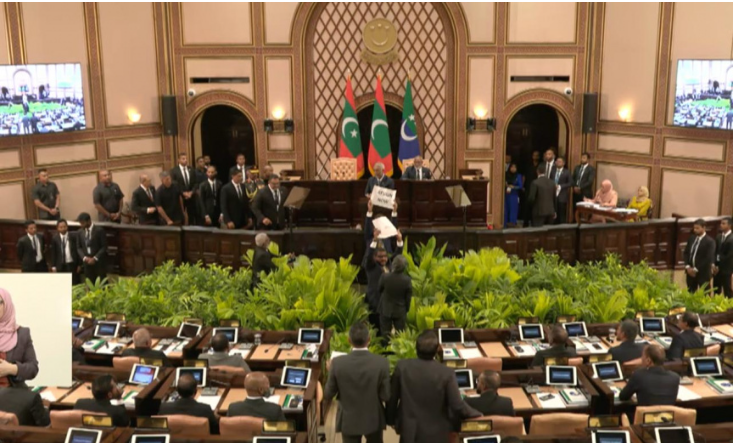
Respect in a society doesn’t appear on its own. It grows out of the habits we accept, the behaviour we encourage, and the standards we set for ourselves over time. We can have freedom of expression and media freedom without throwing dignity out the window. Speaking freely doesn’t mean speaking without restraint. The real question is whether we choose to use that freedom responsibly.
Yesterday, while watching the UK Parliament, I was struck by a moment that revealed this distinction clearly. When a member described the Prime Minister as a “liar,” the Speaker immediately intervened and asked the member to withdraw or leave the chamber. In many democracies, such language is common. Yet in the UK’s parliamentary tradition, certain words are considered unparliamentary—not because criticism is forbidden, but because the institution demands a minimum standard of respect. The Speaker’s intervention was not about protecting a leader; it was about protecting the dignity of the House.
In today’s Majlis, the contrast was evident. During a debate on minimum wages and resort staff, Baarashu MP Ibrahim Shujau criticised MDP’s Kendhoo MP and claimed the points raised were largely taken from government proposals. He went further, describing the MP as “stealing” from ruling party discussions. There was no intervention from the chair, and the remark passed as entirely normal for the Majlis.
You can see the difference clearly when you look at how our own political culture operates. In our society, terms like “liar,” “thief,” and “corrupt” are used so casually that they have lost meaning. Public discourse has become so coarse that even the most personal details of an individual—down to the colour of their clothing—become fodder for public ridicule. When anyone appointed to a state job is immediately subjected to character assassination, it reflects not accountability but a collapse of social norms.
Even outside the Majlis, the same behaviour spills into social platforms. It has become effortless to circulate unsubstantiated claims and character‑assassinating language, as if public shaming is a free‑for‑all with no consequences. One may reasonably ask: which religion or social culture allows this? What happened to the civilised behaviour we expect from others, yet so rarely practise ourselves?
Much of this begins in the Majlis. The legislature should be the institution that models dignity, discipline, and constructive debate. Instead, it has often become the place where vulgarity is normalised and where the public learns that shouting is more effective than reasoning. This is not the fault of one party alone.
Over the years, both major political parties have produced members who are far better at trading insults and using vulgar language than at the actual work of governing. Some are elected largely because of their skill in throwing barbs, yet when it comes to real governance, they fall short — something we have seen time and again. And when elected representatives abandon respectful language, the public inevitably follows their lead.
Other democracies face corruption and political tension too. The United States, for instance, is no stranger to political scandal. Yet their mainstream political culture still maintains boundaries around personal insults and defamatory language. Public figures may be criticised, but there remains an expectation—at least in formal settings—that debate should not descend into personal degradation. This is not because their democracy is perfect, but because they recognise that institutions lose legitimacy when their members behave without restraint.
Some may argue that we are part of South Asia, where confrontational political culture is common. It is true that the region’s politics often reflect deep social divisions, lack of formal education, limited civic education, and leaders who rely on emotional mobilisation rather than policy debate. But this does not mean we must inherit these habits. A nation chooses the culture it passes to its future leaders. If we normalise disrespect today, we will raise a generation that believes leadership is about volume, not values.
A respectful society isn’t one that avoids criticism. It’s one where people criticise honestly and responsibly, without tearing each other down. It is one where institutions uphold standards that elevate public discourse rather than degrade it. It is one where freedom of expression strengthens democracy instead of eroding social dignity.
In the end, it comes down to this: what kind of political culture are we choosing to pass on to the next generation? One shaped by insults, mockery, and personal attacks—or one grounded in respect, responsibility, and national pride? That choice will define not only our politics, but our identity as a nation.