News Desk
Chief Government Spokesperson Mohamed Hussain Shareef has given an extensive account of the administration’s political, economic and foreign policy direction in a detailed interview with Insight Media founder Anees Shihaar, a former Reuters journalist with more than two decades of experience. The conversation covered the government’s response to the recent local council election, the restructuring of ministries, debt management, relations with India and Sri Lanka, national security and the President’s domestic priorities.
Mundhu said the government had taken the public’s message from the election seriously, even though he rejected the claim that the ruling coalition suffered a defeat. “The result was below par from our perspective,” he said. He noted that no incumbent government has won midterm local elections in the Maldives. “People know that if you give a government a carte blanche halfway, their concern is that we are going to sit on our laurels,” he said.
He said President Dr Mohamed Muizzu responded immediately by signalling that the government would accelerate delivery. “The first thing he said publicly that evening was I have heard you,” he said.
A major part of the interview focused on the President’s decision to streamline the state machinery. Mundhu said the government had reduced ministries from 20 to 15 and asked 10 ministers to resign to allow a structural reset. “What he actually did was he started reforming the system,” he said. “He is actually reducing a lot of political appointees in government to the tune of about a third.”
He said the President intends to move toward a merit‑based system. “In the future he is going to appoint me based on merit only and how well I can deliver,” he said. “Action will speak louder than words.”
On the economy, Mundhu said the administration inherited a difficult fiscal position. “We inherited an economy where the external debt was very high, in fact about 136 percent,” he said. “Anything over 80 percent is in the red zone.” He accused the previous government of borrowing heavily near the end of its term. “A lot of the borrowing done by the previous government under the guise of COVID was politically motivated,” he said. “A lot of it was actually not even endorsed by parliament.”
He said the government has been restructuring repayment schedules with key partners while maintaining development spending. “This month alone we have repaid nearly a billion repaid, not just restructured,” he said. He said the administration had brought the country “from the brink of what you experienced in this country [Sri Lanka] to a point of absolute stability.”
On foreign policy, Mundhu said the government’s position is guided by the “Maldives First” principle. He said the controversy over Indian military personnel was rooted in constitutional limits. “It is not the helicopters. It was the boots on the ground with the helicopters that we wanted to change,” he said. “Our constitution does not allow it.”
He said the issue was resolved through dialogue. “From day one we can count India of this government as one of our strongest, most reliable and most treasured development partners,” he said. “The issues that were there we actually resolved it like adults.”
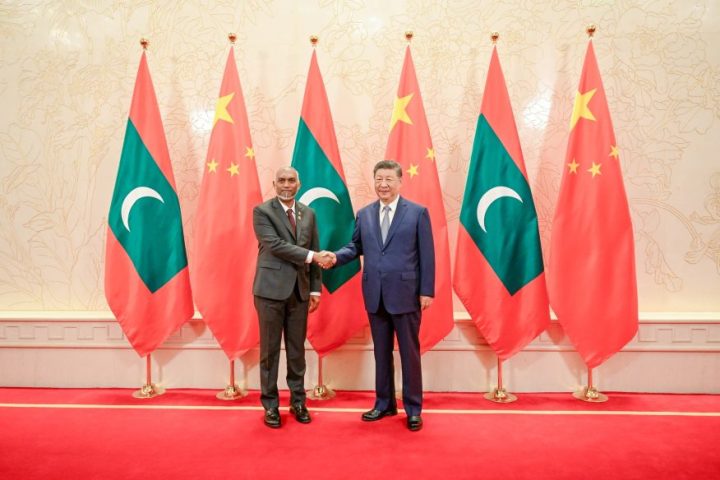
He said the government maintains a balanced approach toward major partners. “There is no development in the Maldives without India, there is no development in the Maldives without China,” he said. “We would like to say this government under Muizzu is not either pro‑China or pro‑India but we are pro‑Maldives.”
On relations with Sri Lanka, Mundhu highlighted shared security and economic interests. “There is no defence for Sri Lanka without defence for Maldives,” he said. “Collectively the two countries occupy well over half of the northern Indian Ocean.” He said the government would like to see the Bank of Maldives open in Colombo to support Maldivian businesses. “It is going to be a confidence booster for businesses in the Maldives to start investing in Sri Lanka,” he said.
The interview also touched on national security and social issues. Mundhu said the government is continuing investigations into past political attacks and strengthening counter‑extremism measures. “Extremism, terrorism, violence has no place in our society,” he said. “We have so far managed to identify the root cause, but we cannot take the foot off the pedal.”
He said the government is concerned about rising social challenges. “We have had a number of suicides of young people,” he said. “The Attorney General’s Office is working on an anti‑bullying regulation.”
On domestic development, Mundhu said the President’s background as an engineer and former housing minister shapes his priorities. “We are in the process of dredging a brand new city next door,” he said. “It is Greater Malé now reclaiming from the sea. It is a massive undertaking.” He said housing remains a central focus. “His major focus is going to be housing, particularly social housing,” he said. “We have to build these housing for them,” referring to more than 20,000 applicants.
The interview offered one of the most detailed explanations to date of the administration’s political and economic strategy as it enters the second half of its term.
The full interview is available on YouTube.