 News Desk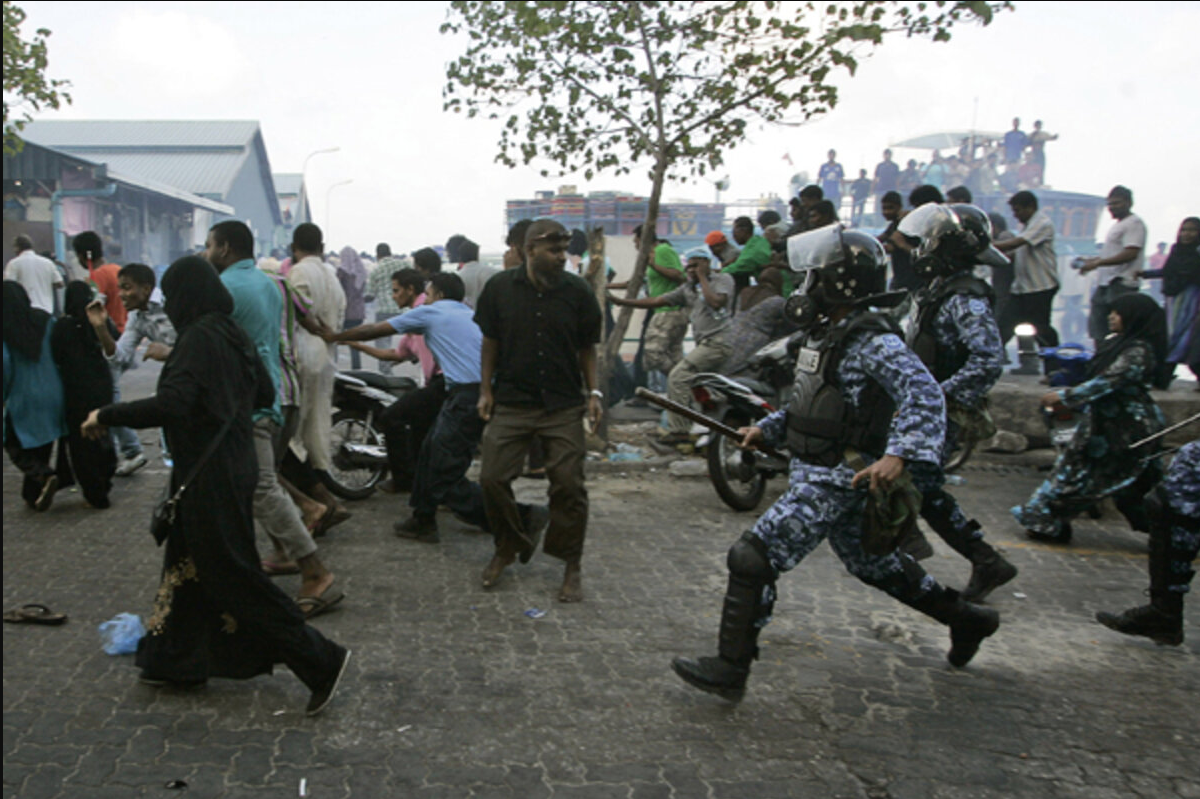
Fourteen years have passed since 8 February 2012, a day etched into the country’s political memory as one of the most violent and consequential episodes in modern Maldivian history. What began as a political crisis following the resignation of President Mohamed Nasheed quickly spiralled into nationwide unrest, arson attacks and the destruction of state property worth millions.
For many Maldivians, the events of that day were not an isolated eruption but the culmination of years — even decades — of political tension, mistrust and polarisation.
To understand 8 February, many analysts trace the story back to the Maldives’ long transition from the 30‑year rule of President Maumoon Abdul Gayoom. His departure in 2008 marked the beginning of the country’s first multi‑party democracy, but it also unleashed deep political rivalries.
During the transition, political rhetoric hardened. Security services — once seen as pillars of the state — became targets of ridicule and defamation. New political actors embraced a confrontational style, and respect for institutions eroded. What some saw as democratic awakening, others viewed as the fraying of social order.
President Mohamed Nasheed’s administration inherited a country in flux. Opposition protests were frequent, and counter‑protests by government supporters became a defining feature of the era — at times led by the president himself. Tensions escalated dramatically in early 2012 when the military detained a Criminal Court judge — an act condemned by the Supreme Court and criticised by international partners.
The arrest triggered nightly demonstrations. Police officers, caught between political factions, complained of inconsistent orders and unequal enforcement. On 7 February, officers demanded assurances from the president that they would not be asked to carry out unlawful commands. Nasheed declined to give such a guarantee. By the afternoon, he had resigned.
What followed the next day was unprecedented. Believing Nasheed had been forced out in a coup — a claim later rejected by the Commonwealth‑appointed CoNI inquiry — thousands of his supporters took to the streets across the country.
The protests quickly turned violent. Police stations were torched. Court buildings burned, destroying marriage records, divorce files and vital documents. Government offices were ransacked. Vehicles were set ablaze. In some islands, mobs attacked officers and political opponents. The damage ran into hundreds of millions of rufiyaa.
For many Maldivians, 8 February became a symbol of how political anger, once unleashed, can consume institutions, communities and the very fabric of public life.
Fourteen years later, the Maldives has changed in many ways — new leaders, new parties, new political alliances. Yet the tone of political discourse often feels familiar. Accusations of dictatorship, corruption and betrayal remain common. Personal attacks still overshadow policy debate. The language of rivalry continues to dominate the national conversation.
Political observers note that while the public has increasingly demanded policy‑driven leadership and honest engagement, parties have struggled to move beyond the confrontational style that defined the early years of multi‑party politics.
The events of 8 February left deep scars. Many perpetrators of arson and assault were never held accountable, a failure that legal experts say undermines public trust in the justice system. The absence of accountability, they argue, leaves the door open for future unrest.
For others, the anniversary is a reminder of the fragility of democratic institutions — and the responsibility shared by leaders and citizens alike to protect them.
As the Maldives marks the 14th anniversary of one of its darkest political days, the country continues to wrestle with the legacy of 2012. The images of burning police stations, destroyed courtrooms and injured civilians remain vivid for those who lived through it. And perhaps just as striking, the political alliances that once held firm have long since fractured: leaders who stood shoulder‑to‑shoulder during those turbulent hours are now rivals, some no longer on speaking terms, and a few have seen their careers rise or fall depending on how — and when — they switched sides.
The hope, many say, is that the lessons of 8 February — about restraint, accountability and the dangers of political hatred — will guide the country toward a more stable and mature democratic future.