 News Desk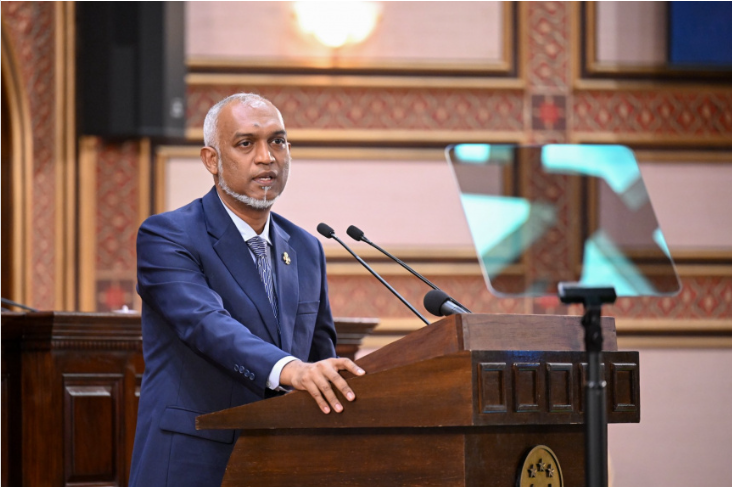
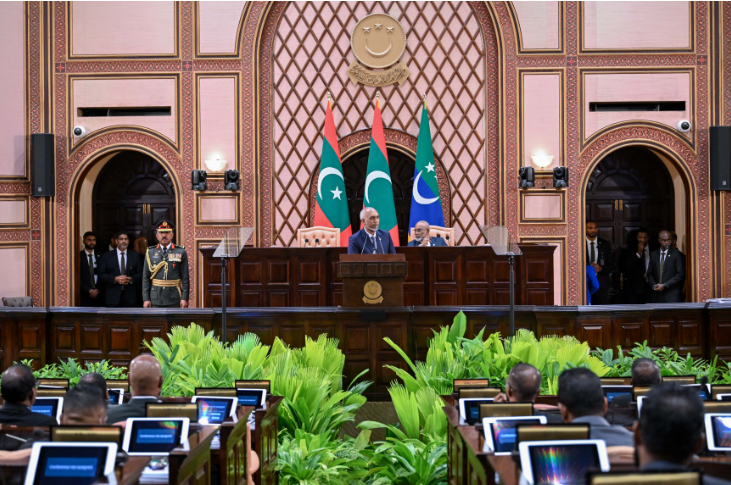
President Dr. Mohamed Muizzu began delivering his third presidential address at 9 a.m., opening with a defence of his administration’s record and a pledge to accelerate reforms in the year ahead.
Muizzu said the government had “reformed and developed many areas” over the past year and would unveil additional initiatives in the coming months. He highlighted a surge in mosque construction, noting that 74 mosques were built last year and 90 projects were completed nationwide. The government spent 19.4 million rufiyaa on mosque repairs in 2024, he said, with 15 million rufiyaa allocated for similar work this year.
The president also pointed to increases in religious stipends, saying the monthly allowance for Hafiz had doubled from 2,000 to 4,000 rufiyaa to encourage Quran memorization. He announced new efforts to train children with disabilities to teach the Quran, describing it as part of a broader push to expand religious education.
Muizzu said the government’s attempts to strengthen the Zakat system had improved public trust and boosted contributions. He added that his administration would continue implementing policies “in accordance with Islam.”
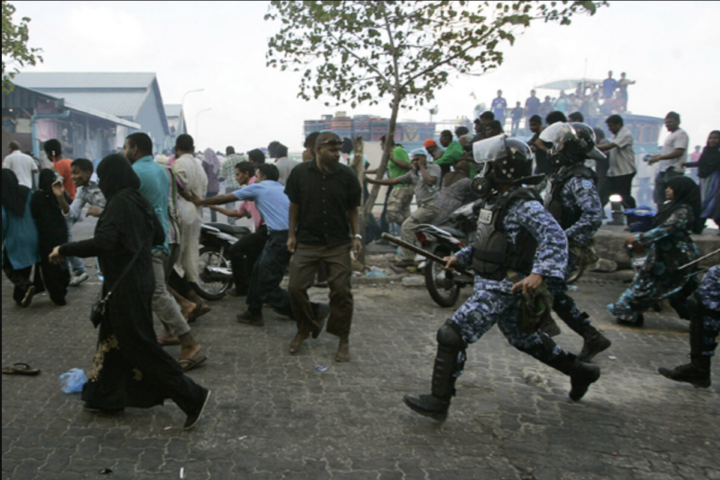
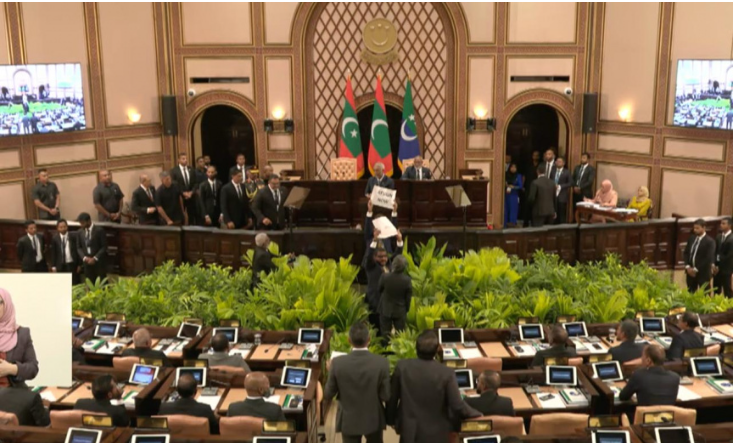
The address was briefly disrupted about 11 minutes in, when members of the opposition Maldivian Democratic Party began shouting from their benches, forcing a pause in the proceedings.
Resuming his remarks, Muizzu announced that the government would launch a nationwide campaign this year to promote ethics and respect, saying the administration would introduce the necessary legislation in the coming months.
He also highlighted ongoing efforts to expand military training, noting that development of the MNDF’s Addu Centre had begun as part of a broader overhaul of defence education. Strengthening fire, rescue and emergency services would be a major priority this year, he said, describing the current capacity as in need of “significant improvement.”
To bolster port security, Muizzu said the government had restructured the Aviation Security Command, expanding its mandate to include port protection. He added that securing additional resources for the command was a high priority.
On foreign policy, the president said his administration would focus on deepening ties with neighbouring and Islamic countries. He argued that Maldives had reduced its dependence on a small group of partners and emerged as a nation “that speaks on the world stage,” suggesting the country should follow a similar path.
Turning to the long‑running dispute over the Chagos Archipelago — known locally as Folhavahi — Muizzu said the area had historically been used by Maldivians for fishing and remained part of the country’s traditional maritime domain. He noted that the Maldives lodged a formal objection with the United Kingdom on Jan. 18, 2026, opposing the transfer of the islands to Mauritius.
Muizzu criticized the previous administration for what he described as the loss of Maldivian maritime territory in the case before the International Tribunal for the Law of the Sea (ITLOS). He said the Attorney General had been instructed to pursue legal avenues to reclaim the disputed area, and that a committee report submitted on Jan. 22 had now been acted upon by the Cabinet.
“We have begun the legal process to recover the area lost from our Exclusive Economic Zone,” he said.
Muizzu said the letter concerning the maritime boundary dispute — originally sent to Mauritius by former president Ibrahim Mohamed Solih — will be withdrawn at his request.
Muizzu said the government would also establish an office dedicated to matters related to the Chagos region.
He further announced the creation of a Commission of Inquiry to investigate decisions made by the previous government, saying those actions had caused “irreparable damage” to the country’s territorial interests.
Muizzu turned to the economy, noting that the national budget recorded a surplus during the first 40 weeks of last year — a rare development for the Maldives. He said total revenue and grants reached 38 billion rufiyaa in 2024, and the government expects that figure to rise to 40.4 billion rufiyaa this year.
He accused the previous administration of taking on “massive debts” and printing money, arguing that his government had been forced into a stabilisation effort as a result.
According to the president, foreign‑exchange reserves strengthened last year, with deposits into the Sovereign Development Fund increasing and official reserves rising sharply. He said the Maldives Monetary Authority deposited $492 million as part of the government’s dollar‑management policy, pushing gross official reserves above $1.13 billion — the highest level in the country’s history, he claimed.
Citing the IMF’s 2023 assessment, which classified the Maldives’ risk of debt distress as high, Muizzu said his administration had taken steps to improve foreign‑exchange liquidity. He added that $150 million of the government’s sukuk repayment would be covered by the SDF, with the remainder to be refinanced.
“This government has always worked to save the country from the debt trap created by previous administrations,” he said, adding that April’s debt obligations would be met “in a manner that ensures long‑term sustainability.”
Muizzu said the SDF would be further strengthened so the state would not need to borrow additional funds to service its debt in the future.
Muizzu said one of the biggest obstacles facing small and medium‑size enterprises was the absence of a reliable online payment system. He noted that the local product Swift by the government had now been introduced as an international payment platform.
He said his administration was prioritizing support for SMEs, with 349 million rufiyaa disbursed so far under various financing programs. The government also settled 6.3 billion rufiyaa in outstanding payments owed to local businesses last year, he said, and had cleared 469 million rufiyaa of the 882 million rufiyaa in long‑pending bills owed by state‑owned companies.
Muizzu added that Addu City had been designated a concessional zone for SME development, saying the government would open opportunities for investors interested in transforming the region into an information‑technology hub.
Muizzu reiterated that his administration was working to reduce the Maldives’ dependence on a small group of foreign partners, arguing that the country had begun to “speak with its own voice” on the international stage.
He said the government aimed to create “green opportunities” for both high‑end domestic investors and foreign businesses. According to the president, 54 foreign investment projects were secured last year, which he described as evidence of renewed international confidence in the Maldives.
Muizzu said full employment would be possible only if the Maldives addressed what he described as the country’s long‑standing problem of undocumented migrant workers. As part of the government’s “Kurangi” operation, he said authorities had collected fingerprints and facial‑recognition data from more than 250,000 migrants.
He added that more than 3,800 applications had been submitted under the government’s re‑registration program for foreign workers, and that a third phase of the Kurangi operation would be launched in the coming months.
The president also pointed to youth‑training initiatives, saying they had helped generate thousands of new jobs. More than 7,000 positions were created in the private sector last year alone, he said.
Muizzu said no new resorts were opened in 2023, but more than 6,000 beds had been added to the tourism sector over the past two years through expansions and new guesthouse capacity. He said seven additional resorts were expected to open this year, describing tourism as a continuing pillar of economic growth.
Muizzu said the government had decided to develop at least 10 new resorts over the next three years, with the aim of making “every Maldivian a shareholder” and ensuring that foreign‑currency earnings flow directly into citizens’ accounts.
He added that the administration made “special efforts” last year to promote tourism in Addu City, including the reopening of the Shangri‑La resort and the allocation of land for integrated tourism development in Hithadhoo.
He also outlined the government’s plan to channel revenue from new resort‑development projects directly to citizens. Under the scheme, every Maldivian with a national ID card would receive a share of the income once the investments begin generating returns, which he said is expected from 2030 onward. According to government estimates, each citizen could receive about 400 rufiyaa annually; a family of five, he said, could earn the equivalent of roughly $2,000 a year.
Muizzu said efforts to expand water production in the Malé region would raise output by 25 percent this year, describing it as a critical step toward meeting rising demand.
Muizzu said his administration was working to address long‑standing concerns raised by large‑scale fishermen, noting that they would benefit from expanded processing capacity. He announced that construction of a 100‑ton fish‑packing facility in HulhuMale’ would begin in the middle of this year, describing it as a key step toward strengthening the sector’s value chain.
Highlighting the government’s push into renewable energy, Muizzu said the Maldives had previously generated 53 megawatts from renewable sources, but his administration had increased that capacity by 110 megawatts over the past two years.
Muizzu said his administration’s policy was to “establish justice” in the education sector, arguing that past inequities had left many students behind. He said the government had expanded access to schooling and launched teacher‑training programs last year to improve instruction for children with disabilities. That initiative, he added, will be broadened this year.
He also announced that children with disabilities would be allowed to continue homeschooling under specific circumstances. Parents of such children who work in the civil service, he said, would be permitted to work remotely or be assigned home‑based duties.
Muizzu said the government was focused on improving “neglected areas” of the education system, framing the reforms as part of a broader effort to ensure equal opportunity for all students.
Muizzu also announced that a new program to train therapists would begin in March, describing therapeutic services as one of the most understaffed sectors in the Maldives. Until the country can train enough professionals, he said, additional therapists would be brought in from abroad to meet demand.
Turning to healthcare, Muizzu highlighted the government’s recent efforts in fertility treatment, saying a significant number of women had received care for endometriosis and polycystic ovary syndrome under programs expanded by his administration. He added that 30 million rufiyaa had been deposited into the national Fertility Fund to support long‑term access to treatment.
Muizzu said the government had made significant progress in improving provincial healthcare over the past year, noting that more than 100 infrastructure projects were already underway across the islands.
Muizzu said the government aims to bring 2.5 million tourists to the Maldives this year — an 11.3 percent increase — making tourism one of the administration’s top economic priorities. He noted that 2025 ended with 2.2 million tourist arrivals, a 9.8 percent rise from the previous year.
“The government aims to attract 2.5 million tourists this year, an increase of 11.3 percent,” Muizzu said. “To achieve this, we will promote the Maldives through an inclusive national initiative. For that purpose, 2027 will be designated as the Year of Visit Maldives.”
He said the Visit Maldives Year would be a nationwide campaign jointly organized with domestic and international tourism partners.
Muizzu added that 2025 marked the highest number of tourist arrivals in the country’s history, and was also the fastest year on record for the Maldives to reach one million visitors.
Muizzu said the government would revise the previous administration’s joint‑allocation housing scheme, allowing groups who were collectively granted a single plot to divide it into individual plots if all recipients agree. A new category will be created to facilitate the separation, he said.
He added that applications for land will soon be opened even for individuals whose spouses already hold a residence, describing the move as part of a broader effort to ensure housing access for every Maldivian.
Muizzu said the government was committed to expanding housing options at multiple levels — from affordable flats to units under the social‑housing program — and pledged that “every Maldivian citizen” would have a path to secure a home.
Muizzu said the government was introducing the country’s first “open‑prison island” concept, under which an entire island would be designated as a correctional community where inmates can live and work in a rehabilitation‑focused environment. The project, he said, would be overseen by the Maldives Correctional Service.
As part of broader efforts to improve prison conditions, he noted that all cells had been electrified and that a state‑of‑the‑art scanner had been installed at Maafushi Jail to prevent the smuggling of prohibited items. The scanner, which will be operational in April, is expected to curb scam calls originating from inside prisons, he said.
Muizzu added that the first cohort of 344 young people completed government‑run training programs on December 28, with some receiving vocational training as part of the administration’s rehabilitation and skills‑development initiatives.
Muizzu said the government would establish a Citizens’ Complaints Bureau within the President’s Office to make the administration “as responsive to the people as possible.” The bureau will use an automated system incorporating artificial intelligence to register and manage public complaints, he said. Responses will be issued through the system, and government agencies will be held accountable for addressing the concerns raised.
Muizzu said he would begin holding weekly briefings with journalists starting in March, meeting the media every Monday from 10 a.m. to 11 a.m. to provide direct updates on government policy. He added that cabinet ministers would also hold a weekly press briefing, describing the initiative as part of a broader effort to increase transparency and improve communication with the public.
Muizzu concluded his third presidential address at noon, delivering the longest presidential address in the Maldives’ 90‑year parliamentary history.
Every year, the Maldives’ People’s Majlis convenes for an opening session steeped in ceremony far beyond everyday proceedings. Article 84 of the constitution mandates this event, where the president delivers the Presidential Address to the nation through its lawmakers.
The practice traces back over 90 years to December 22, 1932, when the country’s inaugural parliamentary gathering assembled in Malé.