News Desk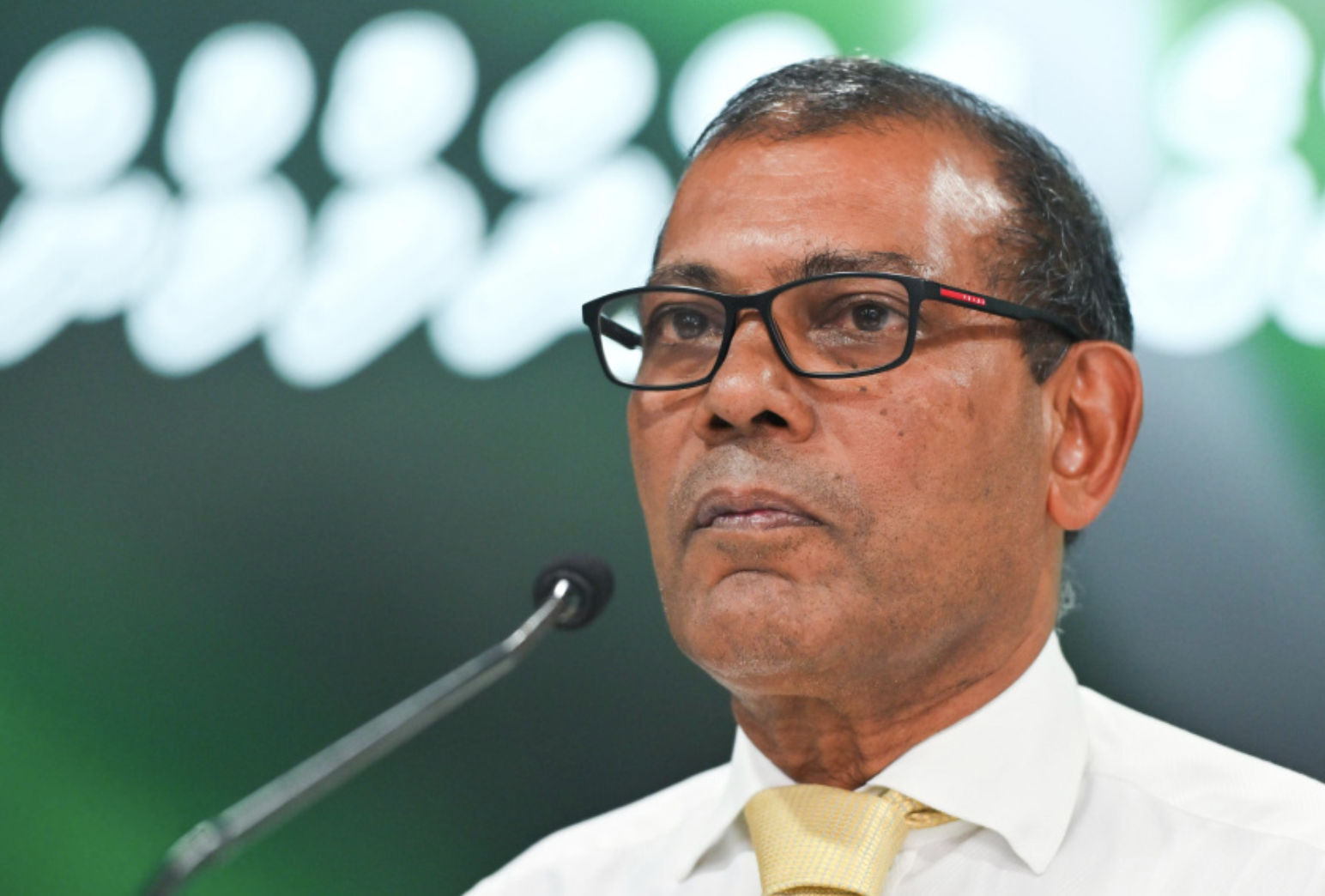
The label follows him everywhere. Laadheenee. Irreligious. Secular. In the Maldives, where politics and Islam are inseparable, it has become the most potent weapon in the arsenal of Nasheed’s opponents, applied liberally and rarely interrogated. Following a July 26th speech by the president, reports are circulating targeting Nasheed, questioning his religious identity, and mixing Israel into the narrative.
The reports doing the rounds in certain local media circles this week, accusing him of attacking the country’s Islamic identity, is the latest iteration of a narrative that has been in circulation for nearly two decades.
It is worth asking, with some seriousness, whether it is true.
Mohamed Nasheed lists his religion as Islam. He was born and raised Muslim in a country where Islam is not a private choice but the constitutional fabric of national life. He has not renounced his faith. He has not called for the removal of Islam from the constitution. He attends Friday prayers. His Wikipedia page, for what that is worth, identifies him as a practising Muslim.
What he has done, consistently and often provocatively, is something different. He has been a liberal Muslim in a political environment that has come to treat liberalism and Islam as mutually exclusive. And in doing so, he has given his opponents the most durable political weapon in Maldivian politics: the suggestion that he is not really one of them.
To understand the laadheenee label, you first need to understand what Nasheed actually did, and what it cost him.
He was part of the Maldives’ first opposition party in exile in Sri Lanka in 2004, returned to the Maldives in 2005 defying a government ban on political parties, was arrested during a non-violent protest in August 2005 and charged with terrorism before the charges were eventually dropped. He was arrested, imprisoned and tortured on multiple occasions, which led to Amnesty International naming him a prisoner of conscience and to him being called the Mandela of the Maldives.
In 2008 he defeated Maumoon Abdul Gayoom, who had ruled the Maldives for thirty years, in the country’s first democratic election. That is not a small thing. It is the defining political achievement in modern Maldivian history. The man who made it happen did so at enormous personal cost, through years of civil disobedience, imprisonment and exile.
As president, he gained international recognition for his strong stance on climate change, holding an underwater cabinet meeting to highlight the existential threat rising seas posed to the Maldives.
His first cabinet included, as Minister of Islamic Affairs, a scholar from the Islamic University of Madinah. The Adhaalath Party, the country’s main Islamic political party, was a coalition partner in his government. These are not the choices of a man who came to office with an anti-Islam agenda.
What the Laadheenee Label Actually Rests On
The accusations against Nasheed on religious grounds rest on a handful of episodes, some real, some exaggerated and some that require considerably more context than his critics typically provide.
The statues at the SAARC summit in Addu City are the most cited example. Cultural artefacts from member nations were displayed as part of the summit, including some from Hindu-majority countries. To his critics, who were then in the opposition from Gayoom’s DRP, this was an invitation to idolatry on Maldivian soil.To a more measured reading, it was a diplomatic courtesy extended to regional neighbours at a multilateral event, of the kind that Islamic-majority countries host routinely without it being considered a theological crisis.
The speech in Denmark in 2013 is more genuinely complicated. Nasheed spoke about the need for an alternative narrative within Islam, language that landed badly in the Maldives and was used to portray him as someone who wanted to reform or diminish the religion. Whether that was his intent or whether he was speaking in the register of a global reformer trying to address radicalisation is a question that depends partly on which translation you read and partly on the good faith you extend to the speaker.
The concern about multi-faith education was largely a projection. What was proposed under his administration was broader civic education, not the removal of Islamic studies. The distinction mattered. It was not always made.
The Israel question is the most politically charged. His government did engage with Israeli medical professionals and there was contact at diplomatic levels. This was used to paint him as pro-Israel in a way that resonated deeply in a Muslim-majority country with strong solidarity toward Palestinians. Whether engagement constitutes endorsement is a moral and political argument, not a theological one.
There is a body of scholarship on what happens when a Muslim-majority country transitions from authoritarianism to democracy, and the Maldives is an instructive case. When the structures of religious authority have been centralised and used to legitimise one-party rule for decades, as they were under Gayoom, the arrival of political pluralism creates a vacuum that is almost always filled, at least partly, by more assertive religious voices.
Gayoom himself was no model of Islamic governance. He presided over decades of corruption, imprisoned political opponents, and used state Islam selectively to consolidate power. But he controlled the religious narrative. When Nasheed broke his hold on politics, he simultaneously disrupted his hold on that narrative. The Adhaalath Party and others who had been constrained under Gayoom suddenly had room to operate, and they used that room partly to define the new democratic space in religious terms.
Nasheed, as a liberal democrat, occupied a different part of that space. His vision of the Maldives was outward-facing, pluralist in its politics and committed to human rights in the international liberal sense. That vision was not anti-Islamic. But it was not the vision of those for whom Islamic identity and political Islam are the same thing. The gap between those two positions has defined Maldivian politics ever since.
The Activist and the Accusation
The laadheenee label surfaces most reliably at particular moments. When Nasheed protests. When he challenges the government. When he aligns with causes that make the ruling class uncomfortable. It is deployed not as theological analysis but as political disqualification. Call a man irreligious in the Maldives and you have, in theory, removed him from the legitimate political community.
The reports circulating in local media this week is a version of this tradition. It is detailed, it is confident and it is written in the register of doctrinal concern. What it does not engage with is difference between a man who rejects Islam and a man who practices it differently from those who are using religion as a political instrument.
Nasheed is not irreligious. He is liberal, which in the Maldivian political context amounts to the same accusation. He believes in democratic pluralism, in climate science, in international human rights frameworks and in a version of Muslim identity that can coexist with all of those things. His opponents believe that coexistence is itself the heresy.
Nasheed is someone who has proven that he can read the usual religious recitation that is read before a speech. However, that is not the case for all Maldivians. Case in point is that some members of the ruling party were not able to recite prayers on Prophet Muhammad (peace be upon him), and this was seen more than once on national television and live broadcasts.
Nasheed survived an assassination attempt in 2021 that nearly killed him. The people who planted that bomb were not secular liberals. They were men operating in the name of a religious certainty that his brand of politics threatened. That context sits beneath the laadheenee label, even when it goes unacknowledged.
A Verdict That Requires More Than a Label
The honest assessment of Nasheed is this. He carries a record of imperfections and complexities; a complicated, sometimes reckless political figure who has made genuine mistakes, created real enemies, and chosen confrontation when compromise might have served him better. One needs to examine the real causes for what he did and the environment he faced: the civil service was obstructive, the judiciary was against him, and the Majlis was dominated by political rivals, meaning nothing was deliverable. Still, this does not justify the arrest of a notorious judge or the mismanagement of his political coalition.
His relationship with the religious establishment was never carefully cultivated and sometimes actively antagonised.
But he is also the man who dismantled thirty years of authoritarian rule through non-violent resistance, who put climate justice on the international agenda with genuine moral force, who survived imprisonment, torture and a bomb, and who keeps coming back. That record does not belong to a man who hates his country or his faith.
Whether the Maldives will ever find a way to hold both of those truths at once, the achievements and the accusations, the liberal Muslim and the activist, without collapsing one into the other, is the deeper question that the laadheenee label has always been designed to prevent.