 News Desk
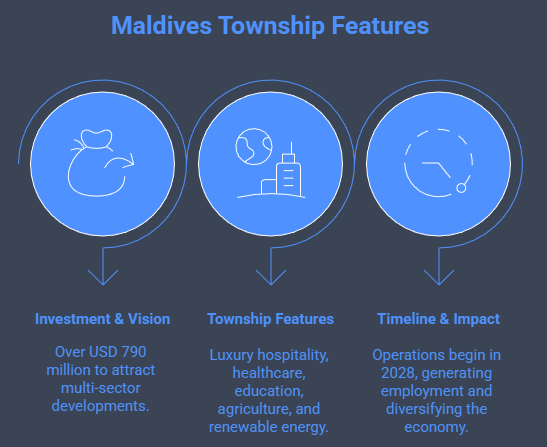
Malé, Maldives — For decades, the Maldives has been known as a tourism paradise that fuels its economy. This week, however, the island nation announced a project its leaders believe could reshape that story: its first sustainable township, a $790 million project led by Crystal Holdings.
Officials call the township a turning point. It blends luxury hospitality with residential living, but also adds a hospital, a leadership school, and even an island dedicated to advanced farming and aquaculture.
At least 60 percent of the township’s energy is expected to come from renewable sources, a nod to the Maldives’ vulnerability to climate change and its need to reduce carbon emissions. Operations are targeted to begin in 2028, with the government promising high-value employment, diversified regional economic activity and a new stream of long-stay visitors and high-net-worth residents.
The announcement carries political weight. Past attempts to attract investment through special economic zones faltered, with critics accusing the government of secrecy and of selling national assets. Those failures left the SEZ Act with little credibility.
President Dr. Mohammed Muizzu’s administration wants to change that. Recent amendments to the SEZ Act define a sustainable township as a large-scale development with hospitals, schools, recreation, waste management, and modern agriculture—built with environmental safeguards and infrastructure for residents to live on site.
Investors committing at least $500 million will enjoy major concessions: property tax starting at one percent, income tax capped at five percent for the first decade, and no import duties on capital goods.
Supporters call the township a ‘new economic door.’ Lawmaker Ibrahim Shujau insists past mistakes won’t be repeated. The stakes are high: tourism still dominates the Maldives’ economy, leaving it exposed to global shocks and climate change.
The sustainable township, if realized, could mark a genuine shift, embedding healthcare, education, agriculture and renewable energy into the nation’s development model. It could also signal to international investors that the Maldives is serious about creating stable, transparent frameworks for large-scale projects.
For President Muizzu, the township is more than economics—it’s a symbol of ‘revolutionary development,’ as Economic Minister Mohammed Saeed put it. Success will hinge on execution, transparency, and political stability.
The Maldives has set a bold target: operations by 2028, powered largely by renewable energy, staffed by local workers and serving as a hub for medical tourism and advanced agriculture. For a nation perched precariously on the frontlines of climate change, the project is both a gamble and a necessity.
Observers abroad will be watching. If successful, the Maldives’ experiment could become a model for other island nations seeking to diversify. If not, it risks joining a list of ambitious projects undone by politics. For now, the government is betting that this time will be different building not just resorts, but hospitals, schools, farms, and renewable grids.
In the words of the press release announcing the permit, the township represents “a significant step forward in attracting next-generation, multi-sector developments beyond conventional tourism-based models.” For the Maldives, it is a step into uncharted territory, one that could redefine its place in the global economy.