 News Desk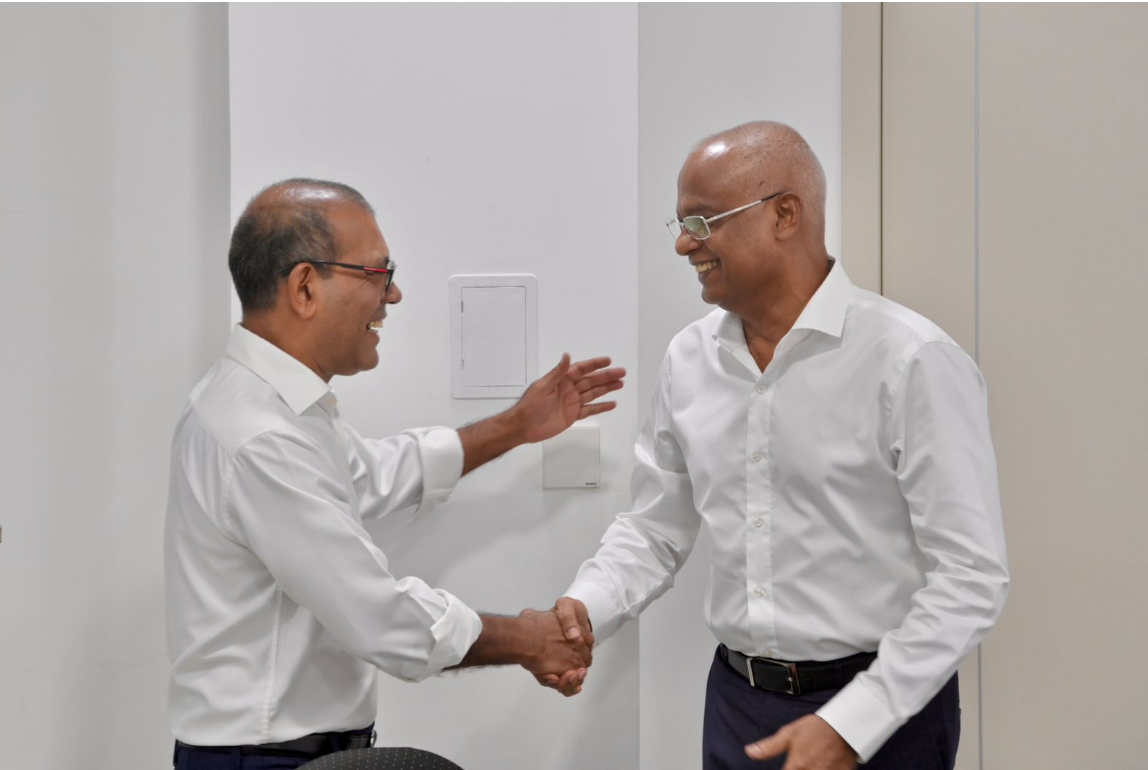
The joint press conference on Dec. 24, 2025, between former Presidents Mohamed Nasheed and Ibrahim Mohamed Solih was not a seismic political moment, but it was one that seasoned observers should take note of. It was less a conventional briefing than a carefully staged display of unity inside a party long riven by internal fractures.
Their history as rivals — even frenemies — stretches back to Nasheed’s 2023 breakaway to form The Democrats after accusing Solih of governance failures, corruption, and reluctance to pursue long‑promised reforms. The split contributed to a series of electoral defeats that ultimately delivered the presidency to Dr. Mohamed Muizzu. The rupture not only weakened the Maldivian Democratic Party (MDP) but exposed its chronic vulnerability: personal ambition repeatedly overwhelming collective strategy. With Nasheed’s faction dissolving back into the MDP earlier this year, the reconciliation now presented to the public reads as a pragmatic reset, though one still shadowed by unresolved tensions.
The moment carried echoes of the Roosevelt–Taft rapprochement — a reminder that political relationships, even after years of hostility, can soften and recalibrate. Symbolism matters in Maldivian politics, and the image of the two men seated side by side signalled an attempt to turn the page.
Yet the optics also underscored a potential liability. The event cast them as equals rather than establishing a clear hierarchy, a dynamic that has historically paralyzed MDP decision‑making. Nasheed, with his global stature as a climate advocate and democracy icon, brings international reach. Solih offers steadier, if often criticized, administrative experience. Their joint message — insisting there is “no distance” between them and expressing openness to alliances that could even include longtime adversary Abdulla Yameen — suggested a unity born of necessity rather than reconciliation of substance.
This equal‑status arrangement risks repeating past cycles of gridlock. In a small, polarized political arena like the Maldives, such arrangements often devolve into performative alliances that collapse under pressure, particularly when electoral stakes rise.
The looming local council elections on March 28, 2026, especially in Malé City, will serve as an early test of this fragile pact. The MDP has accelerated its primaries to Jan. 16, signalling urgency as it faces a disciplined ruling PNC.
Malé — dense, politically symbolic, and often a bellwether of national sentiment — will be closely watched. The contest between incumbent Mayor Adam Azim and former MP Ali Azim for the MDP ticket highlights internal competition that could expose lingering fractures. The stakes rose further when Solih, Nasheed, and the party’s president and former foreign minister, Shahid, all appeared to lend their weight to Ali Azim’s candidacy. Their alignment suggests an attempt to project cohesion at the top, but it also risks deepening perceptions of factional favouritism within the party.
For some MDP members, the trio’s endorsement reads as a coordinated effort to reassert control over the party’s direction after two years of turbulence. It signals that the leadership is rallying behind a candidate they believe can unify Malé’s fractious electorate and counter the ruling PNC’s growing influence in the capital. But for others, the move revives long‑standing concerns about elite‑driven decision‑making — a pattern that has historically alienated MDP grassroots organizers and fuelled internal resentment.
Adam Azim, who has cultivated his own base through a high‑visibility and often dynamic mayoralty, may interpret the leadership’s tilt toward his rival as an implicit vote of no confidence. During his tenure, he pushed ahead with visible urban‑management initiatives despite limited fiscal space and persistent political headwinds, earning a reputation among supporters as a hands‑on administrator who delivered where he could. That record makes the leadership’s alignment behind Ali Azim all the more sensitive: it risks being read not merely as strategic positioning but as a dismissal of an incumbent who weathered structural constraints and maintained public engagement in a difficult governing environment.
That dynamic could inflame internal tensions at precisely the moment the MDP is trying to project unity. If the primary becomes a proxy battle between competing power centres — the Nasheed–Solih–Shahid bloc on one side and Adam Azim’s supporters on the other — the party risks entering the March elections weakened, regardless of who ultimately secures the nomination.
The leadership’s intervention also underscores a deeper strategic dilemma: whether the MDP intends to rebuild around familiar figures or open space for a new generation. By backing Ali Azim, the party’s top brass may be signalling a preference for continuity over renewal. Yet that choice carries risks. If the endorsement is perceived as orchestrated rather than organic, it could reinforce the narrative that the MDP’s internal democracy remains fragile, shaped more by personal alliances than by transparent competition.
In this sense, the Malé primary is more than a local contest. It is a referendum on whether the Nasheed–Solih reconciliation can withstand the pressures of real political decision‑making — and whether the party can avoid slipping back into the factionalism that contributed to its 2023 defeat.
Poor results, whether driven by voter fatigue after the 2023 losses or frustration with the MDP’s unresolved governance issues and internal drift, would not only tarnish both leaders’ legacies but could reopen old wounds. Many within the party argue that the MDP has struggled to articulate a coherent internal structure since the split, leaving questions about discipline, decision‑making, and the space for emerging leaders.
A disappointing showing in March would sharpen those concerns, reinforcing the perception that the party has failed to reinvigorate itself or elevate a new generation capable of carrying the movement forward. In that scenario, blame‑shifting between the two former presidents could easily revive past grievances, deepening factional divides at the very moment the party needs renewal and clarity of direction.
Critics already argue that the reconciliation is a temporary bandage. A disappointing showing could trigger blame‑shifting between the two men, fracturing the opposition further and strengthening President Muizzu’s position ahead of the 2028 presidential race.
A historical external perspective adds nuance. Former U.S. Ambassador to the Maldives Robert O. Blake Jr., who served from 2006 to 2009 and later oversaw South and Central Asian Affairs at the State Department, repeatedly emphasized that Maldivian political disputes should be resolved through internal dialogue and cooperation. He urged parties to avoid confrontation and pursue consensus‑based solutions. The Nasheed–Solih rapprochement aligns with that philosophy, privileging domestic political repair over international mediation. But it also reflects a recurring flaw Blake observed during his tenure: elite‑driven bargains that lack grassroots legitimacy.
Looking ahead, the durability of this partnership depends on whether the two leaders can translate symbolism into action. In the best‑case scenario, a united MDP could leverage their combined influence to confront the party’s core challenges — rebuilding economic credibility and restoring confidence in its governance model — and regain momentum heading into 2026. Solih’s strength has always been internal stabilization, a complement to Nasheed’s external visibility, and together they could offer a clearer contrast to the ruling party if they manage to align on policy direction and organizational discipline.
At the same time, analysts note that President Muizzu has been articulating his policies through a series of town‑hall‑style meetings — an approach that some describe as a departure from the more centralized communication style of previous administrations. Supporters argue that this format has allowed him to listen more closely to the public, understand their grievances, and present what they see as comprehensive solutions to the daily challenges Maldivians face.
Supporters also argue that he is addressing the capital’s half‑century‑old housing crisis in a more comprehensive and structured way than his predecessors, and that these efforts are slowly gaining public confidence.
They also point out that, unlike the Nasheed–Solih governing era — when coalition partners such as Qasim Ibrahim and the Adhaalath Party often acted as influential power brokers — the current administration has consolidated authority more tightly. Observers say this has enabled President Muizzu to sidestep the factional bargaining that once shaped policy outcomes, giving his government a clearer line of command even as critics question the long‑term implications of such centralization.
For the MDP, this contrast only heightens the stakes. The party’s attempt to project unity now unfolds against a governing landscape where the executive operates with fewer internal veto points and a more streamlined chain of authority. That shift places additional pressure on Nasheed and Solih to demonstrate that their reconciliation is more than symbolic — that a party long defined by competing centres of gravity can function cohesively at a moment when its chief rival appears more structurally aligned.
In the long term, MDP’s resilience may depend less on the two former presidents and more on whether they can cultivate new leadership. Their recent praise for figures like Fayyaz Ismail hints at an awareness that generational transition may be necessary. Without genuine policy alignment and renewed voter trust, however, this reconciliation may prove fleeting — another chapter in the cycle of rivalry that has long constrained Maldivian democratic politics.
Photo: MDP