 News Desk
Malé, Maldives — The government, together with the national carrier Maldivian, has unveiled a new air‑connectivity initiative aimed at stitching together the country’s southernmost atolls with faster, more flexible transport options — a move officials describe as a turning point for mobility and economic life in the region.
At the heart of the project is a reconfigured de Havilland Canada DHC‑6 Twin Otter, long a workhorse of Maldivian seaplane operations. The aircraft, once fitted with floats for lagoon landings, has now been converted to a wheeled configuration, enabling it to operate from short, paved runways across the southern atolls, including Gaafu Alifu, Gaafu Dhaalu, Fuvahmulah and Addu.
The 15‑seat aircraft is known for its ability to take off and land on extremely short strips — a feature that Maldivian officials say will allow the government to expand air access without the heavy financial burden of building full‑scale airports. Instead, small airstrips can be constructed in remote communities, opening the door to night operations and more reliable inter‑atoll travel.
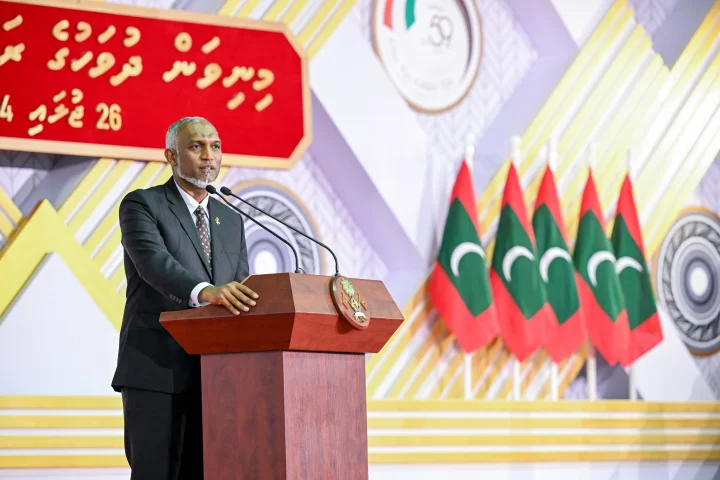
“This is about creating practical, affordable access for our people,” President Dr. Mohamed Muizzu said last month, noting that lightweight airstrips paired with small aircraft offer a more efficient alternative to large‑airport construction. “We are now talking about building landing strips for these small seaplane‑sized aircraft with wheels so that they can land in many islands at night.”
The project unfolds at a moment when the Maldives has reached the highest level of domestic air connectivity in its history. The country now operates the most extensive airport network of any small island developing state, a system that has become a defining national asset.

Twenty airports span the archipelago — five international and fifteen domestic — a scale of aviation infrastructure unmatched by any island nation of comparable size. What distinguishes the network is not only its breadth but its design: a strategically distributed chain of airports that ensures north–south continuity, provides redundancy in transport routes, and strengthens the resilience of tourism, emergency response and public services.
The Ministry of Transport, which is overseeing the rollout, has framed the initiative as a strategic investment in southern development. By improving air links between the atolls, officials hope to ease long‑standing transportation challenges, strengthen ties between resorts and inhabited islands, and support medical travel, education and commerce.
Maldivian has introduced promotional fares to encourage early adoption. A ticket between Gan and Fuvahmulah is priced at 500 Maldivian rufiyaa, with similarly low fares on routes connecting the Gaafu atolls. Officials say the pricing is designed to make inter‑atoll travel accessible to ordinary residents, not just tourists.
The project also signals a broader shift in how the Maldives approaches domestic aviation. With 20 airports already scattered across the archipelago, the government is now exploring smaller, more flexible infrastructure that can reach communities previously considered too remote or too costly to serve.
For a nation defined by its geography — scattered islands, long sea distances, and a growing population — the new service represents a significant step toward a more connected south, and a more cohesive Maldives.
New Airport Project in Dhihdhoo Begins With Arrival of Mega Dredger