 News Desk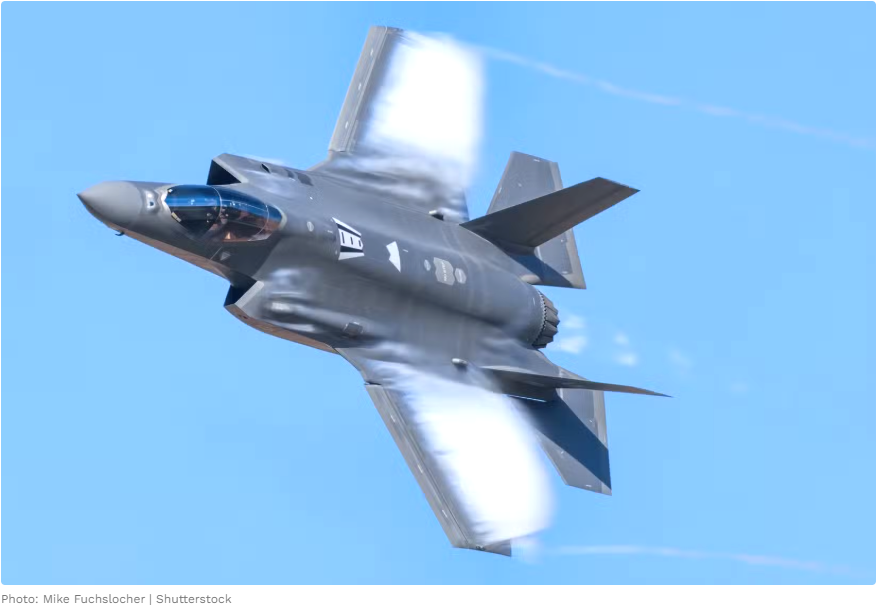
When President Donald Trump announced that Saudi Arabia would be allowed to purchase the F‑35 fighter jet, the move was heralded as a breakthrough in Gulf security. Yet beneath the rhetoric lies a more complex reality: the deal is less about Riyadh’s military modernisation than Washington’s balancing act—reassuring Israel, bolstering its defence industry, and binding Saudi Arabia more tightly to American power.
For Saudi Arabia, the jets are a coveted symbol. They represent entry into the exclusive club of fifth‑generation aircraft operators, a status long reserved for Israel in the Middle East. But the aircraft Riyadh will receive are not the same as those flown by Israel. U.S. law requires that Israel maintain a “qualitative military edge,” and Israeli jets already enjoy unique privileges, including the freedom to integrate local weapons and electronic warfare systems without American approval. Saudi aircraft, by contrast, will be tethered to U.S. software packages, stripped of sensitive systems such as the AIM‑260 Joint Advanced Tactical Missile, and delivered years behind schedule.
That timeline is deliberate. Washington has a history of delaying deliveries to allies for political reasons. Pakistan’s experience with the F‑16 programme is a cautionary tale: in 1989, Islamabad paid for 28 aircraft, but deliveries were blocked for nearly eight years under the Pressler Amendment. Analysts warn that Saudi Arabia’s F‑35s, even if signed today, may not be operational until the mid 2030s. By then, the U.S. and Israel will likely be flying upgraded versions, leaving Riyadh with outdated technology.
Training adds another layer of delay. Pilots for fifth‑generation aircraft require years of preparation, and Israel already has nearly a decade of operational experience with the F‑35. Saudi pilots will be starting from scratch, meaning meaningful air superiority will remain elusive well into the next decade.
The dependency is structural. Unlike older aircraft, the F‑35 relies on a centralised software and logistics backbone known as ALIS (Autonomic Logistics Information System), now transitioning to ODIN (Operational Data Integrated Network). This system manages everything from mission planning to maintenance. Because it is U.S.‑controlled, it gives Washington the ability to restrict or even disable aircraft remotely if a buyer acts against American interests. As experts at the Royal United Services Institute (RUSI) note, “allies operate the jets, but the United States retains ultimate authority over their functionality.” Israel alone was granted exemptions to run its own systems, insulating it from this vulnerability. Saudi Arabia will not have that privilege.
In practical terms, Riyadh is not just buying aircraft—it is buying into a system where Washington holds the keys. As one critic put it, “building a palace and handing the keys to a stranger.” Saudi Arabia may own the jets, but the United States can decide how freely they fly.
This “kill switch” reality reinforces the broader theme: the deal is less about Saudi sovereignty and more about U.S. leverage. It ensures that Riyadh remains dependent on Washington for its core defence capabilities, while Israel continues to enjoy true autonomy. It also raises questions about Saudi Arabia’s ambitions for indigenous defence development. Under Vision 2030, Riyadh has pledged to localise half of its defence spending. Yet the F‑35 sale undercuts that goal. The aircraft will be tightly controlled by U.S. export restrictions, limiting Saudi freedom to modify or innovate.
If the F‑35 sale symbolises prestige for Riyadh, its parallel missile programme with China represents a source of deep anxiety in Washington. U.S. officials fear that Saudi Arabia’s pursuit of ballistic and hypersonic systems with Beijing could collide with the stealth fighter deal, creating risks of espionage and eroding Israel’s qualitative military edge.
Pentagon analysts warn that Chinese involvement in Saudi missile development could open a backdoor to America’s most sensitive technologies. As one defence official put it, “We cannot have technology associated with that aircraft compromised and find its way to China.” The concern is not abstract: China’s J‑20 stealth fighter is widely believed to have benefited from stolen U.S. designs, and Saudi Arabia’s dual‑track cooperation raises alarms about inadvertent transfer.
Congressional scepticism is mounting. Lawmakers have pressed the administration to explain safeguards, with some arguing that the sale risks “grinding down Israel’s air superiority” if Saudi F‑35s are ever paired with advanced missile systems. Israeli officials have quietly lobbied against the deal, submitting memoranda that highlight the danger of Riyadh’s growing ties with Beijing.
The paradox is stark. Washington wants to arm Saudi Arabia against Iran, but doing so risks empowering China indirectly. Abdullah F. Alrebh described the dilemma as a “high‑stakes referendum” on whether the partnership can evolve beyond a transactional oil‑for‑security model. For now, the buzz in Washington is sceptical: the F‑35 sale is framed less as a military upgrade than as a geopolitical gamble, one that could entangle America’s crown‑jewel technology in China’s orbit.
Even with the jets, Saudi Arabia will not eclipse regional rivals. Iran maintains a vast missile arsenal and indigenous production capacity, while Turkey has become a leader in drone warfare and defence innovation. Both countries retain advantages that a delayed, restricted Saudi fleet cannot erase. In this sense, the deal does not alter the regional balance but reinforces Saudi reliance on U.S. protection.
The F‑35’s combat record is limited. Israel has used its F‑35I “Adir” variant in Syria and Gaza, striking Iranian‑linked targets and militant infrastructure with little risk of encountering an equal adversary. The United States employed the jet in Iraq against ISIS in 2019 and in Afghanistan against Taliban positions, again in environments where stealth and advanced systems were not tested against peer competitors. Analysts at RUSI have noted that the F‑35’s combat record so far is “against lightly defended targets, not in contested airspace.”
By contrast, the Dassault Rafale has already been tested in contested skies. India’s Rafales were deployed in Operation Sindoor (May 2025), following the Pahalgam terror attack. Indian jets struck terrorist infrastructure in Pakistan and engaged in air battles against Pakistan’s J‑10CE and JF‑17 fighters equipped with advanced Chinese PL‑15 missiles and HQ‑9 air defence systems. The operation demonstrated the Rafale’s ability to operate in a peer‑to‑peer combat environment. French Rafales have also been used extensively in Libya, Mali, and Iraq, showcasing versatility and reliability in sustained campaigns.
Economics are central to the bargain. For Washington, the sale is a boon. Lockheed Martin profits, U.S. jobs are secured, and billions flow into the defence industry at a time of economic strain. For Riyadh, the jets are more about prestige than battlefield utility. William Hartung of the Quincy Institute warned: “Washington needs to take steps to ensure that the financial interests of a handful of weapons contractors do not drive critical U.S. arms export policy decisions.”
The political dimension is equally significant. Crown Prince Mohammed bin Salman has stated that Saudi Arabia, as custodian of the two holy mosques, will eventually join the Abraham Accords. Yet normalization with Israel risks sidelining Palestinian rights, with critics arguing that such alignment could legitimize actions described by some as genocidal. The F‑35 sale is part of this broader bargain: advanced jets in exchange for political alignment.
In the end, the U.S.–Saudi F‑35 deal is not a military revolution. It is a skewed transaction where Washington gains economically and strategically, while Riyadh receives delayed, downgraded aircraft that deepen dependency. Regional rivals Iran and Turkey retain their edge, and Palestinian rights risk being subordinated to geopolitical bargains. For Saudi Arabia, the purchase is more about symbolism than sovereignty. For the United States, it is a successful business deal that reinforces its leverage in the Gulf.
As Abdullah F. Alrebh observed: “The F‑35 negotiation encapsulates a central paradox… It pits the transactional imperative to counter Iran—by arming a key partner—against the complex legacy doctrine of preserving Israel’s qualitative military edge.” The paradox remains unresolved, and the palace keys remain firmly in Washington’s hands.