News Desk
MALE’, — Having twice held the reins of executive power and once commanded a sweeping majority in Parliament, the Maldivian Democratic Party (MDP) now finds itself navigating unfamiliar territory. Reduced to just a fraction of its former numbers in the People’s Majlis, the principal opposition party is attempting to exert influence through a classic legislative tool: relentless parliamentary questioning.
Yet, recent data released by opposition lawmakers paints a striking picture of an administration slow to respond, highlighting a growing friction between the executive branch and a diminished but vocal opposition.
According to data shared on social media platform X by Mohamed Ibrahim (Kudu), the opposition MP for North Galolhu, MDP lawmakers have submitted 258 formal questions to government cabinet ministers. Of those, 180 queries targeted just eight key cabinet members, with the vast majority remaining largely unanswered or overdue.
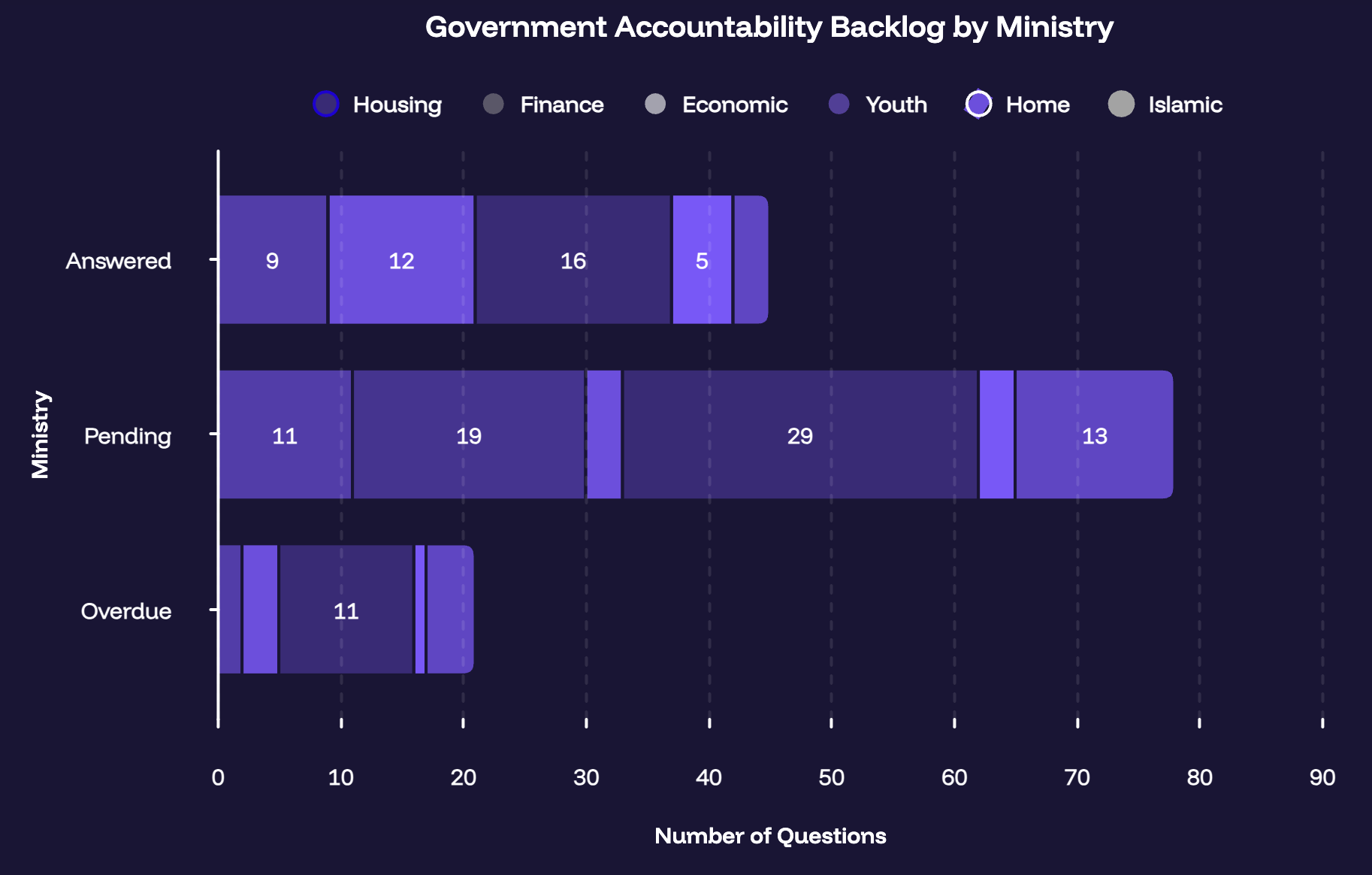
The performance metrics reveal a substantial backlog in government accountability:
- Housing and Infrastructure: Minister Abdulla Muththalib faced the highest volume of scrutiny, receiving 56 questions. Only 16 have been answered, 11 have passed their statutory response deadline, and 29 remain pending.
- Finance: Former Finance Minister Moosa Zameer stepped down leaving 25 out of 26 questions unanswered. His successor, Hassan Zareer, faces 19 submitted questions, with zero responses delivered to date.
- Economic Development: Minister Mohamed Saeed received 22 questions, answering 9. Two deadlines have lapsed, and 11 remain unanswered.
- Youth Affairs: Minister Abdulla Rafiu responded to just 3 of 20 questions, leaving 13 pending and 4 overdue.
- Home Affairs: Minister Ali Ihusan holds a higher completion rate, answering 12 out of 18 questions, though 3 remain overdue and 3 pending.
- Islamic Affairs: Dr Mohamed Shaheem Ali Saeed answered 5 of 9 questions, with 1 deadline passed and 3 pending.
An Accountability Crisis?
The parliamentary group of the MDP has voiced deep frustration, accusing the ruling People’s National Congress (PNC) leadership of shielding ministers from floor appearances.
“Even when questions are formally submitted, ministers are rarely brought before the chamber to face direct questioning,” MDP parliamentary representatives noted in a recent press conference. “When they do appear, they come prepared only to address softball questions from ruling party MPs, using the floor to criticise the former MDP administration rather than providing substantive answers to current policies.”
For the MDP, which governed until recent political realignments shifted the balance of power, the figures serve dual purposes: a critique of cabinet transparency and evidence that despite their reduced seat count, opposition MPs remain an active legislative force.