News Desk
CAIRO — Across the sprawling agricultural expanses of the Nile Delta and deep into the arid reaches of Sinai, a quiet revolution is reshaping the bedrock of Egyptian society.
Data unveiled at the Egypt Forum 2026 presents a compelling narrative of a nation steadily fortifying its core resilience. Behind the headline figures released by the Egyptian Cabinet lies a deliberate, multi-pronged effort under President Abdel-Fattah El-Sisi to rebuild the state’s foundational pillars: food security, agricultural modernisation, and robust social safety nets.
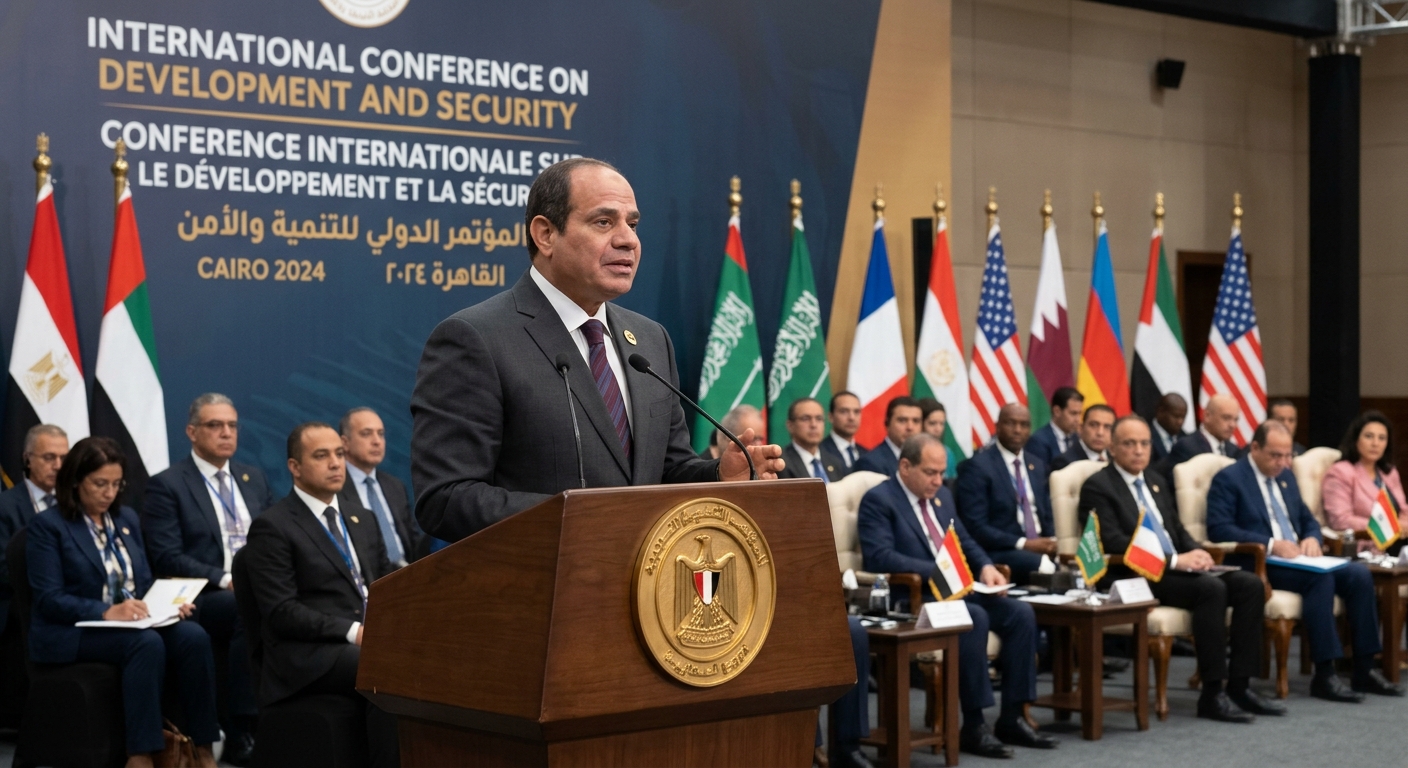
Rather than relying on short-term fixes, Cairo has anchored its long-term strategy in structural stability—a point President El-Sisi reinforced at the forum, emphasizing that the country’s recent strides would have been impossible without baseline national security and political continuity.
The most striking visual evidence of this transformation stretches across Egypt’s farmland. Official data reveals that cultivated land has expanded significantly to 10.5 million feddans—up from 9.1 million a decade ago—pushing total cropped area to 17.5 million feddans.
This expansion has yielded tangible returns in national food security:
-
Wheat Production: Domestic output reached 11 million tonnes on 3.7 million feddans, up from 7.8 million tonnes, helping to curb import dependency.
-
Livestock & Dairy: Red meat output rose to 600,000 tonnes, boosting self-sufficiency to 60 per cent, whilst fresh milk production climbed to 7 million tonnes.
-
Poultry & Fisheries: Poultry self-sufficiency has reached an impressive 98 per cent, supported by EGP 200 billion in targeted investment, while fish self-sufficiency rose to 93.5 per cent.
-
Global Reach: Agricultural exports have more than doubled since 2014/15, topping 9.5 million tonnes.
Crucially, the agricultural push is tied to modern governance and community development. Over 4.4 million “smart farmer cards” have been issued since 2019, digitising agricultural support and connecting thousands of cooperatives directly to modern distribution networks. Farther east, the state is developing 18 agricultural communities across North and South Sinai, establishing roots for over 2,000 families across 11,000 feddans.
Parallel to the greening of the desert is a substantial expansion of Cairo’s social protection infrastructure. The flagship Takaful and Karaama (Solidarity and Dignity) cash-transfer initiative—launched in 2015—has evolved into one of the region’s most comprehensive welfare programmes.
To date, the initiative has supported 8.3 million families, with 4.7 million families currently enrolled at an annual cost of EGP 54 billion. Far from creating permanent dependency, the programme has seen 2.2 million families successfully transition off support as their financial stability improved.
Moreover, the safety net enforces long-term human development: compliance metrics indicate a 94 per cent school attendance rate and a 92 per cent health check-up rate among participating households.
Complementing cash transfers, specialized social services have broadened their reach:
-
Inclusion: Over 1.6 million persons with disabilities now hold integrated-services cards, with 1.23 million accessing dedicated rehabilitation care.
-
Early Childhood & Elderly Care: A landmark digital census registered over 48,000 nurseries nationwide, while state-supported alternative-family care for children nearly doubled to over 12,500.
To safeguard these gains against global economic volatility, Egypt has drastically overhauled its storage and supply chain infrastructure. The country’s silo capacity has quadrupled to 4.4 million tonnes across 85 modern facilities, moving away from vulnerable open-air storage and drastically reducing post-harvest waste.
Today, Egypt’s strategic reserves of essential commodities—including wheat, sugar, vegetable oils, and meat—cover approximately six months of domestic demand. On the ground, a vast distribution network encompassing 30,000 bakeries and thousands of subsidized consumer outlets ensures that between 250 million and 260 million loaves of subsidized bread reach over 64 million citizens daily.
As the Egypt Forum 2026 makes clear, the quiet revolution unfolding across the nation is fundamentally about building endurance. Through disciplined investment in land, supply chains, and human capital, Egypt is constructing a steady, self-reliant foundation for the decades ahead.