 News Desk
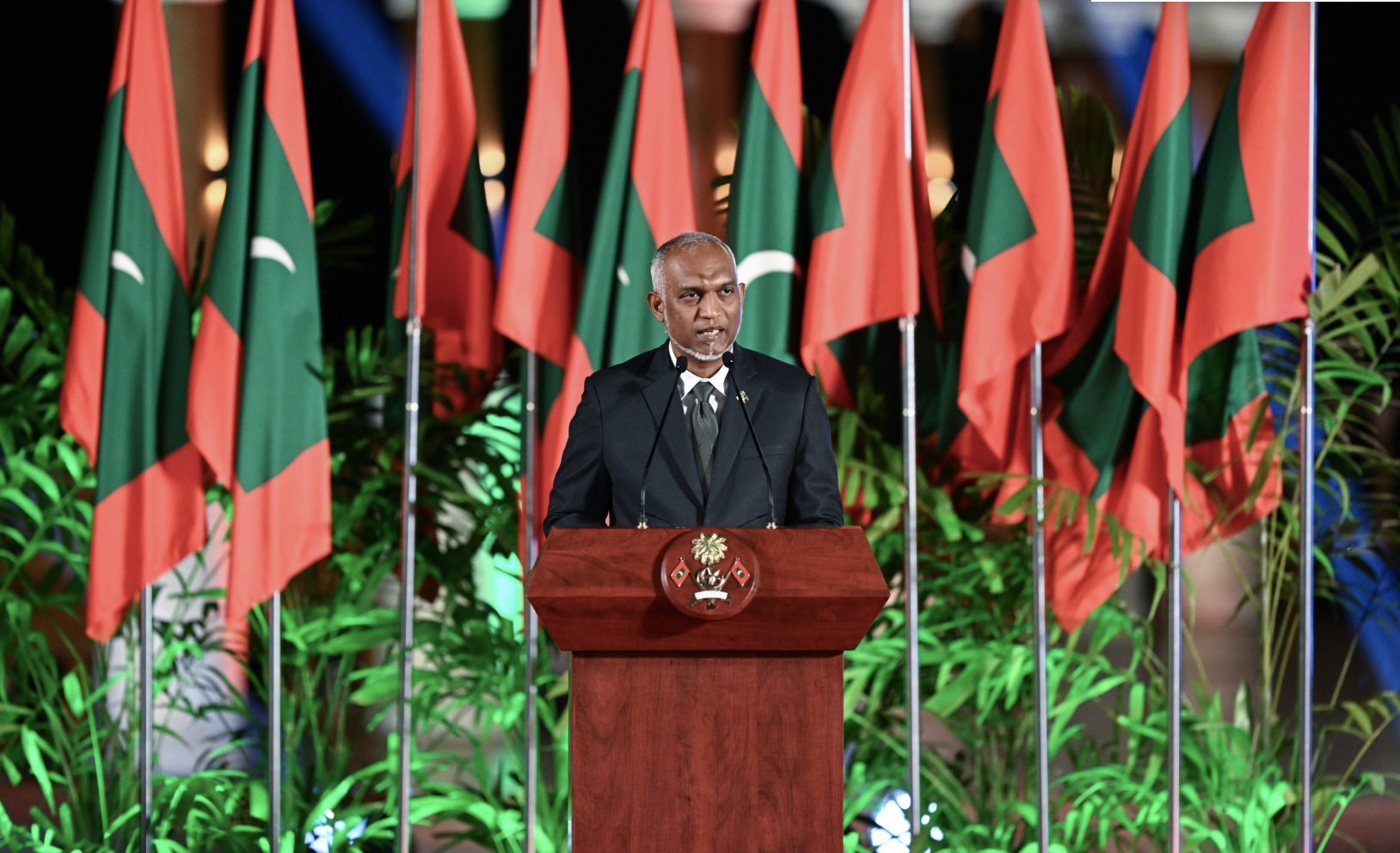
Standing in the breezy, harbourfront expanse of Republic Square, where the turquoise waters of the Indian Ocean lap against the capital’s northern edge, President Dr Mohamed Muizzu invoked the harrowing ghosts of a national tragedy to deliver a stark warning about the country’s economic future.
Addressing military commanders, state dignitaries, and gathered citizens on Tuesday to mark Victory Day, the President drew a sweeping, historical arc from 16th-century naval sieges to the bloody, mercenary-led coup attempt of 3 November 1988. But his ultimate target was modern: a looming financial crisis that he argued poses as grave a threat to Maldivian sovereignty as any foreign invader.
“Even at this moment, it feels as though we can still hear the echoes of the gunfire released in defence of this beloved Maldivian soil on Victory Day,” President Muizzu said, his voice echoing across the cobblestone plaza where, nearly four decades ago, gun battle erupted at dawn.
“Through the silence of the dawn, we can almost hear the sincere takbeers raised by the devoted children of our nation,” he continued. “We can picture the tear-stained faces, overwhelmed by the weeping and sobs of the many beloved Maldivian citizens who were lined up as human shields by the enemy in this very square.”
The annual commemoration marks the defeat of a mercenary invasion launched 38 years ago by a group of Maldivians alongside armed Tamil militants from Sri Lanka, an assault that claimed 19 Maldivian lives and left deep scars on the national psyche. Yet, as President Muizzu gestured toward the dedicated memorial honoring fallen soldiers like Martyr Hussain Adam, he pivoted from commemorating past bloodshed to framing a contemporary struggle for self-determination.
For the President Muizzu, true sovereignty in the 21st century can no longer be measured merely by military hardware or border defense. Instead, it must be fought in the balance sheets of the state treasury.
“Just as we liberated this nation from the tyranny of weaponry, we must also liberate the Maldivian nation from the tyranny of debt,” President Muizzu declared in one of the speech’s most pointed passages.
“How is the subjugation of a nation defined in this modern era?” he asked the quieted crowd. “Whether it is a nation, a community, a family, or an individual standing alone, one is able to speak one’s mind freely, break free from the influence of others, and assert one’s existence with peace of mind only by possessing self-sufficiency. Otherwise, one will forever have to remain subservient to the creditor; forced to follow the directives of that creditor whether one likes it or not, living amidst anxiety and distress.”
The imagery was deliberate. The republic—famed internationally for luxury, white-sand resorts—has faced mounting international scrutiny over its national debt obligations and fiscal deficit. In his address, the President framed his administration’s economic austerity measures not merely as policy choices, but as existential national duties.
Recalling his inaugural address delivered in the same square on 17 November 2023, he reminded the public of the promise to pull the country back from a financial precipice.
“I told you that the Maldivian economy was at the bottom of a deep abyss, and that we would rescue the Maldivian state from that economic abyss and save it from the traps of debt,” he said. “By the will of Almighty Allah, we have rescued the nation from the warnings repeatedly given by various parties that the Maldives could go bankrupt. We have brought an end to the culture of recklessly taking on debt and printing money, and we are paying off the debts that were incurred.”
To reinforce his argument, President Muizzu took his audience on a detailed tour through Maldivian history, framing political betrayal and foreign meddling as a recurring threat enabled by internal divisions.
He recalled the 16th-century Portuguese armada whose warships lined up outside Malé’s reef while battles raged near the royal grounds of Sultan Park, and the 1753 invasion by Malabari raiders who burnt the 800-year-old royal palace to the ground, destroying state archives. He also invoked the infamous Boduhulhu—the Great Arson—pointing out that each historical tragedy shared a common, bitter trait: Maldivian actors colluding with outside powers out of a lust for political power.
“The answer provided by history is that it was an aggression orchestrated from behind the scenes by a faction of Maldivians driven by a lust for power,” President Muizzu noted, adding that “history is the mirror in which the future reflects itself.”
Turning to defense and foreign policy, the President highlighted key promises delivered during his tenure, including the departure of foreign military personnel stationed in the country and the acquisition of new defensive capabilities for the Maldives National Defence Force.
“Having established a foreign policy that puts the interests of the Maldives first, the foreign troops stationed in this country have been sent away,” he said, underscoring his stance on national defense. “Militarily, the capabilities of the National Defence Force are being enhanced in every way. What is the purpose? The quickest, easiest answer is to say it is to defend the independence of the Maldivian nation.”
Yet, as two new generations come of age without personal memories of 1988, President Muizzu warned that the struggle to maintain independence requires looking past political emotion and internal strife.
“Rather than remaining to perish in the bondage of debt, we must welcome the prosperous dawn of self-sufficiency,” he said in closing. “We must place sincere national patriotism ahead of political emotion. We must prioritize collective well-being over personal feuds.”
Here is the unofficial translation of the speech by Etruth:
Brave Maldivian military personnel of the past and present, military families, leaders of the state, distinguished dignitaries in attendance, and all beloved Maldivian citizens; As-salamu alaykum
Even at this moment, it feels as though we can still hear the echoes of the gunfire released in defence of this beloved Maldivian soil on Victory Day. Through the silence of the dawn, we can almost hear the sincere declarations of faith raised by the devoted children of our nation. We can picture the tear-stained faces, overwhelmed by the weeping and sobs of the many beloved Maldivian citizens who were lined up as human shields by the enemy in this very square. And what else? The profound emotional resonance of the people of Malé and every island across the Maldives—standing together as one congregation, as one nation, raising their hands in supplication to the Almighty—continues to stir within our hearts today.
Indeed, without a shadow of a doubt, in so many ways today is a momentous day in the history of the Maldives’ independence. It is a day intertwined with the sincere prayers, efforts, and sacrifices of many. It is a day of precious national memories, bound to the blood of our esteemed martyrs and the tears of the living. It is the Maldives’ proud Victory Day.
Many Maldivians who experienced firsthand the terrifying and harrowing situation witnessed by the Maldives on 3 November 1988 are still among us today, attending this ceremony.
Among them are the courageous personnel of the Maldives National Defence Force (MNDF). Some individuals who serve in the police today are also here. General citizens are here. Particularly, those who played a direct role in securing that victory are present.
Today, we commemorate those memories, those experiences, those recollections. Therefore, first and foremost, praising Almighty Allah, I extend my best wishes and congratulations to the brave soldiers of the Maldives National Defence Force, past and present, and to all Maldivian citizens. I also convey my warmest regards to the families who had to endure various harrowing experiences during this incident, and especially to the families of all the martyrs.
Now, 38 years have passed since the dangerous and aggressive attack of November the Third. This means that two entirely new generations, who did not witness this event, have joined us. They will have their dreams. We have duties and responsibilities towards them. That is the responsibility of making their future a happy one. That is the obligation of building a safe Maldives for them. That is also the trust of bequeathing a content and prosperous life with which they can be satisfied.
Viewed from this perspective, as you know, the foundation of all these aforementioned matters is connected to our nation’s independence, the economic self-sufficiency of the Maldives, and the assured preservation of the sovereignty and independence of the Maldivian state.
The question is: How do we ensure this reality?
How do we uphold and maintain these principles in today’s world?
What are the scholarly principles considered in this modern era to guarantee the independence of nations?
To what extent do we heed and carefully observe those matters?
How is the subjugation of a nation defined in this modern era?
And how does the world perceive a nation’s independence, its dignity, grandeur, power, authority, and honour?
In providing answers to these questions, I wish to bring a few points to the remembrance of all my beloved Maldivian citizens.
To comprehend and truly feel those matters, let us first reflect upon the very square in which we are gathered today. Let us also contemplate the area surrounding this square and connected to it. Let us bring to our hearts right now the historical truths that this entire area reminds us of. What kind of truths are they?
Indeed, they are the lessons embodied in certain historical events where Maldives’ independence was compromised, and where our ancestors achieved victory. As a wise saying goes, history is the mirror in which the future reflects itself.
Beginning from the 16th century, the Portuguese came to the Maldives, causing various disturbances and launching attacks. Among them, in one particularly dangerous conflict, their warships were lined up just outside this very reef.
Now, picture the famous Sultan Park that you see near the Islamic Centre! That was the site of the official, grand royal palace at the time. Therefore, the fiercest battles on that occasion were fought between these two locations—right in this area.
How many Maldivians must have been wounded?
How many lives were lost?
How many families must have been left destitute and in distress?
Bring to your hearts the terror, the food shortages, and the agony of starvation that our ancestors felt during those days!
The question is: How did the door open for the Portuguese to inflict such immense harm on the Maldives and its Maldivians?
The answer provided by history is that it was an aggression orchestrated from behind the scenes by a faction of Maldivians driven by a lust for power.
Who was at the forefront?
Indeed, a former king. He sent people because he wanted to ascend the throne once again. They began tampering with the sovereignty of Maldivians. They began dismantling the internal stability of Maldivians. When it came to serving his own selfish interests, he did not hesitate to turn this pleasant, green square into a river of Maldivians’ blood. Therefore, these are things we must reflect upon today—on Victory Day. These are the truths that this square, or this area, reminds us of.
Now, reflect upon the event that occurred thereafter, in 1753. That is the famous attack by the Malabaris. How are we to measure the damage inflicted upon the Maldivian state and the Maldivian people by this aggression?
The 800-year-old grand royal palace, upon which the monarchy of the Maldives was based, was raided and burnt to the ground by the Malabaris.
Numerous mosques and countless civilian homes were burnt to ashes.
The blood of many Maldivians was shed.
The chastity of many women was violated, and numerous children were orphaned.
Alongside these deeply painful and massive losses, the state archives were also destroyed.
Countless documents preserved for 800 years were lost.
Imagine! When a foreign force of warriors invades, arrests the king, kills numerous citizens, and burns the royal palace, civilian homes, and mosques to ashes, the turmoil that would descend upon this peaceful Maldivian environment. The terror the people would endure. The distress that human emotions would suffer. The ominous atmosphere generated across the entire island, and the heartbreak of weeping and sobbing echoing from every single home.
History also clearly states the purpose behind the brutal situation created by the Malabaris, and reveals who was behind the scenes. This turmoil and warfare were likewise spawned by a lust for power—with Maldivians themselves pulling the strings from behind.
Allow me to mention another event that this area speaks to us of.
That is the story of the infamous Great Arson. This, too, was an extremely dangerous incident carried out against Maldivians, masterminded by a faction of Maldivians themselves.
Who was behind the scenes?
Who was practically involved?
While there was an external imperialist state lending its support, all the evil within was perpetrated by a group of Maldivians lusting after power.
They threw the country into turmoil.
They deceived the public.
They spread baseless stories.
Furthermore, they destroyed the homes of citizens and the precious heritage of the state. In carrying out these actions, they even duped and enlisted a section of the public who were oblivious to what was truly happening.
Indeed, would any person who wishes well for the country lie, deceive, play with the sentiments of the people, lead the public out into the streets, and destroy the peace of the nation?
Would they tear apart the security of the country?
Indeed, these are all memories that this area refreshes for us; experiences that it brings to our attention.
The aggression of Victory Day, which is associated with this area, was likewise a merciless act of aggression in which 19 Maldivians shed their blood, masterminded by a group of Maldivians who betrayed the nation out of a lust for power.
As we look back upon Victory Day, standing here and gazing around us, we can see the places where various martyrs fell and, as a special symbol, a dedicated monument in the name of Martyr Hussain Adam. These poignant reminders revive the priority and honour accorded to freedom in the hearts of Maldivians, and the respect and reverence Maldivians hold for our martyrs.
They attained martyrdom because they did not wish to see any misfortune befall the Maldivian nation;
because they desired to preserve this paradise of peace in a state of tranquility;
because their hearts could not bear to see even the slightest tremor touch the supreme honour of this hundred-per-cent free, Islamic motherland.
Every single mujahid of Victory Day—and especially every martyr—is someone who has left us with countless stories. Before some of them lay their beloved wives, children, and beloved country: the happy future of their family and the secure tomorrow of the nation.
Before some martyrs lay their beloved parents and beloved country: the happiness of those parents, the blessed life they were about to begin, and the precious grains of sand of their own homeland.
Every single martyr chose the Maldivian motherland.
They chose the Maldivian nation.
They gave precedence to the freedom of the country and the motherland; to peace and security; and to future development and progress.
What is the result?
The result is that today we stand here beneath the shade of this honourable Maldivian flag, smiling in the joy of freedom alongside our children and families.
We were afforded the opportunity of this sublime blessing because of their sincere sacrifice. Therefore, the consequence of loyalty to the nation is always prosperity. The consequence of treason against the country is always wretchedness. This honourable square continues to remind the Maldivian ummah of this clear truth.
Beloved citizens of the Maldives;
On 17 November 2023, when I first addressed the public, I stood right on this historic ground. I remember well the policies I presented to you, my beloved Maldivian citizens, that day beneath the shade of our proud Maldivian flag, which is the symbol of our freedom.
Among them, first of all, I referred to the economic situation of the Maldivian nation. I told you that the Maldivian economy was at the bottom of a deep abyss, and that we would rescue the Maldivian state from that economic abyss and save it from the traps of debt.
Secondly, I presented the details of the special priority we would give to showing respect to the Maldivian flag, honouring the elements of Maldivian nationalism, and reviving Maldivian nationalism.
Among those, I explicitly stated that we would give equal priority to the qualitative development and material development of Maldivians.
That is the narrative of building generations that know how to think aligned with Maldivians, and that will respect our own values with scholarly awareness—alongside infrastructural development. In the same breath, I stated that in implementing my policies, we would draw a very thick red line concerning the independence, sovereignty, and supreme authority of the Maldives, and uphold it firmly.
To make these matters a reality, a great deal of careful work is being carried out. By the will and predestination of Almighty Allah, we have rescued the nation from the warnings repeatedly given by various parties that the Maldives could go bankrupt. We have brought an end to the culture of recklessly taking on debt and printing money, and we are paying off the debts that were incurred. Consequently, the confidence of foreign investors in this beloved Maldivian nation is increasing day by day.
The work initiated to cultivate young people with a national, patriotic mindset under the name of the National Service of the Maldives is proceeding. Over a thousand young people have already graduated, and hundreds more are graduating even now. They are acquiring various worldly, national, and personal training and knowledge as they step out into the workforce.
Having established a foreign policy that puts the interests of the Maldives first, the foreign troops stationed in this country have been sent away. The letter sent to relinquish a vast, massive oceanic area lying completely within the sovereign jurisdiction of this country has been retracted, and the work that the Maldives must undertake in the international arena regarding the relinquished area has begun.
Militarily, the capabilities of the National Defence Force are being enhanced in every way.
What is the purpose?
The quickest, easiest answer is to say it is to defend the independence of the Maldivian nation. But there is a reason why we defend independence. There is a meaning to it. That is safeguarding the sovereignty of that country. Whether intellectually or financially, it is about strengthening the self-sufficiency that a country ought to have, and firmly establishing its own national identity. Its purpose is to guarantee peace and security for the citizens, and to secure a self-sufficient, prosperous, and happy life for the people.
Now, what is the most fundamental foundation for securing a self-sufficient, prosperous, and happy life for the citizens?
Without a doubt, it is the establishment of the nation’s economic independence.
Why? Because whether it is a nation, a community, a family, or an individual standing alone, one is able to speak one’s mind freely, break free from the influence of others, and assert one’s existence with peace of mind only by possessing self-sufficiency.
Otherwise, one will forever have to remain subservient to the creditor; forced to follow the directives of that creditor whether one likes it or not, living amidst anxiety and distress. This truth does not change simply because it is a nation. The example for a country is precisely the same. A nation can speak its own voice, and protect its own religion and its own ways, only when it breathes life into an economy that does not have to beg, thereby achieving economic independence.
Therefore, today, on the proud Victory Day of the Maldives, as we reflect upon the nation during such a special ceremony concerning our independence, I believe we must ponder these points deeply. Just as we liberated this nation from the tyranny of weaponry, we must also liberate the Maldivian nation from the tyranny of debt.
The fires of bigotry, discord, and corruption must be extinguished before the altar of national interest. We must learn and recognize what is best for the country. And by securing and facilitating such opportunities, we must bring the nation’s boundaries to a point where not the slightest fading can occur to the red lines of the country’s independence, sovereignty, and supreme authority.
We must bring relief to the suffering of the younger generations and the people. Rather than simply watching other nations around the world progress with independence, we must think of ourselves and put the thoughts of the nation first.
We must confront revolutionary changes that will have a positive impact on the entire treasury of the nation, ensuring that not the slightest weakening occurs to our nationalism, independence, and red line of sovereignty.
The result of this will be that, alongside the establishment of state self-sufficiency for the domestic development of the Maldives that the people desire, the economic backbone of the Maldivian state will be strengthened in its dealings with the outside world.
Economic independence will be achieved.
This proud Maldives will rapidly step into the list of developed nations in the fields of individual development and national development. By giving equal priority to the qualitative development and material development of Maldivians, the Maldives of these proud Maldivians will become a civilised nation as a result of the development brought about in this manner.
This vision is the vision of every single Maldivian citizen. Development is the right of every single individual. Progress is something that will elevate the honour and dignity of the Maldivian nation. It is the hope of every Maldivian who wishes well for the country; the prayer of every Maldivian’s heart.
Standing in this historic square, the absolute assurance I give you is that I will not do anything in a manner that would bring even the slightest blemish to any national pillar—such as the hundred-per-cent Islamic identity of the Maldives, the complete independence of Maldivians, and our distinct identity. Instead, every step I take, and every decision I make, will be taken to ensure complete vitality, freshness, protection, and safeguarding for all the national elements of the Maldives. It will be for that noble purpose. Thus, it comes with the supreme joy and assurance of bringing a much more developed, new life to the Maldivian citizens.
Beloved citizens of the Maldives;
The success we achieved on Victory Day is a success achieved for the sake of freedom. It is a success achieved for the survival of Maldivians. It is a success achieved in the hope of building a bright future for Maldivians. Therefore, as that event approaches nearly 40 years, it is very important to reflect deeply on how the world operates today and how we must defend our independence today. We must learn lessons from the picture shown by the mirror of history and brighten the face of the future.
We must place sincere national patriotism ahead of political emotion.
We must prioritize collective well-being over personal feuds.
We must make room for national security, self-sufficiency, and the happiness of every individual Maldivian ahead of the lust for power and jealousy. Rather than remaining to perish in the bondage of debt, we must welcome the prosperous dawn of self-sufficiency.
May the Merciful Allah grant us good judgment and success in this! May He grant progress and success to the Maldivian nation! May He grant it freshness and vitality! May He preserve this beloved motherland in a state of independence forever and ever! Amen.