News Desk
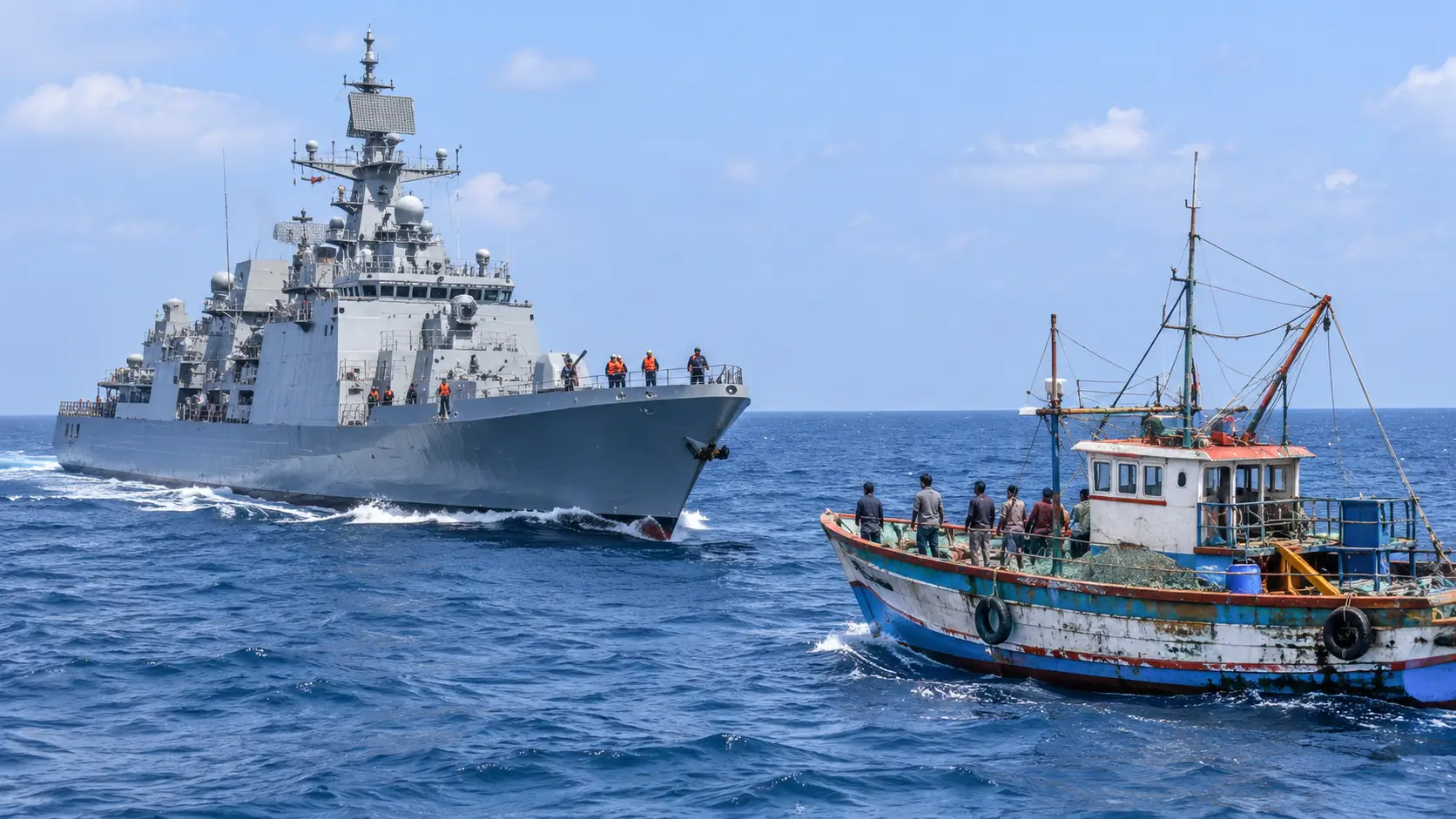
The rescue of an Iranian fishing vessel off Somalia was more than a successful anti-piracy mission. It showcased India’s expanding ability to project military power, counter maritime threats and meet its humanitarian obligations well beyond its own waters.
On 29 October 2026, Somali pirates seized the Iranian fishing vessel F.V. Azini off Somalia’s northeastern coast. Initially, the hijacking seemed like another familiar episode of piracy in the western Indian Ocean. The response that followed was anything but routine. More than 6,000 kilometres from Mumbai, the Indian Navy launched a complex operation involving a warship, a maritime reconnaissance aircraft, Marine Commandos (MARCOS) and an Indian Air Force C-17 Globemaster III strategic transport aircraft. After more than 48 hours, all 20 crew members were rescued, the Indian Ministry of Defence said.1
Why send advanced military assets thousands of kilometres from India’s coast to retrieve a foreign fishing vessel? The answer lies less in the vessel’s economic worth than in its possible value to organised maritime criminal networks.
The mission brought together preventive maritime security, long-range military reach, coordination across the armed services and humanitarian duty. Taken together, these capabilities illustrate the emerging shape of India’s blue-water naval power.
For Somali pirates, fishing vessels may be useful for far more than their immediate economic value. They can be turned into floating operational bases, often called motherships. Stocked with supplies and weapons and carrying smaller assault craft, these vessels allow pirate groups to operate far beyond coastal waters.
The International Maritime Bureau (IMB) has repeatedly warned that pirate groups armed with automatic weapons and rocket-propelled grenades use hijacked fishing boats and traditional dhows as motherships. In November 2025, the Malta-flagged tanker Hellas Aphrodite came under attack about 560 nautical miles off Somalia, underscoring the far-reaching offshore capabilities of these criminal networks.2
Significantly, the European Union’s Maritime Security Centre Indian Ocean had warned that the hijacked Azini was nearing a commercial shipping lane and could serve as a launch platform for further pirate attacks.3
India’s intervention, therefore, was more than a hostage-rescue mission. It was a preventive maritime security operation designed to disrupt a possible sequence of future hijackings. Neutralising a pirate mothership before it is fully operational can avert multiple attacks, safeguard commercial shipping and weaken piracy’s economic incentives. The sophistication of the Azini operation becomes clear when viewed through three interconnected operational dimensions.
The Indian warship was already deployed in the region. With support from maritime reconnaissance aircraft, it located and monitored the hijacked vessel before moving to intervene. The operation reflects India’s shift from reactive coastal defence to persistent, intelligence-led maritime security.
A blue-water navy is defined by more than aircraft carriers, nuclear submarines or guided-missile destroyers. Its effectiveness also rests on the ability to maintain awareness across vast maritime spaces, detect emerging threats and act before they escalate.
India’s Information Fusion Centre–Indian Ocean Region (IFC-IOR), established in Gurugram in December 2018, provides an institutional base for maritime information-sharing and international security cooperation.4
The Indian Navy initially used non-kinetic measures to restrict the hijacked vessel’s movement and prevent its escape. Rather than immediately deploying overwhelming firepower, the operation emphasised containment, measured escalation and the safety of hostages.
Counter-piracy missions are especially complex because criminals and innocent civilians share the same operational space. Indiscriminate military action could transform a rescue operation into a humanitarian disaster.
The capacity to exercise restraint while retaining credible coercive superiority sets a professional navy apart from one that depends chiefly on firepower. Military strength is shown not only by the ability to use lethal force, but also by the judgement to recognise when it is unnecessary.
During the night of 1-2 November, an Indian Air Force C-17 Globemaster III flew a long-range mission to deliver MARCOS personnel and specialised tactical equipment to the operational theatre. The flight covered more than 6,000 kilometres and lasted over eight hours. The Ministry of Defence said the deployment location had to be adjusted during the mission, adding substantially to its complexity.5
An operation of this kind demands precise navigation, real-time intelligence, integrated communications, specialised training and close coordination between naval and air force assets. It places India among the militaries able to conduct complex expeditionary missions well beyond their immediate neighbourhood.
The Azini operation was no isolated display of Indian naval capability. On 16 March 2024, the Indian Navy completed a complex anti-piracy mission to free the Malta-flagged merchant vessel M.V. Ruen, which had been hijacked. The operation took place about 2,600 kilometres from mainland India and involved INS Kolkata, INS Subhadra, remotely piloted aircraft, P-8I maritime reconnaissance aircraft and MARCOS personnel inserted by C-17 airdrop. After more than 40 hours of sustained action, 35 Somali pirates surrendered, while all 17 crew members still aboard were rescued unharmed.6
Just two weeks later, on 29 March 2024, INS Sumedha and INS Trishul rescued 23 Pakistani fishermen from the hijacked Iranian fishing vessel Al Kambar 786. After more than 12 hours of sustained tactical pressure, nine suspected pirates surrendered. They were later taken to India to face legal proceedings.7
The fishermen’s nationality gives the rescue particular significance. Even amid geopolitical hostility between India and Pakistan, humanitarian duties were not allowed to yield to bilateral political antagonisms. For a responsible maritime power, a seafarer’s nationality cannot determine the worth of his life. The significance of India’s naval presence must also be viewed in light of Somali piracy’s resurgence.
The IMB’s October 2026 assessment recorded a decline in global piracy and armed-robbery incidents, from 116 in January-September 2025 to 51 in the same period in 2026. Yet Somali pirates were responsible for eight vessel hijackings and 94 per cent of the seafarers taken hostage worldwide during those nine months.8
This concentration of piracy threatens maritime trade, energy transport, insurance costs and global supply chains. India’s response reflects its self-declared role as a net security provider, first responder and preferred partner in the Indian Ocean Region. It also advances the country’s wider maritime vision, set out through SAGAR and later MAHASAGAR.9
Such action is grounded in international law. Article 100 of the United Nations Convention on the Law of the Sea requires states to cooperate in suppressing piracy, while Article 105 provides the legal basis for seizing pirate vessels on the high seas.10
Yet naval intervention alone cannot eliminate piracy for good. Lasting maritime security depends on international cooperation, more effective coastal governance, intelligence-sharing and stronger institutions in vulnerable littoral states. The Azini operation’s deeper significance lies in India’s ability to pair hard power with the tools of soft power.
Projecting military force thousands of kilometres from home demonstrates operational reach. Using that capability to safeguard foreign seafarers and international commerce builds strategic goodwill and strengthens India’s standing as a responsible maritime power.
India is increasingly showing that leadership in the Indian Ocean need not rest on territorial ambition or coercive dominance. It can also be earned by providing security, demonstrating operational reliability and respecting human life.
A fishing vessel recovered, twenty lives protected and a potential threat to international shipping neutralised — through intelligence, precision, restraint and professionalism. This is the quiet assertion of maritime power, and perhaps the clearest expression of blue-water professionalism.
References
- https://www.pib.gov.in/PressReleaseIframePage.aspx?PRID=2331872&lang=2®=48&utm
- https://icc-ccs.org/piracy-and-armed-robbery-prone-areas-and-warnings
- https://mscio.eu/alerts/197?utm
- https://ifcior.indiannavy.gov.in/about_us?utm
- https://www.pib.gov.in/PressReleaseIframePage.aspx?PRID=2332387&lang=2®=48&utm
- https://iccwbo.org/news-publications/news/maritime-piracy-incidents-remain-at-historic-lows-despite-somali-piracy-concerns
- https://www.reuters.com/world/indian-navy-rescues-iranian-fishing-vessel-hijacked-by-pirates-2024-03-30/
- https://iccwbo.org/news-publications/news/maritime-piracy-incidents-remain-at-historic-lows-despite-somali-piracy-concerns/
- https://www.pib.gov.in/PressReleasePage.aspx?PRID=2114491&lang=2&re®=48
- https://www.un.org/depts/los/piracy/piracy_legal_framework.htm