News Desk
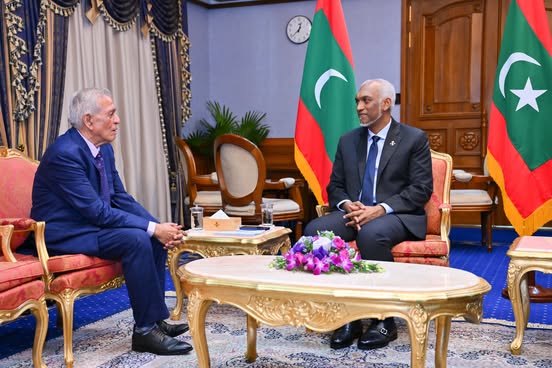
President Dr Mohamed Muizzu met with Professor K. K. Aggarwal, President of the South Asian University (SAU), at the President’s Office on Monday to discuss expanding higher education opportunities and institutional partnerships between the Maldives and the regional university.
According to the President’s Office, the courtesy call focused on collaborative programmes in areas of mutual priority, particularly public health and climate change, alongside efforts to strengthen academic ties between SAU and Maldivian higher education institutions to broaden pathways for young people.
Yet behind the diplomatic pledges lies a quieter reality: nearly two decades after its conception, an institution co-founded and financially supported by the Maldives remains largely absent from the country’s higher education landscape—and from the broader regional conversation.
Established by the eight member states of the South Asian Association for Regional Cooperation (SAARC), South Asian University was conceived at the 13th SAARC Summit in Dhaka in November 2005, with its founding intergovernmental agreement signed in April 2007. As a founding member, the Maldives participated in the early institutional groundwork, including the selection of the 100-acre campus site in Maidan Garhi, South Delhi, and has maintained an assessed annual financial contribution toward the university’s operational budget under the SAARC cost-sharing formula.
Unlike SAARC’s capital expenditure—which was borne primarily by the host government of India—recurring operational costs are divided among all eight member nations according to an agreed scale, under which the Maldives contributes a fixed percentage share alongside Bhutan.
Despite this sustained financial commitment and a formal quota system reserving seats for students from all member states, SAU’s footprint in the Maldives has remained minimal since the university began academic operations in 2010. While Maldivian students have occasionally enrolled in postgraduate and doctoral programmes in New Delhi, the institution has neither established a visible alumni network in Malé nor emerged as a primary destination for Maldivian scholars, who continue to look predominantly toward Britain, Australia, Malaysia, and bilateral Indian scholarship schemes such as the Indian Council for Cultural Relations (ICCR).
The contrast with other regional and intergovernmental universities is stark. Institutions such as the University of the South Pacific (USP)—which serves 12 Pacific island nations through a network of regional campuses and distance-learning centres—or the International Islamic Universities in Malaysia (IIUM) and Islamabad (IIUI), which have trained thousands of Maldivian graduates and public servants over the decades, have built deep, tangible human-resource pipelines across borders.
SAU, by comparison, has struggled to generate comparable regional momentum. Operating solely from its New Delhi campus and constrained for years by construction delays, administrative bottlenecks, and the broader diplomatic paralysis affecting SAARC since 2016, the university has had limited visibility across member states. Even with the recent introduction of virtual programmes aimed at widening access, its academic and research footprint outside India remains modest.
For the Maldives, Monday’s discussions signal an attempt to extract more practical value from a longstanding regional commitment—particularly in climate science and health, where domestic capacity needs are acute. Whether renewed high-level engagement can translate into meaningful enrolment and institutional collaboration, however, remains an open question.