News Desk

The Maldives National Association of Construction Industry (MNACI) Yearbook 2026 shows construction activity picking up in volume this year, even as output remains below pre-pandemic levels and contractors contend with steep material costs, delayed payments, and permit bottlenecks.
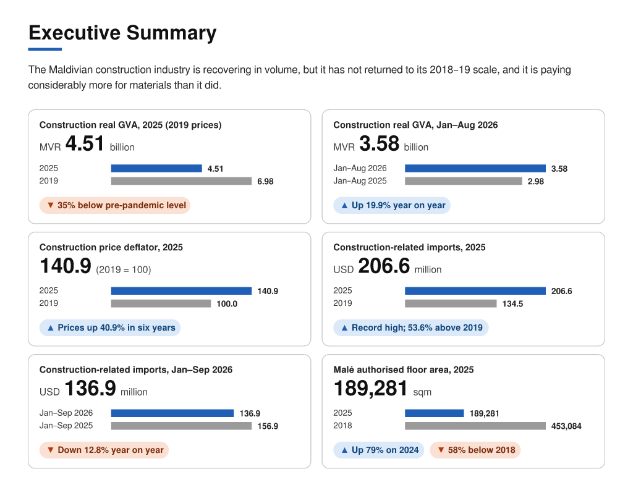
Published to mark MNACI’s 25th anniversary and compiled from Maldives Monetary Authority (MMA), Maldives Bureau of Statistics (MBS), Maldives Customs Service, and Malé City Council figures alongside MNACI estimates, the report notes that real construction gross value added (GVA) in constant 2019 prices reached MVR 4.51 billion in 2025—up 4.4% from the previous year but still roughly 35% below the MVR 6.98 billion peak recorded in 2018 and 2019.
During the first eight months of 2026, real construction GVA totalled MVR 3.58 billion, or an average of MVR 447 million a month, up 19.9% compared with the same period of 2025 and hitting a post-pandemic monthly high of MVR 539 million in July. Second-quarter 2026 output climbed to around MVR 1.39 billion after four years largely stuck between MVR 1.0 billion and MVR 1.2 billion, though the 2026 monthly average still trails 2019’s MVR 582 million average by 23%.
At the same time, the construction price deflator (2019 = 100) rose to 140.9 in 2025—up 40.9% over six years, or about 5.9% compounded annually—putting illustrative nominal output in 2025 at roughly MVR 6.35 billion (about 91% of 2019’s MVR 6.98 billion).
As MNACI President Mohamed Ali Janah writes in his message in the yearbook, contractors are doing about a third less physical work for nearly the same money, squeezing margins on fixed-price contracts.
Construction-related imports hit a record USD 206.6 million in 2025, up 32.9% year on year and 53.6% above 2019’s USD 134.5 million, following a step-up in monthly arrivals from an average of about USD 10.1 million in January–July 2024 to roughly USD 16.5 million between August 2024 and September 2026. In January–September 2026, however, imports dipped 12.8% year on year to USD 136.9 million even as output rose, which the yearbook suggests could reflect drawing down stocks imported in 2025 or less material-intensive project phases.
MMA data for Other Depository Corporations shows outstanding loans and advances to the private construction sector at about MVR 9.95 billion, alongside more than MVR 862 million in construction loans to public non-financial corporations.
Janah notes that government-backed housing support—including “Help to Build” grants of up to MVR 200,000, “Help to Buy” grants of up to MVR 250,000, and housing and construction loans capped at 5% interest through Bank of Maldives, Maldives Islamic Bank, HDFC, and Maldives Finance and Leasing Company (MFLC)—has helped ease equity hurdles and inject liquidity, though the yearbook points out that land limits in Malé mean volume gains are more likely in Hulhumalé and the atolls.
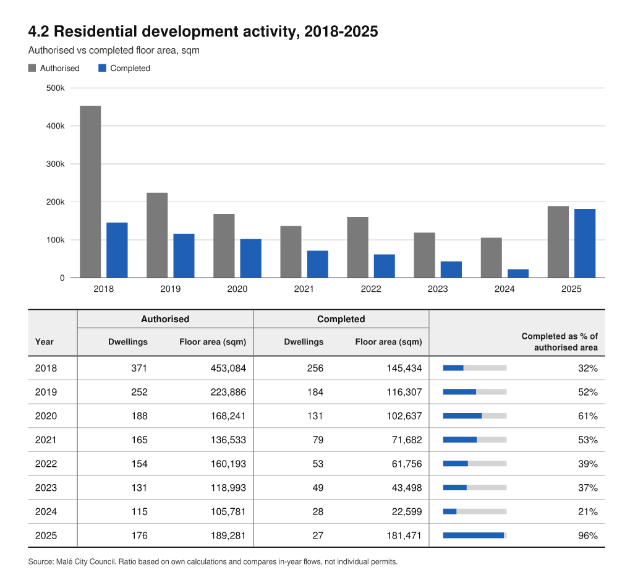
In Malé City, authorised floor area rebounded 79% in 2025 to 189,281 square metres after falling 77% between 2018 (453,084 square metres) and 2024 (105,781 square metres), while remaining 58% below 2018. Non-residential floor area accounted for 47% of authorised space in 2025, up from 26% in 2019, and completed floor area reached 181,471 square metres even though completed dwellings stayed low at 27 units compared with 256 in 2018, pointing to larger, higher-density builds.
The yearbook also flags foundation dewatering rules under Utility Regulatory Authority Regulation No. 2021/R-20 as a costly friction point, with daily permit fees starting at MVR 500 for an initial permit and rising to MVR 1,000, MVR 1,500, MVR 2,000, and MVR 4,000 or more across extensions—meaning 30 extra days of dewatering costs MVR 15,000 at the base rate, MVR 60,000 at the third extension, and MVR 120,000 at MVR 4,000 a day before pumping, fuel, labour, or long discharge pipe runs are factored in.
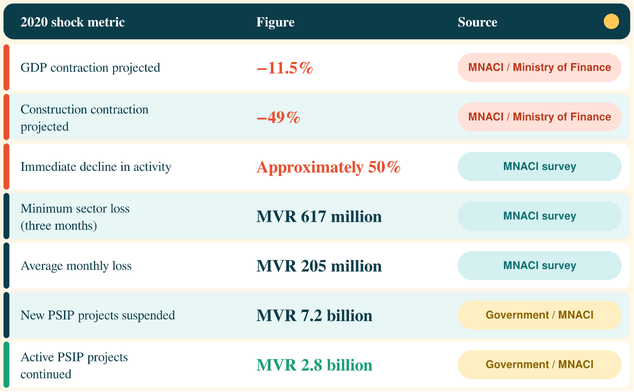
MNACI’s 2020 industry impact report estimated direct sector employment at 5,000 to 7,000 Maldivians and 40,000 to 50,000 expatriates—mostly from Bangladesh, India, Sri Lanka, and Nepal—within a foreign workforce exceeding 150,000 nationwide (including more than 50,000 irregular workers), while underlining MNACI’s zero-tolerance stance against human trafficking and its push for worker regularisation, humane housing, and updating its voluntary 2010 site health and safety guide with post-pandemic Health Protection Agency protocols.
To read or download the MNACI Yearbook 2026, click here.