News Desk
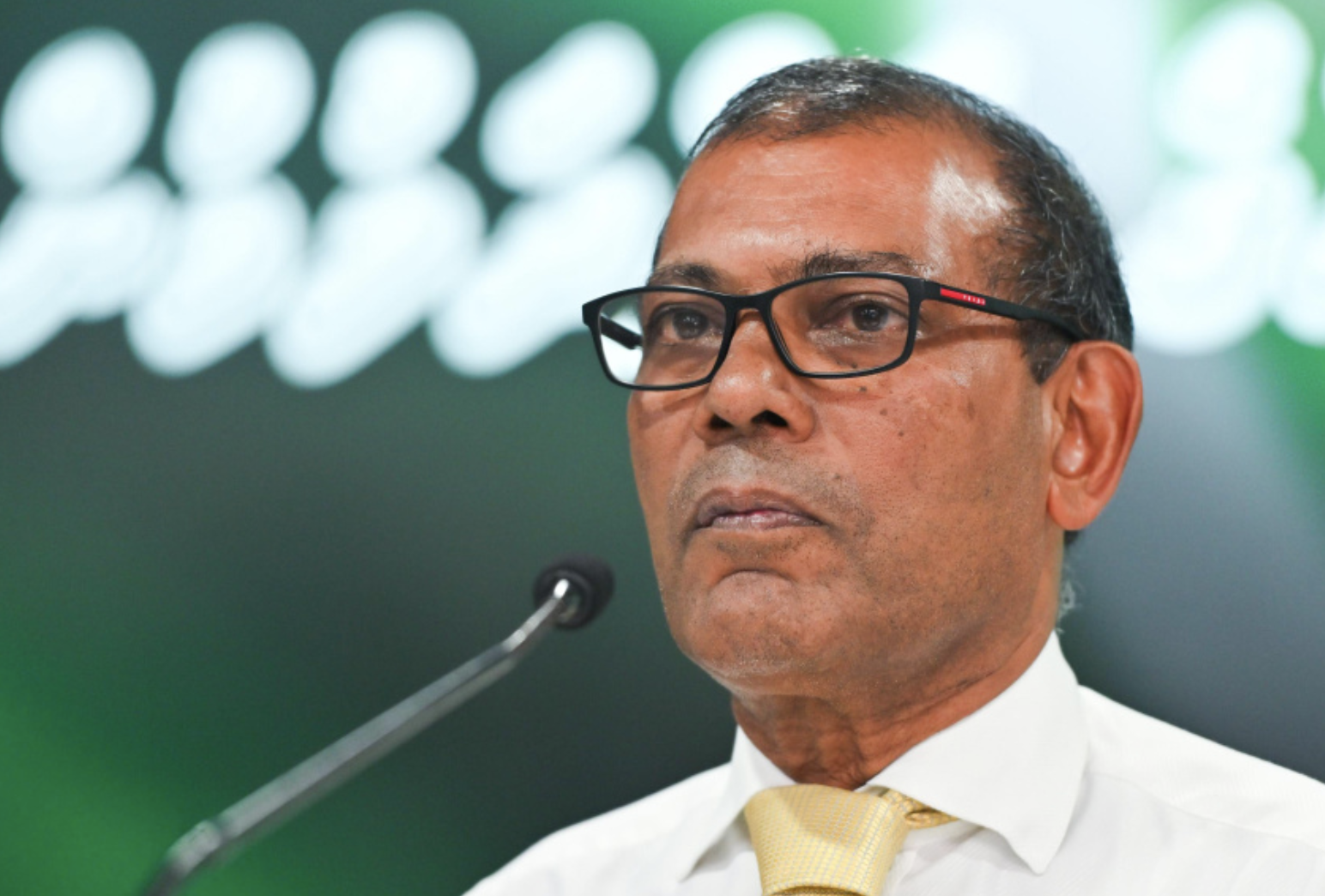
Mohamed Nasheed stood before his party’s protest on Thursday night and called the GMR airport deal a mistake made without asking the people. He did not mention — and few needed reminding — that when his own party tried to put the Rasmalé deal to a referendum, he was the only one in the room who said no.
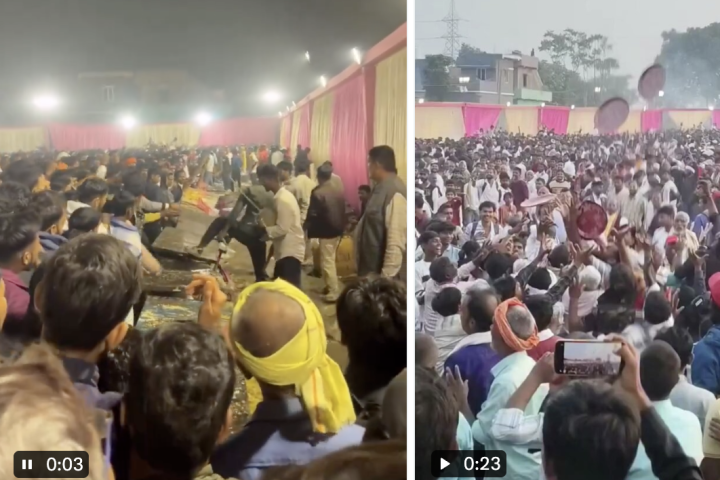
There is a particular kind of politics that only Mohamed Nasheed can perform: repentance for a sin the audience watched him commit. On Thursday night, at an MDP protest titled “Ahaabala“, the party’s chairperson and former president stood before the crowd and delivered a lesson in consultation.
Handing the country’s main airport to India’s GMR in 2010 without asking the public was a mistake, he said. A mistake, he said twice, in case the first one landed softly. “I am saying today that was a mistake. That was a mistake. With that experience, I have come here. We know we cannot get success by doing something without asking the people. The people of the whole Maldives must get behind anything. Those people must know.”
He was there to demand a referendum before the government signs the Rasmalé project — the 500 hectares of publicly reclaimed land at Fushidhiggarufalhu earmarked for Eagle Hills, the Abu Dhabi developer founded by Mohamed Alabbar, the man behind the Burj Khalifa. Under the reported terms, Eagle Hills takes the land on 99-year leases without paying an acquisition fee or rent; the state’s compensation is 5,000 housing units in Hulhumalé, worth roughly half a billion dollars, recovered from the state’s own share of project revenue. President Muizzu has already ruled out a public vote. The Real Estate Bill underpinning the deal sits in committee, where his party holds a supermajority.
It is, by any measure, a fine speech. Here is what it leaves out.
When a referendum resolution came before the MDP’s National Council — proposed by the party’s own Kolamaafushi councillor, urging the government to delay signing until the people were asked — Nasheed rose and said: “I completely back this initiative.”
He was the sole member of the council to oppose the resolution. He told the room that Maldivians were descended from people who arrived from elsewhere, and offered a parable about three vessels that reached the country three centuries ago, one halting at Hoarafushi, and what a century of opportunity might look like. While his party’s former chairperson Fayyaz Ismail and former president Ibrahim Mohamed Solih backed the referendum, Nasheed backed the deal. He had supported it, by his own colleagues’ account, since the day it was announced — through the #EagleHillsOut campaigns, through the lawmakers who denounced Alabbar in Parliament, through the warnings that the lease structure quietly outflanks the constitutional limit on foreign land control. Indeed, when his own MPs attacked Alabbar in the Majlis, Nasheed’s concern was that the attacks could jeopardise investment from the UAE.
He did temper his support at a later media briefing — the project was good, he said, but the government must seek the public’s consent first, and proceeding without a referendum “could cause enormous harm to our country”. Even then, he warned his own party against talking of cancellation: “It would also cause significant harm to the Maldives state.” What has changed between that caution and Thursday night’s podium is not the deal itself. The deal is the same 500 hectares it was when he endorsed it. What has changed is the room he is standing in.
That pattern does not stop at Rasmalé. Consider Henley & Partners, the London-based firm that advises governments on selling residence and citizenship to the wealthy, and that designed the Maldives’ “Pearl Residency” golden visa programme.
Nasheed’s party submitted a formal motion to Parliament seeking to halt the scheme, citing procedural flaws and risks to national security and fiscal sovereignty. Nasheed went the other way, writing on X that the programme would be “exceptionally beneficial to the Maldives” — an expanding frontier, he said, for the nation’s core tourism business. The firm, for its part, honoured him with its 2024 Global Citizen Award: a sculptural medal, a 20,000-dollar prize and a year of the firm’s global network, handed over at its own investment-migration conference in Singapore.
Claims that circulate on social media that Nasheed has been paid by Henley & Partners have never been substantiated, and it would be wrong to state them as fact. What the record shows is narrower, and honestly, enough: a man whose party fought the investor-residency scheme while its chairperson publicly blessed it, and who is now the country’s loudest voice against signing away land without a mandate.
None of this means the argument he made on Thursday is wrong. It may be entirely right. The GMR saga is the most expensive teacher the Maldives has ever hired: a 25-year lease signed in 2010, protests, cancellation under President Waheed, arbitration, and a 271-million-dollar bill — 4.1 billion rufiyaa — paid by the state under Yameen.
If Rasmalé proceeds without a referendum and ends the same way, Nasheed will have been proved right, which is a thing he is good at. Nasheed has also spent recent weeks visiting more than a hundred islands, and what he reports is real: school grades closing as people drift towards Malé, atolls emptying, residency projects crowding into the capital’s edge while the north and south stand half-full.
But the country has heard this voice before, and it is entitled to ask which Nasheed will show up. The one who endorses the deal in the council chamber, or the one who finds his voice against it under the protest lights.
The GMR controversy never dies. And neither, it seems, does Nasheed’s instinct to arrive at the scene of the argument — after the signature, after the endorsement, after the mistake — holding the lesson.