 News Desk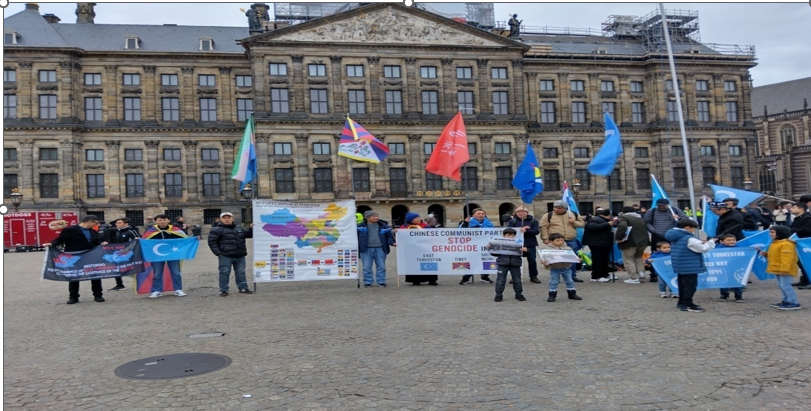
The Uyghur community in Netherlands gathered this week, on 16th Nov, at Dam Square, Amsterdam to mark East Turkistan Republic Day including Tibetans, Southern Mongolians, Hong Kongers and Members of the Federation of Chinese Overseas Democracy and called for restoration of independence of East Turkistan and stop genocide in East Turkistan, Tibet and South Mongolia.
The plight of the Uyghur Muslims in China’s Xinjiang region has become one of the most pressing human rights issues of our time. For decades, the Chinese Communist Party (CCP) has pursued policies of repression, surveillance, and cultural erasure against the Uyghurs and other Turkic minorities. What was once a relatively underreported crisis has now gained significant traction in global media, with Uyghur diaspora groups and human rights organizations ensuring that their voices are heard. As the world prepares to mark East Turkistan Republic Day on 12 November 2025, the spotlight on the Uyghur struggle is sharper than ever.
The CCP’s campaign in Xinjiang is widely described as a genocide by international observers. Reports from human rights organizations and leaked documents reveal a network of “re-education camps” where Uyghurs are detained without trial. Inside these facilities, detainees face indoctrination, forced labour, and abuse. The CCP frames these camps as “vocational training centres,” but testimonies from survivors paint a grim picture of coercion and brutality.
Beyond the camps, the CCP has implemented mass surveillance systems across Xinjiang, using facial recognition, biometric data, and AI-driven monitoring to track Uyghur movements. Religious practices are heavily restricted: mosques are demolished, Qurans confiscated, and fasting during Ramadan is discouraged or punished. Uyghur culture itself is under siege, with bans on language instruction and suppression of traditional music, literature, and art.
Perhaps most chilling is the evidence of forced sterilizations and birth control policies aimed at reducing Uyghur population growth. These measures, combined with family separations and the placement of Uyghur children into state-run boarding schools, amount to a deliberate attempt to dismantle Uyghur identity.
For years, the CCP attempted to suppress information about its policies in Xinjiang, controlling domestic media and spreading propaganda abroad. However, Uyghur activists and diaspora groups have successfully leveraged international media platforms to expose the atrocities. Organizations like the World Uyghur Congress and the Campaign for Uyghurs have coordinated global campaigns, ensuring that the issue remains in headlines.
In 2025, Uyghur advocacy reached new heights. The Uyghur Genocide Accountability and Sanctions Act of 2025, introduced in the U.S. Congress, expanded sanctions against CCP officials and restricted imports linked to forced labour. This legislative push was widely covered by international outlets, amplifying Uyghur voices and pressuring governments to act.
Media coverage has also highlighted the CCP’s propaganda machine. Reports show how Chinese state media carefully crafts narratives to glorify the Party while whitewashing atrocities. Yet, the rise of independent journalism and diaspora-led outlets like Uyghur Times has countered these narratives, offering firsthand accounts and investigative reporting that resonate globally.
Uyghur communities in exile spread across Turkey, Europe, North America, and Central Asia play a crucial role in keeping the issue alive. They organize commemorations, cultural festivals, and advocacy campaigns that attract media coverage. Events marking East Turkistan Republic Day, for example, serve both as cultural revival and political protest. By showcasing Uyghur music, poetry, and traditions, these communities remind the world of what is at stake: the survival of entire population’s identity.
Diaspora activists also engage with policymakers, NGOs, and journalists, ensuring that the Uyghur cause remains visible. Their lobbying has led to stronger sanctions, boycotts of goods linked to forced labour, and increased scrutiny of China’s trade practices.
The growing media attention has translated into tangible political consequences. Countries are increasingly willing to confront China over its treatment of Uyghurs, despite the risk of economic retaliation. The U.S. and EU have imposed sanctions and trade restrictions, while other nations are investigating supply chains to ensure they are not complicit in forced labour.
This pushback has created new trade frictions. China, already facing global scrutiny for its dumping practices, now finds itself under pressure for human rights abuses. The intertwining of economic and ethical concerns means that the Uyghur issue is not just a humanitarian crisis, it is a geopolitical flashpoint.
The CCP continues to deny allegations of genocide, insisting that its policies in Xinjiang are aimed at combating extremism and promoting development. State media portrays Uyghurs as beneficiaries of modernization, while dismissing international criticism as politically motivated. However, the sheer volume of evidence- satellite imagery of camps, survivor testimonies, leaked documents has eroded the credibility of these claims.
The CCP’s reliance on propaganda underscores its fear of global media exposure. As Uyghur activists gain traction, Beijing intensifies its efforts to control the narrative, both domestically and abroad. Yet, the persistence of Uyghur voices ensures that the truth continues to break through.
The Uyghur struggle is not merely about survival, it is about preserving a culture, a religion, and a way of life under siege. The CCP’s atrocities in Xinjiang represent one of the gravest human rights crises of the 21st century. Yet, thanks to relentless advocacy and growing media attention, the Uyghur cause is no longer hidden in the shadows.
As East Turkistan Republic Day is commemorated in 2025, the world is reminded that the Uyghur fight for freedom is ongoing. The challenge now lies in translating awareness into sustained action ensuring that governments, institutions, and individuals hold the CCP accountable. The Uyghurs have succeeded in attracting global media attention; the next step is securing lasting justice.
Source :
https://uyghurtimes.com/u-s-lawmakers-introduce-landmark-uyghur-genocide-accountability-act/