News Desk
Relations between India and the Maldives have not always been linear. The three decades of Gayoom’s rule were marked by unusual stability, but the years that followed introduced sharp swings driven by democratic transitions, geopolitical competition and shifting domestic politics.
They have swung between strategic intimacy and political turbulence, shaped by geography, domestic politics and the shifting ambitions of larger powers in the Indian Ocean. Under President Dr. Mohamed Muizzu, the relationship entered one of its most volatile phases in decades, only to be pulled back from the brink through a mix of pragmatism, pressure and political necessity.
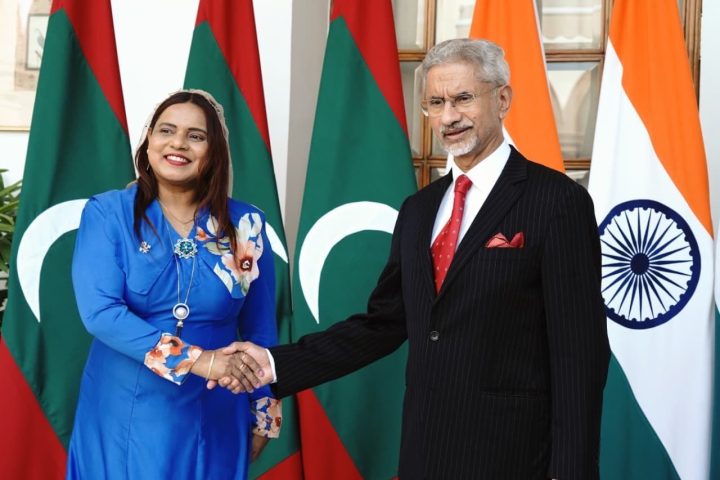
Prime Minister Narendra Modi’s 2025 state visit to Malé, was the first by a foreign leader after Muizzu took office, marked a turning point. The visit was choreographed with the kind of symbolism that both countries deploy when they want to signal a reset.
Velana International Airport was lined with Modi’s photographs and the Indian flag. Jumhooree Maidhaan was similarly decorated. The optics were unmistakable. The two governments wanted the public to see that the bitterness of the India Out campaign was being set aside.
The visit came after two years of strain. Muizzu rose to power on a platform that promised to remove Indian military personnel from the Maldives. His party’s India Out campaign had accused New Delhi of overreach and interference. The rhetoric was sharp enough to provoke diplomatic discomfort. A few Maldivian officials made remarks that strained the tone of the relationship. India responded with restraint but not indifference. It replaced its military personnel with civilian technicians in 2024, a concession that removed the most politically charged issue from the bilateral agenda.
The thaw accelerated in 2025. During Modi’s two day visit, the two sides signed four memorandums of understanding and three agreements. India announced a 565 million dollar line of credit for infrastructure and development projects. Negotiations on a free trade agreement were launched. Modi inaugurated a new Defence Ministry building constructed with Indian assistance. He also attended the Maldives sixtieth Independence Day celebrations as chief guest. These gestures were not merely ceremonial. They signalled that India was prepared to invest political capital in stabilizing the relationship.
Analysts in New Delhi and Malé described the moment as a recalibration rather than a reconciliation. A study published by the Observer Research Foundation in July 2025 noted that both sides had adopted a more pragmatic approach to each other, shaped by necessity and the realities of geography.
The Maldives had sought to diversify its partnerships by deepening ties with China and Turkey. India had responded by increasing development assistance and maintaining diplomatic engagement even during periods of public hostility.
Another analysis from the East Asia Forum argued that Modi’s visit reframed the narrative of India Maldives cooperation and placed the relationship on a more stable footing. The article emphasized that the Maldives continued to rely on India for security, maritime surveillance and emergency response. It also warned that Malé would need to balance its engagement with China carefully to avoid strategic overdependence.
President Muizzu’s own public messaging has shifted over time. In his speeches and interviews, including an op ed he wrote for the Guardian, he has emphasized sovereignty, economic diversification and a foreign policy that places Maldivian interests above those of any external partner. He has argued that the Maldives must not be trapped in the rivalries of larger powers. He has also insisted that the removal of Indian military personnel was a matter of principle rather than hostility. His tone has softened since Modi’s visit, but the core message remains consistent.
The Maldives will continue to engage India, but the terms of that engagement will be shaped by domestic necessities. A fragile economy, mounting debt repayments and the search for predictable external financing leave Malé with limited room for geopolitical experimentation. These constraints are likely to pull the government toward a more pragmatic relationship with India, regardless of the political language used at home.
As 2026 begins, the relationship stands at a delicate but promising juncture. India remains the Maldives most important security partner. It is also a critical source of food, medicine, construction materials and financial assistance. The Maldives, for its part, occupies a strategic position in the Indian Ocean that India cannot ignore. The two countries have agreed to explore a comprehensive economic and maritime security partnership, a framework that could anchor the relationship for the next decade.
Yet Malé is no longer calibrating its external ties with India alone in mind. The Muizzu administration has actively deepened its engagement with Turkey, including the acquisition of Bayraktar TB2 drones and the receipt of a missile capable fast attack vessel for the Maldivian Coast Guard. Maldivian personnel are training in Turkey as part of a broader defence cooperation framework, a move that signals an intention to diversify security partnerships and reduce exclusive reliance on India.
For New Delhi, this growing defence relationship with Ankara, a country whose own ties with India have deteriorated over Kashmir and its alignment with Pakistan, introduces a new layer of strategic uncertainty in the central Indian Ocean.
Pakistan sits in this picture less as an economic partner and more as an ideological and security reference point. Turkey’s closer alignment with Islamabad, including military cooperation and a shared language of Islamist solidarity, intersects with Muizzu’s own emphasis on Islamic identity and his outreach to a wider bloc of Muslim majority states.
Analysts have noted that his foreign policy has sought to foreground Islamic values and connectivity, even as the government courts Gulf and Southeast Asian partners for investment and political support.
A growing reliance on Turkish military technology, the quiet pull of Pakistan and a more assertive Islamic vocabulary in domestic politics could reinforce harder strands of political Islam in the Maldives. These currents may be used to justify strategic diversification and to argue for tighter control over how much space India occupies in Malé’s security and economic decision making.
At the same time, the constraints are structural. The Maldives remains heavily dependent on Indian supply chains, and it is burdened by rising debt and a fragile economy that cannot absorb sharp shocks.
This reality limits how far Muizzu can allow Turkish and Pakistani influence, or domestically mobilized political Islam, to pull the country away from India without incurring serious economic and diplomatic costs.
In practice, the likely outcome in 2026 is not a clean break, but a more crowded strategic landscape in which India remains the indispensable partner, while Turkey, Pakistan and a wider Islamic and Chinese orbit give Maldivian elites additional symbolic and tactical options. Whether that mix produces a stable balance or a more brittle and ideologized politics will depend on how Muizzu manages the tension between his Islamic nationalist Salaf base and the hard arithmetic of economic and security dependence.
Yet challenges remain. The Maldives continues to court Chinese investment for large scale infrastructure projects. Domestic politics in Malé remain polarized. Anti India sentiment has not disappeared. India is wary of being drawn into Maldivian political disputes. Both sides must navigate these tensions carefully.
The trajectory of the relationship in 2026 will depend on whether the political pragmatism of the past year can be sustained. If the agreements signed in 2025 translate into visible improvements in infrastructure, trade and public services, Muizzu will have an incentive to maintain stability with India. If domestic pressures intensify or if geopolitical competition in the Indian Ocean sharpens, the relationship could once again become a battleground for nationalist politics.
For now, the mood is cautiously optimistic. The choreography of Modi’s visit, the agreements signed and the public statements from both leaders suggest that the two countries have chosen engagement over estrangement. In a region where small shifts in political rhetoric can have outsized consequences, that choice matters.