News Desk
Male’, — In the pale early light of Friday morning, passersby on Buruzu Magu noticed something strange atop a warehouse roof — a young woman, motionless but alive, her body sprawled across the corrugated sheet.
Hours earlier, at 4:52 a.m., a sharp crash had echoed through the stairwell of a nearby nine-story building. Few knew then that it was the sound of her fall — through a fanlight on the upper terrace, landing on the roof below.
She would remain there unseen for nearly three hours until someone finally spotted her and called for help. The Maldives National Defence Force (MNDF) Fire and Rescue Service carried her down. She was conscious but gravely injured, the latest casualty of a night steeped in intoxication and confusion — and of a youth culture increasingly shadowed by drugs.
In the days since her fall last Friday, a series conflicting rumors, and a rare closed-door police briefing have painted a picture far more troubling than one tragic accident. Instead, the incident has come to symbolize the urgent, and largely unspoken, crisis of drug use among young people in this Islamic island nation—despite high-profile crackdowns, daily arrests, and even a government ban on vaping.
According to Police Inspector Mohammed Samih, the woman, along with a 21-year-old man, was caught on surveillance footage roaming barefoot through Buruzu Magu at around 4 a.m., visibly intoxicated. They entered a residential building through an unlocked door—one to which they had no ties. The pair, along with two other men, wandered up several floors, knocking on doors, engaging in sexual activity on the stairwell, and appearing disoriented.
Footage shows the woman, now wearing the man’s T-shirt, climbing up to the ninth floor. The man, by then naked, followed her minutes later. At exactly 4:52 a.m., a loud crash echoed through the stairwell. Police say the sound came from her fall—through a fanlight on a locked terrace—landing her on the warehouse roof below.
There were no cameras on the terrace itself, and while the circumstances of her fall remain partially obscured, police say they found no evidence of foul play. The man, distraught and searching for her after the noise, was later seen crying and asking strangers for help—before vanishing from the scene without alerting authorities.
It was not until 7:23 a.m. that people spotted her on the rooftop and alerted emergency services. The Maldives National Defence Force (MNDF) Fire and Rescue Service responded to the scene and carried her to safety. She was conscious but unable to move due to severe injuries. Authorities later confirmed that she had drugs in her system. The man also tested positive for cannabis, though his sample was taken the day after the incident.
What began as an isolated case quickly spiraled into a social media firestorm, rife with allegations of sexual assault and political interference—claims that police have firmly denied. In an unusually private briefing held in response to the online speculation, Inspector Samih clarified that there was no indication of rape, and no involvement of politically appointed figures among the group.
Still, key details remain conspicuously absent. While police confirmed that eight young people—three women and five men—gathered at a separate residence earlier that night, they declined to reveal what occurred there. Four individuals, including the injured woman and the man who accompanied her, later left for another house before arriving on Buruzu Magu.
Only the woman and the man have been publicly identified by age, a departure from usual police transparency. The remaining six individuals’ identities and involvement remain largely obscured. Two of the men who entered the Buruzu Magu residence with the pair refused to provide drug samples, which, under Maldivian law, cannot be taken without consent unless a person is visibly intoxicated.
Police searched the Buruzu Magu house and the man’s residence but said they saw no need to investigate the initial gathering place—despite the hours-long sequence of events that began there and extended until nearly sunrise.
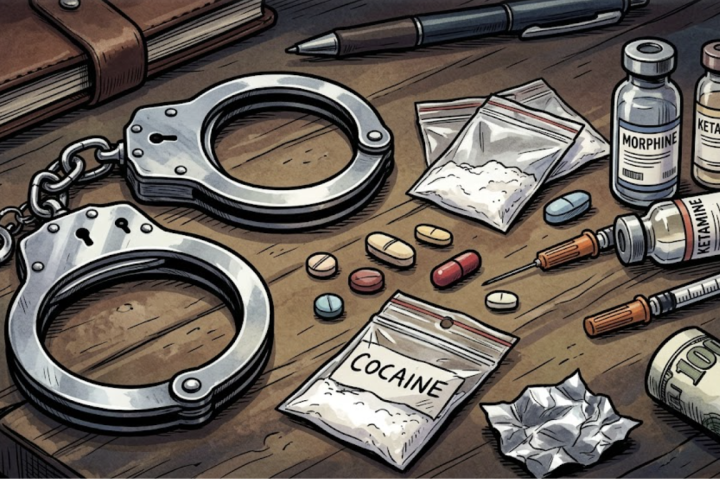
This tragedy is not an anomaly. The Maldives, a conservative Muslim nation, has in recent years contended with an increasingly visible drug problem, particularly among youth. While authorities make daily arrests linked to drug possession and trafficking, the widespread availability of narcotics—including cannabis and harder substances—suggests that enforcement alone may be insufficient.
The government’s ban on vaping, once hailed as a health initiative, now stands in sharp contrast to the growing normalization of drug use in certain circles. Community advocates argue that the crisis is no longer just a law enforcement issue but a social one—requiring interventions that reach beyond arrests and press briefings.
No arrests have yet been made. The man remains under a travel ban as police continue their investigation. The young woman, taken off a ventilator but still in critical condition, lies in a hospital ward—her fall now a grim symbol of how far and fast one can descend.
For a city where such incidents are often reduced to hashtags and headlines, this case has forced a deeper reckoning. Behind every police report and every CCTV frame lies a quieter truth: a generation in crisis, slipping through cracks much wider than a fanlight.