News Desk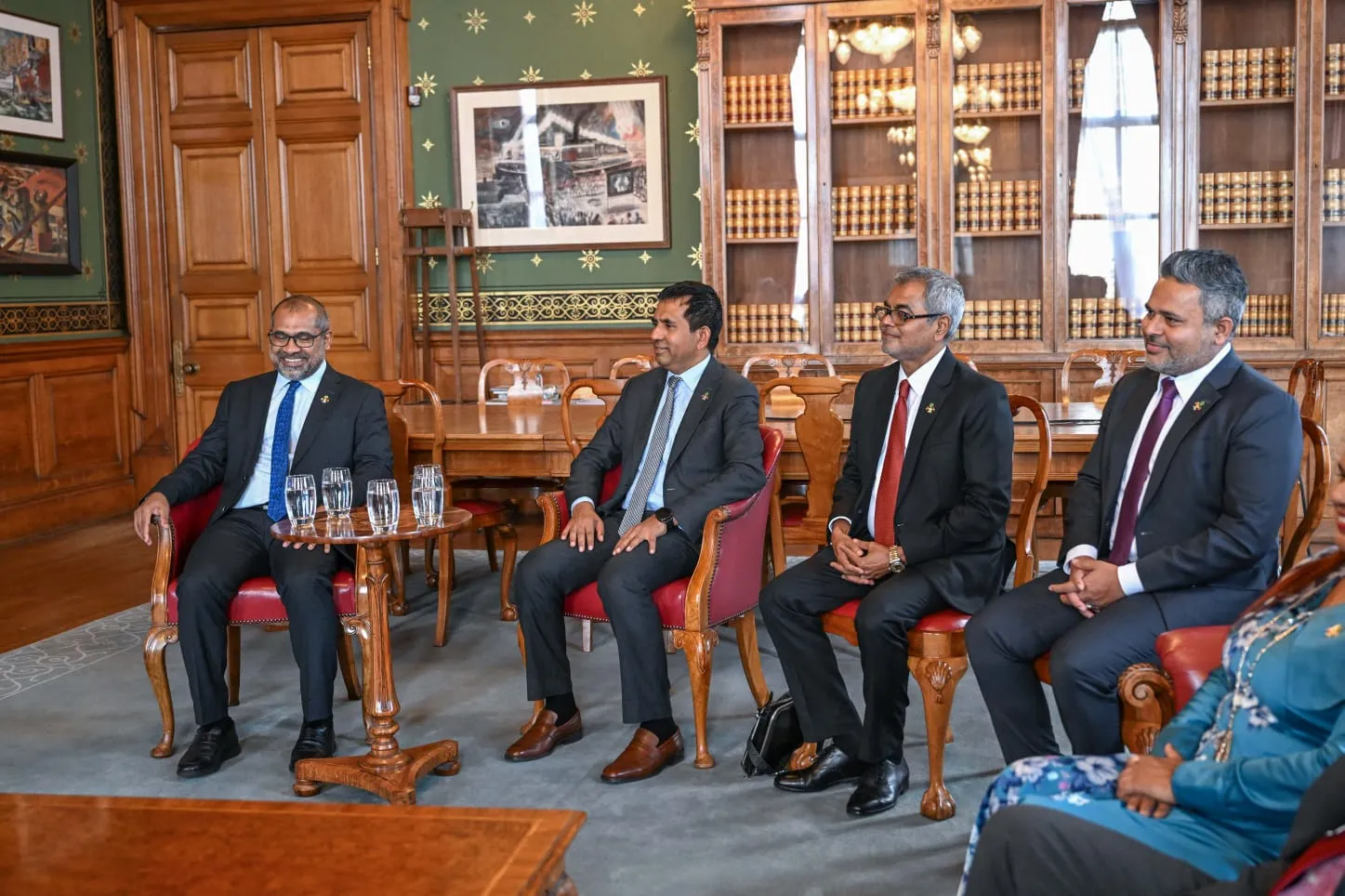
LONDON — Foreign Minister Dr. Abdulla Khaleel has publicly refuted claims that the Maldives relinquished its claim to the Chagos Archipelago, calling online media reports “misleading” and accusing the former Maldivian Democratic Party (MDP) government of secretly ceding rights to the territory in 2022.
While in the UK, Minister Khaleel posted on X in Dhivehi, targeting domestic audiences, to clarify remarks attributed to Maldives Ambassador to Belgium Geela Ali regarding the Chagos Archipelago during a recent European Parliament discussion.
Minister Khaleel’s comments come amid tensions over the sovereignty of the Chagos Archipelago, a strategically significant group of islands in the Indian Ocean that includes Diego Garcia, home to a critical U.S.-U.K. military base.
The Maldives’ claim to the Chagos, referred to locally as Foalhavahi, has stirred controversy both domestically and internationally, marking a rare territorial dispute for a nation known for its peaceful foreign policy.
According to Minister Khaleel, Ambassador Ali was questioned in the European Parliament about the U.S. military presence on Diego Garcia. Her response, he said, merely acknowledged the established U.S. base and highlighted the Maldives’ positive relations with the United States. “Contrary to some online media reports, the Ambassador did not say that Maldives had given up on Chagos,” Minister Khaleel wrote, dismissing the reports as inaccurate. He further alleged that the MDP government, led by former President Ibrahim Mohamed Solih, had secretly relinquished the Maldives’ claim to the Chagos in 2022 through a covert letter, bypassing public and parliamentary consent. “The people of Maldives cannot be deceived,” he added, framing the issue as a betrayal of national interests by the opposition.
The Chagos Archipelago has been at the center of a long-standing dispute between Mauritius and the United Kingdom, with the latter administering the islands as the British Indian Ocean Territory (BIOT) since 1965. The U.K. detached the Chagos from Mauritius before its independence in 1968, a move later deemed illegal by the International Court of Justice (ICJ) in 2019. The ICJ’s advisory opinion, supported by a United Nations General Assembly resolution, affirmed Mauritius’ sovereignty over the Chagos, prompting international pressure on the U.K. to cede control.
In May 2025, the U.K. signed a £101 million-a-year deal to transfer sovereignty to Mauritius while leasing back Diego Garcia for 99 years, ensuring continued U.S.-U.K. military operations.
The Maldives’ claim to the Chagos, based on purported historical and cultural ties that remain uncertain, complicates this arrangement. Former President Mohamed Nasheed and others have argued that the islands, share cultural connections with the Maldives, with some asserting a historical claim tied to Maldivian seafarers.
In 2023, the Maldives shifted its stance to recognize Mauritius’ sovereignty, a decision that sparked domestic criticism, particularly from opposition figures like Nasheed and former President Abdulla Yameen, who accused the Solih administration of compromising national interests.
President Dr. Mohamed Muizzu, who assumed office in November 2023, has made sovereignty a cornerstone of his administration. His government’s assertion of a claim to the Chagos, including a formal letter to the U.K. requesting sovereignty, has drawn attention as Britain and Mauritius finalize their treaty.
President Muizzu’s letter, sent in December 2024, argued that the Chagos have stronger ties to the Maldives than to Mauritius, citing historical records from Maldivian sultans. However, the details of this communication remain undisclosed, with the Maldivian president’s office rejecting a freedom of information request.
Domestic critics, including former Foreign Minister Abdulla Shahid, have accused President Muizzu of exploiting the issue for political gain, particularly after his 2023 election campaign emphasized national sovereignty and an “India Out” policy that strained relations with New Delhi.
The Chagos dispute also intersects with broader geopolitical rivalries in the Indian Ocean, where the Diego Garcia base plays a pivotal role in U.S. and U.K. security strategies. Mauritius’ agreement to allow continued U.S.-U.K. operations has been welcomed by Washington and London, but the Maldives’ claim introduces a new layer of complexity.
India, a close ally of Mauritius and a key partner of the Maldives, has supported the U.K.-Mauritius deal, describing it as a step toward decolonization. Meanwhile, President Muizzu’s foreign policy, including closer engagement with China, such as allowing a Chinese research vessel to dock in early 2024, has raised concerns about the Maldives’ regional alignment, particularly prompting unease in India.
For the Maldives, a nation of 1,200 coral islands with a population of 520,000, the Chagos issue represents a rare foray into international territorial disputes. The controversy has fueled domestic debates, with President Muizzu’s critics accusing him of inconsistency, given his recent acknowledgment that bilateral agreements with India pose “no serious concerns.”
As the Maldives navigates its economic challenges, President Muizzu’s government faces pressure to balance assertive foreign policy with diplomatic pragmatism. The Chagos issue remains unresolved, with the Maldives’ claim unlikely to ever alter the U.K.-Mauritius agreement. Yet, Minister Khaleel’s defense of the Maldives’ position and his accusations against the MDP highlight the issue’s potency in domestic politics, where narratives of sovereignty and national pride resonate deeply.