News Desk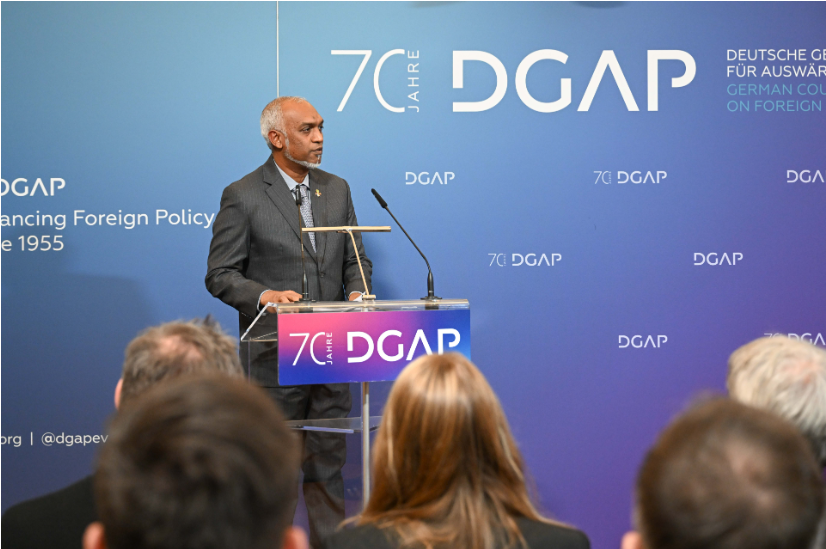
Berlin, — President Dr Mohamed Muizzu used a keynote address at the German Council on Foreign Relations to deliver a pointed message: the stability of the twenty‑first century will depend less on land borders and more on how the world governs the oceans. Speaking to diplomats, scholars and policymakers, he argued that the ocean is no longer a peripheral concern but the arena where climate, security, economics and international law converge.
“It is a great honour to address an institution that has helped shape strategic thinking in Germany and far beyond,” he said, praising DGAP’s long tradition of responsible foreign policy. For small states, he added, Germany’s commitment to multilateralism and international law is not an abstract ideal but “the foundation of our security. And, quite simply, of our survival.”
The President framed the Maldives as an ocean state in the fullest sense. “Our territory is overwhelmingly maritime. Our economy, our culture, and our history are inseparable from the sea,” he said. The country’s future, he argued, depends on how the international community chooses to govern the maritime domain.
He noted that foreign policy has historically been shaped by land, borders and armies, yet the strategic realities of the modern world tell a different story. More than 70 per cent of the Earth’s surface is ocean. Over 90 per cent of global trade moves by sea. Undersea cables carry the data that powers the global economy. The ocean regulates the climate and sustains biodiversity.
Despite this, he said, the ocean has been “underrepresented in strategic and diplomatic thinking” and treated as a sectoral issue rather than a core pillar of global governance.
Climate change, he warned, is already reshaping life in the Maldives. Rising sea levels, coral bleaching, saltwater intrusion and volatile weather patterns are no longer projections but daily realities. “Climate change is not only an environmental issue. It is a strategic and diplomatic issue. An economic issue. And a security issue,” he said.
For low‑lying island states, the consequences reach into questions of sovereignty and statehood. He praised Germany’s leadership in climate diplomacy but argued that the global challenge now is “delivery, not ambition”.
He outlined three shifts that he believes are essential for credible climate governance. First, the ocean must be placed at the centre of climate policy. Second, adaptation and resilience must be treated with the same urgency as mitigation. Third, loss and damage must be addressed as a matter of fairness and responsibility rather than charity.
“The fate of small island states will be one of the clearest tests of whether the global climate response is credible, equitable and morally grounded,” he said.
The President stressed that the rules‑based international order is most visibly tested at sea. Freedom of navigation, maritime boundaries, resource management and environmental protection all depend on respect for international law, particularly the United Nations Convention on the Law of the Sea.
“The Maldives strongly believes that international law is our strongest protection,” he said. It ensures that sovereignty is respected regardless of size or power and that disputes are resolved peacefully. He warned that selective interpretations of maritime law and unilateral actions threaten not only ocean governance but trust across the entire international system.
The Maldives sits at a strategic crossroads of global trade routes and energy flows. The Indian Ocean, he said, has become one of the most consequential regions of the century. His government’s vision is for an open and inclusive ocean governed by international law, free from coercion and excessive militarisation.
“Small states do not seek dominance. We seek balance. We do not seek confrontation. We seek stability and cooperation,” he said.
The President emphasised that the ocean is not only a space of risk but also of opportunity. Much of the ocean remain unexplored and requires science‑driven policy. Tourism, fisheries, renewable energy and marine services form the backbone of the Maldivian economy, but their future depends on responsible governance.
He warned that illegal fishing, marine pollution, biodiversity loss and climate stress threaten not only island economies but global food security. He argued that foreign policy, development cooperation and investment must align to protect the blue economy.
Germany’s strengths in sustainable maritime technologies, marine research, skills development and green finance, he said, align closely with Maldivian priorities. Partnerships in these areas are “strategic investments in resilience, stability and sustainability”.
He drew attention to a less visible dimension of ocean geopolitics: undersea cables. These cables carry the vast majority of global data traffic and are increasingly vulnerable to disruption. Protecting them requires international cooperation and shared norms.
“For a geographically dispersed country like the Maldives, digital connectivity is inseparable from maritime security,” he said. He noted that Germany’s digital and cybersecurity strategies offer scope for cooperation in shaping norms for the digital commons beneath the sea.
The President challenged the long‑standing assumption that small states simply absorb the rules set by larger powers. “Small states are often described as rule‑takers. In ocean diplomacy, that perception is changing,” he said. He argued that island nations are increasingly shaping global maritime norms, pushing for stronger climate ambition, enhanced marine protection and a more inclusive multilateral system. “In ocean diplomacy, small states are increasingly norm‑shapers, advocating ambitious climate action, stronger marine protection, and inclusive multilateralism,” he added, presenting the Maldives as a country whose strategic relevance is reinforced by principled positions and consistent advocacy.
He ended with a reminder that the ocean makes interdependence unavoidable. Pollution crosses borders. Emissions generated far away raise sea levels in the Maldives. Instability in one maritime region disrupts global trade. “Foreign policy in the twenty‑first century can no longer afford to treat the ocean as peripheral,” he said. “For the Maldives, an ocean‑centred foreign policy is existential. For the world, it is increasingly unavoidable.”
He called on Germany to play a leading role in shaping an ocean agenda grounded in cooperation, sustainability and shared responsibility. “How we govern the ocean will ultimately determine not only the future of small island nations, but the future of the international order itself.”
President Muizzu’s address at DGAP formed part of his official visit to Germany, during which he sought to broaden the Maldives’ diplomatic and economic partnerships.