News Desk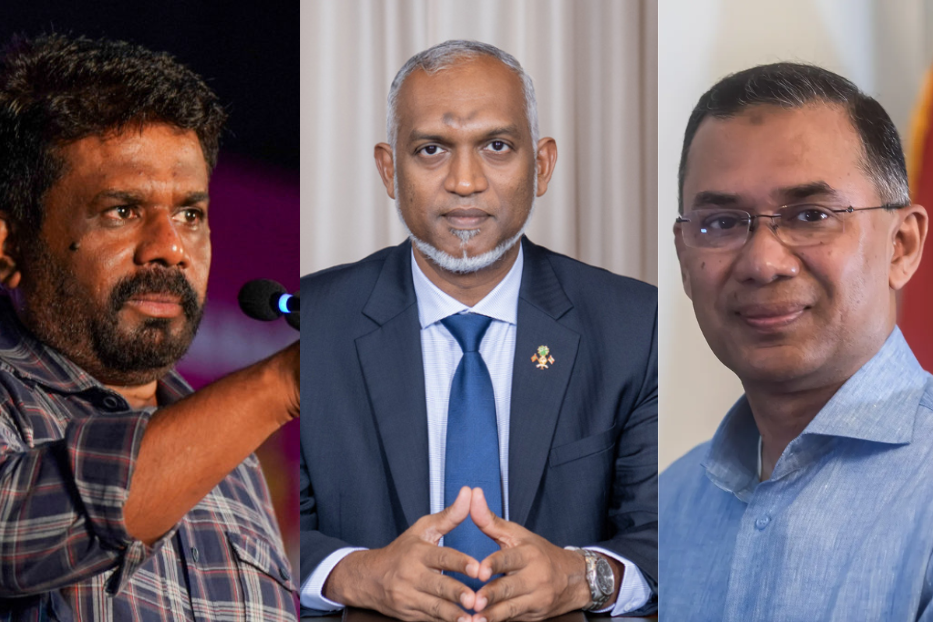
MALE’, Maldives — A friend of mine often says that a barber who has practised his profession for a long time will always follow the same style of haircut. Over the years, he might upgrade to brand-new tools, but his technique remains exactly the same.
In South Asia, politics works just like this. The “old school” guards are still using the same rhetoric and policy phrases—it is essentially a copy-paste of their last statement from decades ago. They might possess the latest gadgets, but their approach remains firmly rooted in the political traditions of the past.
But across the region, a new script is being written. A generation of leaders in their forties and fifties—the “Sovereign Outsiders”—are stepping onto the stage. From the Maldives to Bangladesh, these new faces are bold and they are refusing to follow the old manual. The giants of the region seem content to repeat themselves with ‘managed democracy,’ but this new generation is proving that South Asia is finished with that old manual.
From the presidential addresses of Dr Mohamed Muizzu in Malé to the landslide victory of Tarique Rahman’s BNP in Dhaka this week, the subcontinent is splitting into two distinct speeds. On one side are the old-school giants. They’ve been in charge so long that the whole system is built to keep them there, using the state machinery to crush any real competition.
Then you have the ‘New South Asia.’ These are smaller countries led by people who refuse to play the old games of backroom deals. They are driven by a belief in their own sovereignty and a ‘country-first’ agenda.
The common thread binding this new vanguard is a desire to move past the narratives—often used by opposition voices—that speak of “client state” dynamics. It’s a shift embodied in what might be called the “First” doctrine, most visibly in the Maldives, where President Muizzu’s “Maldives First” policy has moved from campaign slogan to structural reality. He has repositioned the Maldives not as a pawn in a regional chess match, but as a sovereign gatekeeper of the Indian Ocean, diversifying partners from Ankara to Beijing to ensure Malé’s voice is heard on its own terms.
In Bangladesh, the newly minted Prime Minister-designate Tarique Rahman has echoed this sentiment with his “Bangladesh First” platform. Emerging from nearly two decades of exile, Rahman has returned not just to reclaim a seat, but to oversee a “Gen Z-inspired” overhaul. His slogan—“Not Delhi, not Pindi, but Bangladesh first”—is a direct challenge to the old “Barber’s Logic” that suggested Dhaka must always sit in someone else’s shadow.
Even in Sri Lanka, the substance remains identical. President Anura Kumara Dissanayake’s programme of “System Change” is a manifesto of self-reliance. It was born from the ashes of a debt crisis that revealed how the old dynastic elites prioritised their debtors over the sovereign needs of their citizens.
The contrast with the region’s traditional powerhouses is stark. In India and Pakistan, the “managed democracy” model relies on the predictability of the long‑entrenched leadership. These are systems designed to absorb shock, where dissent is often filtered through state-aligned media and the stability of the status quo is valued above the unpredictability of reform.
Yet, in the smaller capitals, the “street” has become the new parliament. The engine behind this ‘New South Asia’ is the youth. In Bangladesh, 45 per cent of voters have no memory of the freedom war or the bitter rivalries of the past. They are tired of the old guard’s recycled speeches and are ready to move on to something that actually matters to their lives today.
For the Maldives, this regional shift is a validation. Today, President Muizzu finds himself part of a new wave of leaders who think the same way of digital reform, anti-corruption, and strategic autonomy. The new leadership in Dhaka and Colombo are already signalling a shift toward this Maldivian model.
Much like Muizzu’s push for tech‑driven governance, both Rahman’s BNP and Dissanayake’s administration are leaning heavily on digitisation as a way to cut through the old, corrupt bureaucracies that once kept power in the hands of a few. And by putting national interest ahead of regional friendships, these governments are forcing the larger players to deal with them on equal terms for the first time in years.
However, boldness are only the first step. The people of the Maldives, Sri Lanka, and Bangladesh have pinned extraordinarily high hopes on these three men. They have been given a mandate to lead at a time when the world is increasingly volatile and unpredictable, with unhinged politicians and geopolitical tensions hovering over the world like a storm.
At the end of the day, you can’t eat a slogan. This ‘New South Asia’ has to be about more than just clever branding and ‘country-first’ speeches. As Tarique Rahman prepares to take the oath in Dhaka, he, Muizzu, and Dissanayake face the same ultimate test: delivery!
In a global landscape that feels increasingly out of control, it is up to these leaders to translate their sovereign “First” doctrines into the tangible prosperity and social security that their subjects have so desperately pinned their hopes upon. For these sovereign outsiders, the talking is done. Now they actually have to show they can make it work.