News Desk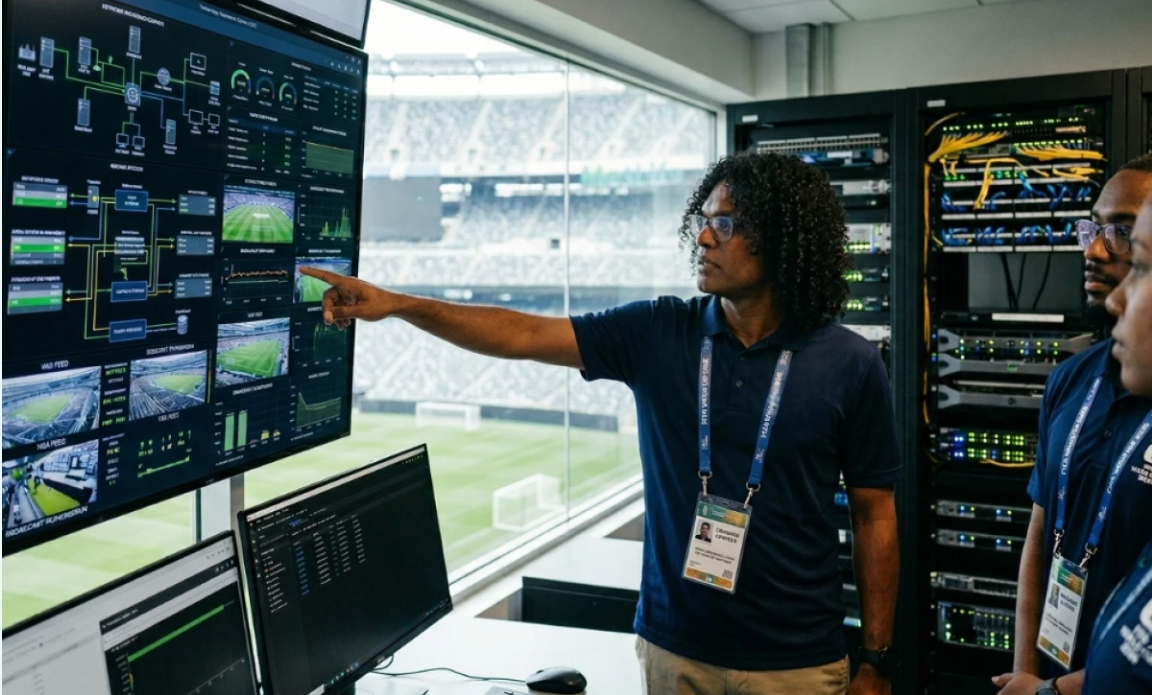
NEW YORK — Mohamed Shahin almost missed the biggest job of his life because he thought it was spam.
The email came in earlier this year, addressed to his New York firm Wit Solutions. FIFA. World Cup 2026. Lead Venue Technology Manager. He looked at it, figured it was one of those, and moved on. It was only after someone flagged it again that he picked up the phone to check. It was real.
“The ultimate goal for a technology manager in an event of this scale is invisibility,” Shahin told to local online Fiyes. “If the systems function perfectly and without interruption, the world simply enjoys the game, never realizing the massive technical effort required to make it happen.”
Shahin grew up in the Maldives. He is now based in New York, running a technology firm he founded, and this summer he is responsible for the digital infrastructure at several World Cup venues, including the stadium where the final is being played. That is MetLife Stadium in East Rutherford, New Jersey, which FIFA is calling the New York New Jersey Stadium for the tournament. It seats more than 82,500 people and is hosting eight matches, more than any other host city, with the final on July 19.
What that actually means in practice is this: every network, every communication system, every cable and server that keeps a stadium of 82,500 people connected and the match officials doing their jobs, that is his problem. VAR feeds, goal-line technology, broadcast communications, the lot. If something breaks on the night of the final, Shahin is the person who has to fix it while the world watches.
The numbers behind a modern World Cup venue are not small. Fans inside a single stadium are expected to use more than 50 terabytes of data per match, roughly the equivalent of streaming HD video for more than three years, all at once. Every person scanning a ticket, paying for a drink, posting a clip, or pulling up a replay is hitting the network at the same time. And that is before the officiating technology is factored in. This year FIFA is running upgraded semi-automated offside technology that uses AI to build 3D avatars of all 1,248 players across 48 teams, tracking their bodies in real time to deliver faster offside calls. None of it works without the network holding up.
The host stadiums have been fitted with serious infrastructure. Cisco has deployed Wi-Fi and data center systems at multiple venues, and Lenovo is running the servers behind FIFA’s Technology Command Center in Miami, which monitors operations across all 16 venues in real time. Verizon, the tournament’s official telecom partner, has installed thousands of under-seat antennas and pushed 5G capacity at host stadiums up by an estimated three to five times. Shahin’s job is to make sure all of that works together at venue level, on match day, when there is no room for it not to.
He has not said much publicly about how he got here. What is known is that he built Wit Solutions in New York and that FIFA found him credible enough to hand him responsibility for some of their most important venues at the biggest tournament in the sport’s history.
For people back home in the Maldives, a country of fewer than 500,000 people, that is not a small thing.
The tournament will kick off in Mexico City on June 11. The final is forty-five days away.
Wit Solutions is a New York-based IT firm. This story is based on information provided by Mohamed Shahin to Fiyes and verified through publicly available FIFA and tournament records.