News Desk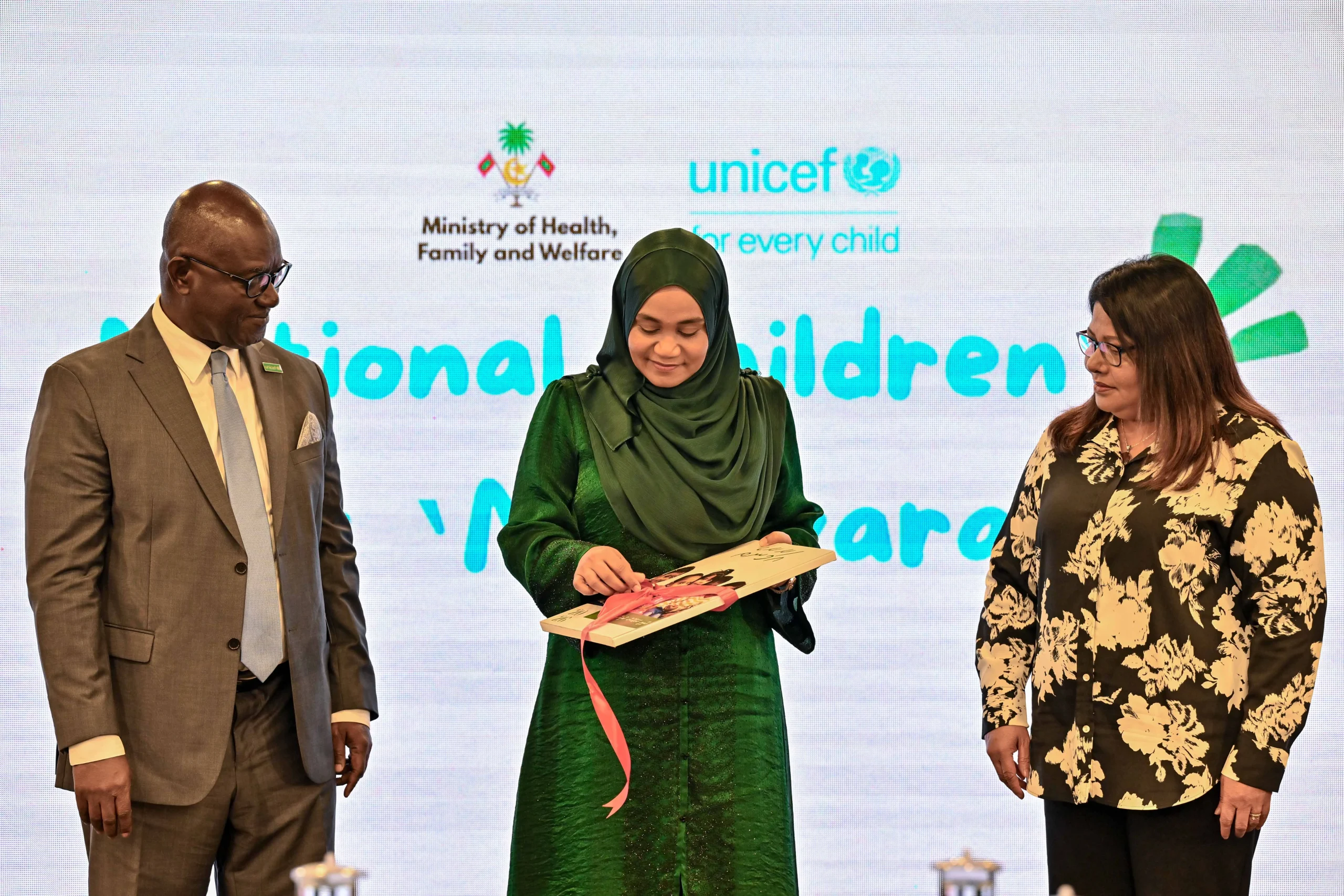
MALE’ — When Sajidha Mohamed took the podium at the Mashwara on Child Rights forum on 4 June to mark National Children’s Day, she was speaking in her official capacity as First Lady. But the words she chose, about abuse that happens in silence, about children whose suffering goes unseen, about the duty of adults to listen and act, carried a weight that went beyond ceremony.
She knows what it looks like when a child is targeted. She has lived it.
In March 2025, Sajidha issued a rare public statement defending her 16-year-old son, Umair Mohamed Muizzu, after false rumours circulated on social media claiming he vaped. The statement was personal, direct and visibly angry in the way only a mother’s statement can be. She described how the rumours, which she attributed to political opponents of her husband, were affecting Umair’s education, his social development and his sense of safety. She said her younger son, then eight years old, was also being harassed. She said she had stayed silent about personal attacks on herself for a long time, but attacks on her children were a different matter.
“Every child in the Maldives is protected under the Constitution,” she wrote. “My son Umair is a 16-year-old child. He has his future ahead of him, and his education is not yet complete. Most importantly, he has no involvement in political decisions his father and I made.”
She announced she would take personal legal action, as a mother, without government involvement. Her goal, she said, was not only to protect her own children but to create a safer environment for all children facing similar threats to their dignity.
That statement, read alongside her remarks at the June forum, tells a more complete story than either document does alone.
At the Mashwara forum, she said child protection goes beyond meeting basic material needs. She spoke about the responsibility of families and communities to support children’s intellectual and character development and to build in them qualities like empathy, resilience and faith. She raised the issue of neglect and psychological harm. “Too often, the abuse and suffering of children occur in silence,” she said.
She called on parents, guardians and educators to take an active role in guiding children through digital spaces, remarks that sit alongside President Muizzu’s announcement earlier in the week that the government is drafting legislation to restrict social media access for children under 16. The two statements, his legislative and hers personal, point in the same direction.
During the forum she launched a magazine focused on children’s rights and development, aimed at building public awareness and community capacity to protect children across the archipelago.
The Mashwara forum is designed to translate policy conversations into practical outcomes. Whether it does that depends on the follow-through. But the person who opened it is not someone speaking about child protection from a comfortable distance. She is a mother who stood up publicly when her own child was targeted, who put her name to a statement that most people in her position would have quietly absorbed, and who chose to say out loud that what was happening was wrong.
That does not make a policy. But it gives a forum its most credible voice.