News Desk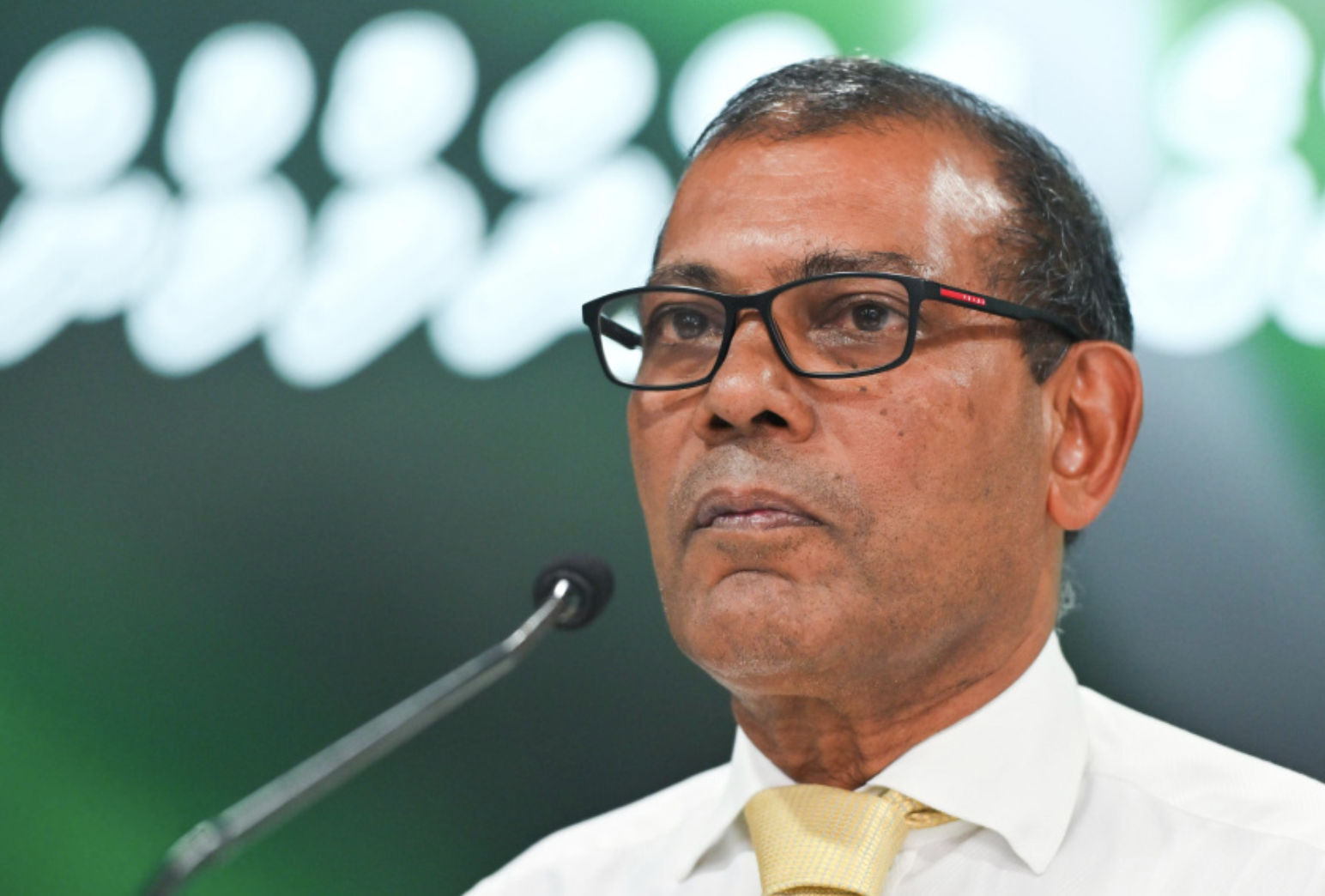
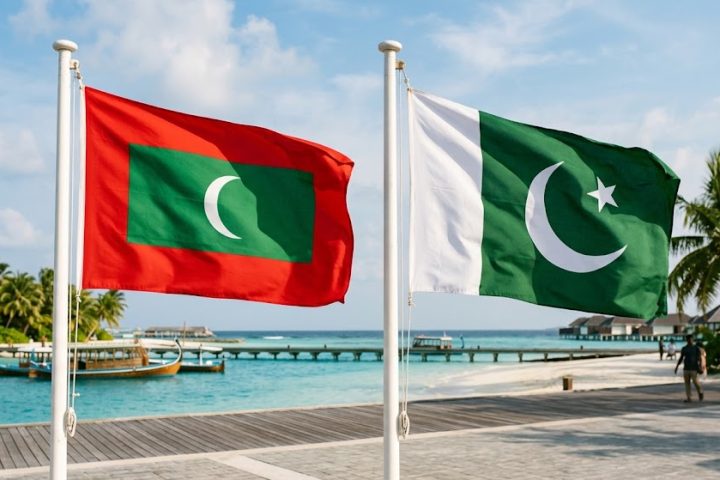
The government’s statement on Wednesday did not mention India, China or any individual. It did not need to. By declaring an “absolute policy” against letting any foreign party conduct maritime security “directly or indirectly” over Maldivian waters, it drew a line through one of the most contested questions in the country’s politics: how a tiny state in the middle of the Indian Ocean should keep itself safe.
The statement appears to answer remarks by Mohamed Nasheed, the former president, who gave an interview to the Indian outlet Firstpost during a visit to India for Sagarmanthan 2026, a forum organised by the Observer Research Foundation. President Nasheed said the Maldives cannot do without New Delhi on security. “For our safety and security, we rely heavily on India, so we must have meaningful conversations with India,” he said. The government, in effect, replied that the security of Maldivian waters would not be entrusted to anyone but the Maldivian state.
The Government of Maldives, in a statement dated 14 October, called the country’s territory and sovereignty “an inalienable right” and said the Constitution places the duty to protect, monitor and exercise full operational control over its waters, including the Exclusive Economic Zone, “solely” with the Maldivian state.
It stressed the strategic value of the sea lanes, which carry a substantial share of the world’s oil and commercial trade between continents. Safe and unhindered passage through those waters, it said, has long served international markets and contributed to regional peace, stability and global order. Refusing to hand surveillance, defence and management of the territory to foreign entities is therefore, in its words, a fundamental policy and a cornerstone of the country’s commitment to regional stability.
It said no part of Maldivian territory would “under any circumstances” be placed under foreign military or operational surveillance initiatives, and urged all parties to refrain from directly or indirectly inviting foreign influence in ways that could affect sovereignty. The wording is broad. It covers military and non-military oversight, and direct and indirect arrangements. The last line is aimed as much at domestic politicians as at foreign parties.
President Nasheed took the opposite view of how a small state should handle larger ones. He rejected the idea that the Maldives can play India and China against each other. “In my mind, you can’t balance,” he said. “You have to find a friend, be good to your friend, don’t play your friend against another, and live happily.”
His reasoning started with geography. “You can choose your friends and foes; geography is rather less negotiable,” he said. He also made an economic case, arguing that India’s rapid growth offers the Maldives a path to prosperity that nationalism cannot. “You can’t eat nationalism,” he said. “To get that prosperity, we must be able to plug into the rapid development of India.”
He was blunter about China. Expensive infrastructure loans, he said, often come without workable business plans, and when the plans fail, lenders can ask for assets in return. “They might come and ask for the bridge, they might come and ask for a road,” he said. He warned that the Maldives now spends more than 25 per cent of its income on debt repayment.
President Nasheed’s warning sits awkwardly with the experience of the past decade, which many Maldivians point to as evidence that borrowing for infrastructure can pay off. One bridge built with a foreign loan, the argument goes, opened the way for the next. The bridge linking Malé to Hulhulé and Hulhumalé, financed with Chinese money, has been followed by the Greater Malé Connectivity Project, which includes a further bridge.
Supporters of this view say the results are visible. They put the economy’s growth from about $5 billion to about $7 billion on the strength of the first link, and say the second is expected to lift it much further, with some projections going as high as $25 billion. No one in the government has endorsed those numbers and economists would treat a fivefold jump with caution. But the sentiment behind them is widely shared.
The trajectory should not surprise anyone who knows the country’s history. In 1982, the Maldives sat near the bottom of the development ladder. Its first loan from China, of $40,000 as per documents in the Ministry of Foreign Affairs, came only after repeated trips to Beijing by Fath’hulla Jameel, then the foreign minister. Four decades later, the Maldives has graduated from the United Nations’ list of least developed countries, ranks as an upper-middle-income economy and is among the more prominent voices in the group of small island developing states. Those who make this case say the arc runs from a loan of a few tens of thousands of dollars to bridges worth hundreds of millions, and that it was built on borrowing from partners willing to lend when others were not.
That outlook also shapes how the public hears the sovereignty argument. Ask in Malé’s tea shops and the answer is often the same: the Maldives welcomes anyone willing to invest in its development. The Maldives can accept lending, trade and investment from many partners and still insist that no foreign power watch its waters.
President Nasheed, by contrast, links the two, treating economic closeness as a reason for closer security ties. The government draws the line differently. Its position leaves the Maldives free to welcome trade, investment and financing from friends old and new, while keeping responsibility for the safety of its own waters in Maldivian hands.
President Nasheed’s own figures help explain the appeal of that approach. If more than a quarter of income already goes on debt service, and about 30 per cent of the budget on climate adaptation, the country has little room for commitments that narrow its choices. Keeping economic partnerships and security responsibilities apart preserves that room, and it does so without questioning the good faith of any partner.
The two positions share a goal and part ways on the method.
Both reject any foreign power taking control of Maldivian waters. President Nasheed said the country must “live within our means” and avoid hostile powers gaining a foothold. The government’s text is aimed at the same outcome.
The disagreement is over what counts as foreign involvement. President Nasheed describes reliance on India as a fact of geography and a source of strategic freedom, arguing that India’s democratic, rule-of-law system lets the Maldives “say no” when views differ. President Nasheed’s position rests on confidence in India’s democratic institutions. The government’s rests on a principle that does not depend on any one partner’s conduct..Its wording, which bars even indirect oversight, leaves no room for the kind of partnership he describes.
President Nasheed placed his argument in a broader context. Disruption in the Red Sea and the Strait of Hormuz, he said, could push shipping towards routes that pass the Maldives, such as the run from Mombasa to Jakarta. That would bring economic benefit, but also risk.
“It is possible for a dozen people with a few AK-47 guns and a launch to disrupt these two channels,” he said, referring to the One and a Half Degree and Eight Degree Channels. Stopping that, he said, would require “superpowers and middle powers” to bring “huge amounts of hardware into the Indian Ocean.”
The government’s statement answers that logic from the other side. If the sea lanes are valuable enough to attract outside powers, it argues, then inviting any of them to police those lanes would make the Maldives a stage for rivalries rather than a neutral host to world trade. The statement says as much when it describes foreign security oversight as destabilising to the wider region.
President Nasheed argued that the Maldives cannot afford an arms build-up, and said climate adaptation already takes about 30 per cent of the budget. He also described the global order as drifting back to the 18th century, when powers carved the world into spheres of influence. Small states, he said, must lean on their long independence. “That means talking to a lot of people, being very mindful about what you do, what you say.”
That passage sits oddly beside his main advice. A country that talks to many people, as he puts it, cannot also commit its security to one. It is closer to the government’s line than to his own.
On internal threats, he treated radicalisation as a domestic problem. “Having a gun in the Indian Ocean doesn’t solve all your problems,” he said. “It’s more important that our society is properly managed and that we live peacefully.” By his own account, the main danger lies at home, and it is one that hardware alone cannot remove.