News Desk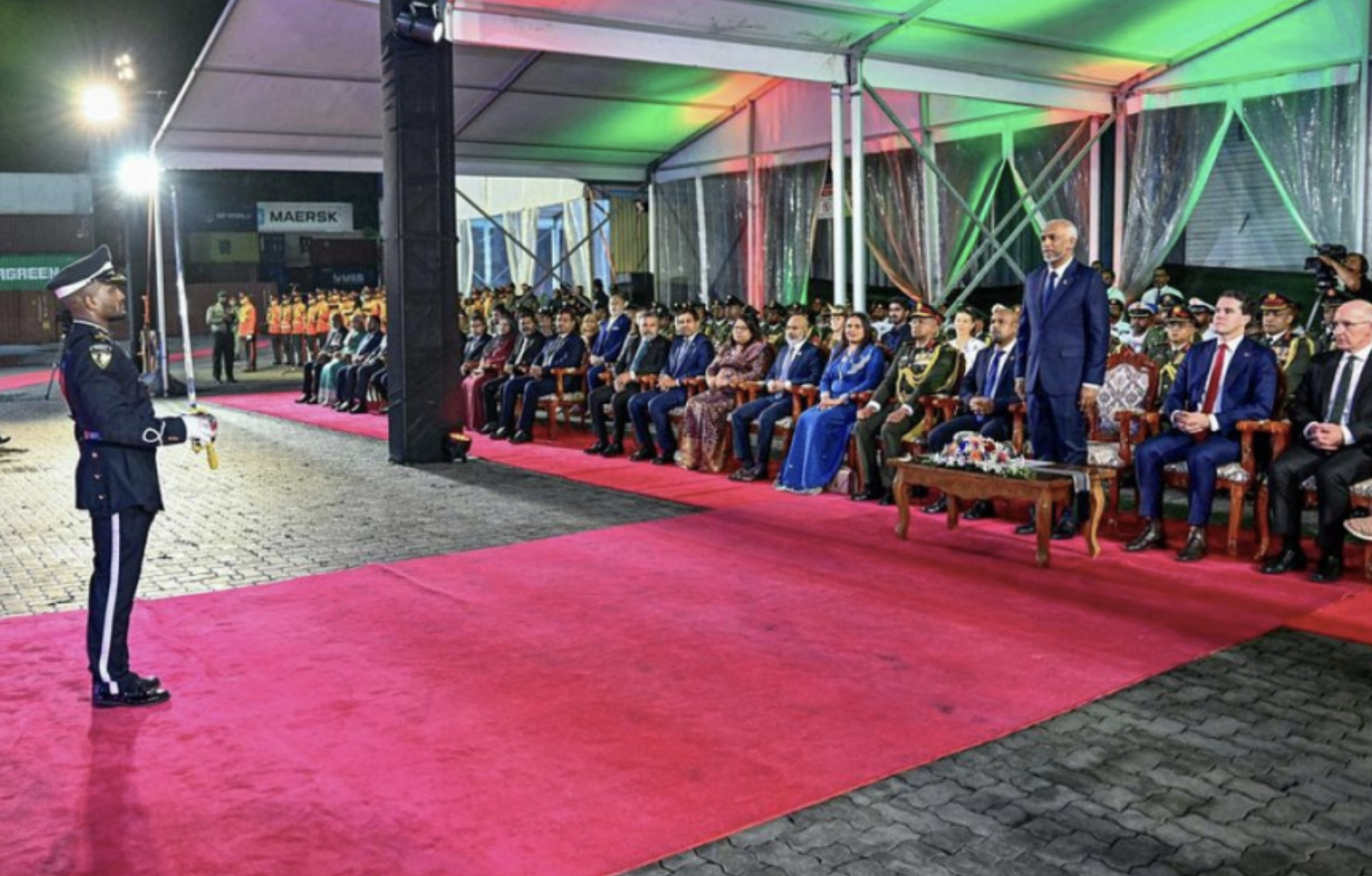
MALE’ — When the MNDF vessel Imaadhuddeen was commissioned yesterday, gifted by Australia to patrol the Maldives’ exclusive economic zone, Chief of Defence Force Major General Ibrahim Hilmy offered a statement that would have been unthinkable from a Maldivian military commander even five years ago.
“Not a single inch of Maldivian waters will be left unguarded,” he said. “We will patrol every corner without hesitation.”
It was the language of a country that has decided, under President Mohamed Muizzu, that it intends to be taken seriously as a maritime security power. Whether it can afford to sustain that ambition, and what it means for the Maldives’ delicate position between competing great powers in the Indian Ocean, are questions that will define the years ahead.
In less than three years in office, President Muizzu has overseen the most significant expansion of Maldivian military capability in the country’s history. The pace and breadth of what has been built, bought, gifted and commissioned is striking for a nation of fewer than half a million people carrying a debt-to-GDP ratio of over 120 percent.
The Turkish Arsenal
President Muizzu’s first foreign visit after taking office in November 2023 was not to India, the country’s traditional security partner and nearest large neighbour. It was to Turkey. The symbolism was deliberate, and it was followed by substance.
In March 2024, $37 million was allocated from the state’s contingency budget to purchase military drones from Turkey. The Maldives acquired Bayraktar TB2 drones, the same platform used in conflicts from Ukraine to Libya, in what than Defence Minister Ghassan Maumoon described as a weapon with firepower capable of defensive manoeuvres to defend the country’s sovereignty, while focusing on surveillance and search operations.
Three TB2s were inaugurated at a ceremony at Maafaru International Airport in Noonu Atoll on 15 March 2024. That same evening, one of the drones conducted a maiden patrol from the base. Turkish media reported the total purchase could include six drones.
The drones were not the only Turkish contribution. Turkey also gifted the Maldives a former Turkish Navy vessel, CGS Dharumavantha, a Doğan-class fast attack craft. Nineteen Maldivian sailors spent a month in Turkey training for its operation. The vessel left Istanbul on July 1, 2025 and arrived in Male’ on August 7, before being formally commissioned on August 15. Turkey, Nordic Monitor noted, simultaneously gifted the warship while selling the armed drones, a pattern that mirrors Ankara’s broader foreign policy of bundling arms exports, debt relief and infrastructure projects into packages designed to extend influence in regions where Western presence is less pronounced.
Building an Air Force From Scratch
On 15 March 2024, President Muizzu inaugurated the MNDF Air Corps, the country’s first dedicated air arm, established by presidential decree to protect the Maldives’ exclusive economic zone and airspace. It was, by any measure, a foundational moment. The Maldives had never had a formal air force before.
In November 2025, the MNDF commissioned its Gan Air Station at Addu City in the south of the country, completing what authorities described as a full launch of all air military operations necessary to maintain the security of Maldivian airspace. President Muizzu used the occasion to announce that military aircraft would be acquired for the Air Corps in the coming year, though no specifications were given.
The proposed state budget for 2026 includes MVR 2.8 billion, or roughly $140 million, for military spending, representing four percent of the total budget. The government keeps specific expenditure details confidential citing national security reasons. Next year’s budget also includes a large expenditure on insurance for the drones.
The Air Corps now operates the Turkish TB2 drones alongside Indian-gifted HAL Dhruv utility helicopters, a Dornier 228 maritime patrol aircraft donated by India in 2020, and ATR 72 transport aircraft. In 2024 and 2025, the MNDF transitioned from a reliance on foreign-piloted assets to an independent 24-hour surveillance model, with the Turkish drones introducing a shift in doctrine toward autonomous patrolling of the northern and southern boundaries of the EEZ.
The New Vessel
The Imaadhuddeen, commissioned recently and gifted by Australia, adds a third major partner to the Maldives’ rapidly diversifying procurement picture, alongside Turkey and China. As of 2025, the MNDF Coast Guard fleet comprises approximately 12 patrol and coastal combatant vessels, supplemented by auxiliary craft and rigid-hull inflatable boats for inshore duties. Maldivian sailors operated the Australian vessel on the 14-day voyage from Australia to Male’, the longest sea journey in the MNDF’s history.
In April 2025, the MNDF also integrated Ajban 442A 4×4 light armoured vehicles from the UAE’s EDGE Group, marking an upgrade to its land capabilities.
The Strategic Picture
The expansion sits within a geopolitical context that has shifted substantially since President Muizzu took office. He expelled Indian military personnel within months of being sworn in, fulfilling a campaign pledge that alarmed New Delhi, and pivoted toward China and Turkey as primary partners. To diversify its security partnerships, the Maldives signed a military assistance agreement with China in 2024 for the provision of non-lethal equipment and training.
Yet the picture is not binary. Australia has now gifted a vessel. The United States maintains a State Partnership Program with the Maldives through the New Jersey National Guard. The Maldives remains a member of the Colombo Security Conclave. India, despite the tensions of 2023 and 2024, continues to provide equipment and has not fully disengaged.
What President Muizzu has built, in effect, is a hedging strategy: accepting hardware from multiple directions while asserting sovereignty over the EEZ with a new doctrinal confidence. The primary security concerns remain illegal fishing, maritime terrorism, narcotics trafficking and climate change, all of which require maritime and aerial surveillance rather than conventional military force.
The drug trafficking case that brought two Maldivian nationals to a Sri Lankan courtroom last week, carrying methamphetamine through Colombo’s international airport in an operation linked to networks operating across the region, illustrates the practical dimension of that surveillance challenge. The Maldives sits at the intersection of Indian Ocean narcotics routes as much as it sits at the intersection of great power competition. What flows through its waters is not only geopolitical interest.
President Muizzu announced plans to double the Coast Guard’s capacity, recondition older equipment, expand the Air Corps fleet and enhance land platforms. The MVR 2.8 billion military budget for 2026 will not be the ceiling. It is, by all indications, a floor.
For a country that has spent decades relying on others to patrol its waters, the ambition is genuine and the hardware is real. Whether the budget can sustain it, given everything else the Maldivian state is trying to pay for, is the question that follows every commissioning ceremony.