News Desk
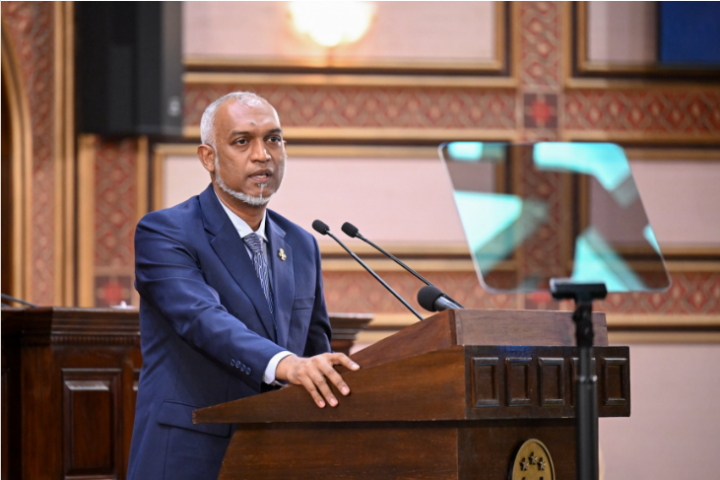
MALÉ — President Dr Mohamed Muizzu has initiated a bold legislative and institutional restructuring, proposing a constitutional amendment to guarantee reserved parliamentary seats for women and youth alongside the creation of high-level national advisory bodies.
Coming roughly two years and a month before the nation heads to the ballot boxes for the next presidential election, the move represents a calculated dual strategy: an effort to entrench progressive democratic reforms while politically outflanking his critics.
Reshaping the People’s Majlis
Under the proposed constitutional amendments announced by President Muizzu, the composition of the People’s Majlis will undergo its most fundamental transformation to date. By mandating specific quotas for women and young leaders, the administration aims to dismantle structural barriers that have long kept marginalized demographics at the periphery of Maldivian lawmaking.
For an administration looking toward the looming electoral horizon, the constitutional push serves as a high-stakes referendum on its reformist credentials. Should the amendment successfully clear the legislature, it will mark a generational shift in Maldivian politics, cementing Muizzu’s legacy as a structural reformer. Conversely, should the bill stall or face fierce opposition, it will lay bare the administration’s legislative limitations and offer voters a clear metric by which to evaluate the government’s political capital and public mandate.
Institutionalizing Expertise: The Advisory Councils
In tandem with the parliamentary overhaul, the administration is formalizing a new apparatus for governance. President Muizzu has announced the formation of two distinct advisory bodies slated to become operational by November 2026.
The initiative features a smaller, elite panel of veteran statesmen and public servants, alongside a sweeping national council comprising 100 to 150 technical specialists and domain experts. Designed to embed systematic, data-driven deliberation into the executive branch, these councils aim to insulate national policy from raw partisanship.
As the clock ticks down toward the presidential race, these sweeping institutional maneuvers reflect an administration eager to project command over the nation’s future—betting that structural inclusion and technocratic governance will resonate with an electorate increasingly demanding accountability and reform.