News Desk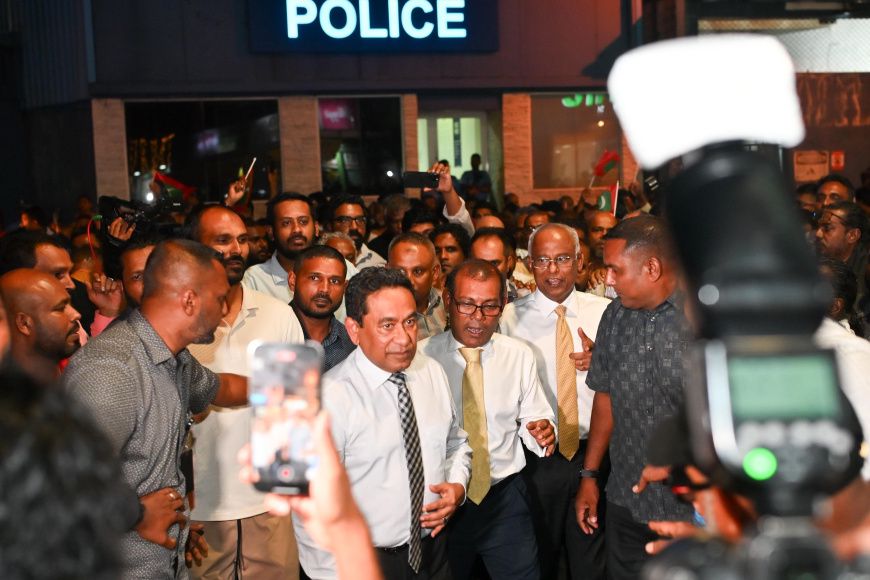
Former President Abdulla Yameen Abdul Gayoom has declared his intention to stand in the upcoming 2028 presidential election, expressing confidence that the incumbent President, Dr Mohamed Muizzu, will not act to prevent his name from appearing on the ballot.
Speaking in an interview with Sanghu TV, Yameen asserted that he does not believe President Muizzu possesses the intent to subject him to political persecution on the scale experienced under the previous administration of President Ibrahim Mohamed Solih.
“I am saying this because I do not believe Muizzu will do such a thing. Therefore, I believe that, God willing, my name will be on the ballot paper in 2028,” Yameen said.
Yameen argued that public support for the current government has deteriorated significantly. He added that President Muizzu is personally aware that his popular backing has dropped below the threshold required to secure an election victory, citing public discontent reflected in recent electoral contests held under the administration.
Allegations of Political Persecution and Judicial Influence
Reflecting on his legal troubles, Yameen insisted that President Muizzu is fully aware that his past conviction and imprisonment under Solih’s administration were driven by political influence rather than legitimate legal grounds.
“Muizzu was a minister who served alongside me. Muizzu knows as much about those MMPRC matters as we do. Therefore, President Muizzu will know that even if Ibrahim Mohamed Solih blamed me for such corruption, it was not the case,” Yameen stated.
While critical of the government’s operational performance and truthfulness, Yameen reiterated his belief that Muizzu would not resort to state-sponsored cruelty against a former head of state:
“I speak with confidence when I say I do not believe President Muizzu could be such a cruel person. I am a former president. Personally, I do not believe anyone would inflict such cruelty on someone of our stature. I do not believe Muizzu would do it. Ibrahim Mohamed Solih did it, and if given another chance, he might do it again. But I say this because I believe Muizzu simply will not do it.”
Despite his faith that Muizzu will not personally persecute him, Yameen rejected claims by the administration that it does not interfere with the judiciary. Citing his ongoing court cases, he highlighted procedural discrepancies as evidence of executive overreach:
“My case currently in court is virtually finished. Almost all hearings have concluded, witness testimonies have been taken, and everything is complete. Now only the closing statements remain. That case was sent to court to charge another person jointly with me. The Prosecutor General’s Office withdrew the case against the other person from court. So how can it be said there is no influence?”
Yameen maintained that while various administrations have exerted control over the courts to differing degrees, the judiciary operated independently during his presidency:
“No judge who was in the judiciary at that time would dare say that President Abdulla Yameen called them and asked them to decide a specific case in a specific way. I did not interfere.”
He noted that the most severe crisis during his term was the Supreme Court order issued on 1 February 2018. Addressing broader judicial integrity, Yameen remarked that judges themselves bear the responsibility of resisting executive or ministerial pressure and upholding the bench’s independence, noting that past rulings favouring prominent business figures were driven by judicial conduct rather than presidential command.
He added that while he possesses concrete ideas to reform and free the judiciary—backed by his long-standing career in constitutional drafting, legislation, parliament, and economic management—he prefers to demonstrate those reforms through direct action rather than public discourse.
Firm Rejection of Parliamentary Governance and “Bodu Badhalu”
Yameen voiced firm opposition to shifting the Maldives from its current presidential framework to a parliamentary system, explicitly rejecting the “Bodu Badhalu” (Grand Change) initiative spearheaded by former President Mohamed Nasheed and former Maldivian Democratic Party (MDP) Chairperson Fayyaz Ismail.
The initiative, which aims to alter the constitutional structure and recently launched a dedicated website to gather public feedback, seeks to transition power toward a parliamentary system. Yameen made it clear he would not support the initiative.
“Executive power does not need to be held in the hands of two people [a President and a Prime Minister]. I do not believe the Maldives is ready for a parliamentary system,” Yameen said.
Outlining his constitutional philosophy, Yameen insisted that supreme executive authority must remain concentrated in a single leader. Dividing power between a President and a Prime Minister, he argued, creates an unstable and unsuitable framework for the Maldives.
His opposition to a parliamentary system is primarily rooted in a deep distrust of the People’s Majlis. Describing parliament as an institution susceptible to financial corruption where members prioritize personal gain and the interests of wealthy businessmen over national sovereignty, Yameen warned against entrusting supreme state authority to the legislature:
“My perspective changed primarily because of the corruption and monetary influence inside the People’s Majlis. Although I previously supported a parliamentary system in theory, practical reality shows that the independence of members is compromised by the financial influence of big businessmen who essentially buy them off.”
Drawing on his extensive tenure as a lawmaker, Yameen reiterated that his first-hand experience with internal parliamentary dynamics convinced him that handing ultimate decision-making power over national sovereignty to the legislature poses a grave risk to the nation.
Sharp Rebuke to MP Shujau Over MMPRC Remarks
Yameen launched a scathing personal counterattack against MP Ibrahim Shujau, the Member of Parliament for the Baarashu constituency, following critical remarks Shujau made during a People’s National Congress (PNC) gathering in Ukulhas.
At the PNC event, Shujau claimed that during Yameen’s presidency, the former leader spent most of his nights playing cards while the core work of state governance was run through the Ministry of Housing. Shujau further alleged that the ruling party was managed via a “Madam’s Office” rather than an official party office.
This was a direct reference to the active involvement of Yameen’s wife, former First Lady Fathimath Ibrahim, in day-to-day administrative and political affairs during his presidency.
Responding directly, Yameen clarified that his administration was structured strictly around cabinet consultation and dedicated ministerial committees handling economic and social affairs. He noted that Dr Muizzu, who served as Housing Minister at the time, was not included in any of those primary decision-making committees.
Dismissing Shujau’s credibility, Yameen rejected any suggestion of a close personal relationship with the MP, characterizing him as a figure tied to disgraced former Vice President Ahmed Adeeb:
“He was never someone I kept close. He was Adeeb’s champion, Adeeb’s henchman. He was one of the participants in the mutiny who first abandoned the party to join President Maumoon’s side.”
Yameen asserted that Shujau’s knowledge of the Maldives Marketing and Public Relations Corporation (MMPRC) embezzlement scheme stems strictly from his alleged role in handling the funds:
“Those who were involved in distributing the money given by Adeeb are the ones who would know how to talk about it. He would not know how to talk about anything else.”