News Desk
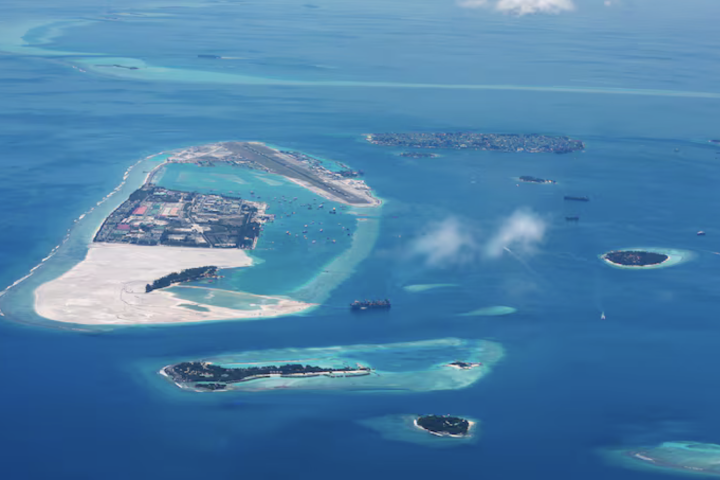
MALÉ / MUMBAI — When local headlines in Malé erupted this week over a projected $20 billion luxury waterfront deal with Abu Dhabi’s Eagle Hills, the narrative seemed straightforward: President Dr Mohamed Muizzu’s flagship Ras Malé urban project had secured its private crown jewel. Yet, amidst the fanfare surrounding private foreign direct investment, a crucial reality remains unsaid in Malé’s media landscape.
While flashy marina masterplans capture public imagination, luxury projects and high-end towers cannot function without foundational, heavy-duty civic infrastructure: power grids, deep utilities, water desalination plants, waste management, and heavy transport links across the lagoon. Private developers do not build this core infrastructure—sovereign credit facilities do.
And far from the ceremonial cameras, the financial engine that makes Ras Malé physically and municipally viable has quietly gone live— courtesy of the Government of India.
The Real Engine: India’s ₹4,850 Crore Line of Credit
On 23 September 2026, the Reserve Bank of India (RBI) issued a circular to Authorized Dealer banks across India, officially operationalising a government-backed Line of Credit (LOC) worth ₹4,850 crores (approx. $580 million / MVR 8.9 billion) for the Government of the Maldives.
Executed through the Export-Import Bank of India (Exim Bank) following a bilateral agreement signed on 25 July 2025 during PM Modi’s Male’ visit and activated on 27 August 2026, this facility provides the exact capital capacity needed to transform reclaimed sand into a liveable smart city.
Key Framework Attributes:
- Structured as an “Umbrella LOC”: The ~$580 million pot is flexible. Rather than being tied to pre-fixed projects, the Ministry of Finance here, can slice funds into targeted sub-agreements.
- Minimum Contract Size of ₹500 Crores (~$60 Million): Designed specifically for large-scale, high-impact civil engineering contracts—matching the scale of primary utilities required for Ras Malé.
- 75% Indian Procurement Mandate: At least three-quarters of all goods, services, and works under financed contracts must be supplied by Indian contractors and engineering firms, bringing proven regional construction expertise directly to Maldivian soil.
- Extended Disbursement Horizon: Funding remains accessible for up to 48 months (4 years) past scheduled contract completion dates, protecting major works against project stalls.
Why Private Investments Rely on Indian Foundations
Private mega-projects like the $20 billion Eagle Hills proposal depend entirely on state-backed utility networks. Commercial developers build atop prepared, connected land; they do not fund sewerage systems, garbage disposal facilities, municipal power grids, or submarine cable networks.
By deploying the ₹4,850 crore Indian facility into Ras Malé’s fundamental infrastructure, President Muizzu’s administration can establish the essential groundwork without resorting to high-cost commercial borrowing or further land-swap dilutions.India is effectively laying the steel, concrete, and cable foundations for the upcoming megacity in the Greater Malé region, upon which all future private investment in Ras Malé will rest.
A Partnership Beyond Rhetoric
The activation of this massive credit line underscores a pragmatic truth in regional geopolitics: when it comes to the long-term, capital-intensive work of nation-building, India remains the most accessible, capable, and immediate partner for the Maldives.
As the technical machinery of the Exim Bank line of credit rolls out through Authorized Dealer banks in India, the onus now moves to Malé to formally submit project proposals. While commercial vanity projects make for compelling headlines, it is the quiet, steady arrival of Indian engineering and finance that stands to turn President Muizzu’s flagship vision of Ras Malé into a reality on the ground—a reality that merits clear and open acknowledgment.