News Desk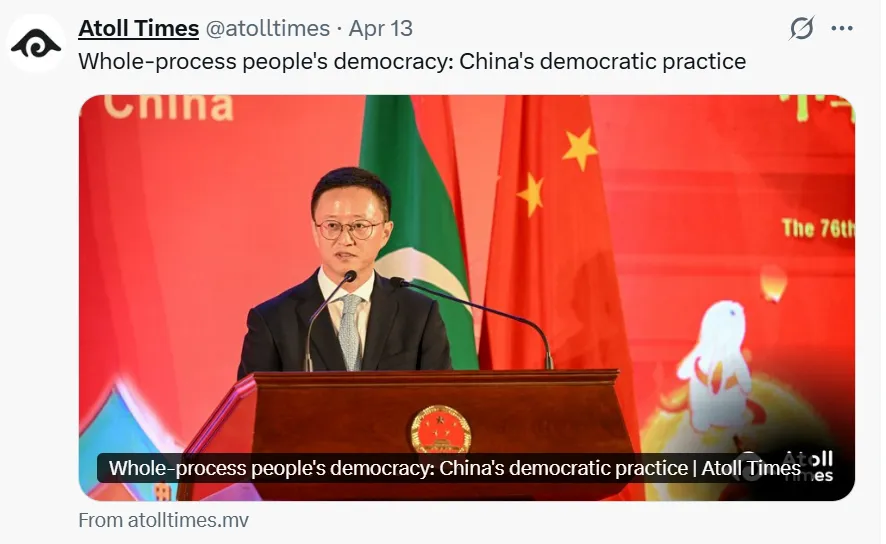
Ambassador Kong Xianhua’s contribution to the Maldivian media landscape is a welcome gesture of engagement. It offers Maldivian readers a window into how China articulates and understands its own governance model. The tone is what one would expect from an experienced diplomat: measured, courteous, and attentive to the diversity of political systems that coexist in the international arena. His article opens space for a broader conversation about how different nations define democracy and how those definitions shape their internal and external outlooks.
In setting out China’s “whole‑process people’s democracy,” the ambassador begins with a fundamental question: What is democracy? His answer leans toward outcomes rather than procedures, drawing on a tradition in Chinese political thought where legitimacy is tied to performance, social harmony, and stability. This framing also echoes a long‑standing global debate between procedural democracy—elections, checks and balances, pluralism—and substantive democracy, which emphasises delivery, welfare, and continuity.
It is a useful starting point, but it leaves aside an important tension: the balance between state‑directed representation and the individual agency of citizens.
In democratic theory, the right to participate, to dissent, and to influence national direction is not incidental; it is foundational. That aspect receives little attention in the ambassador’s text.
The ambassador highlights China’s consultative mechanisms, the scale of participation in the “two sessions,” and the channels through which public concerns are conveyed. These examples are presented as evidence of a system that seeks broad input and stable governance. What the article does not address is the central role of the Communist Party of China in shaping political outcomes, nor the ongoing debate in comparative politics about whether consultation without political competition can fully satisfy the democratic principle of choice.
For Maldivian readers accustomed to multi‑party contestation, open debate, and direct electoral accountability, this omission stands out.
Although the ambassador avoids explicit comparison with Western democracies, the structure of his argument implicitly contrasts China’s model with the liberal democratic tradition associated with the western world. That tradition places weight on individual rights, institutional checks, competitive elections, freedom of expression, and pluralism.
By focusing instead on unity, efficiency, and long‑term planning, the ambassador sidesteps direct critique while positioning China’s model as more stable and development‑oriented.
Yet Maldivians are familiar with elements of the Western model—through constitutional design, judicial practice, and media culture—which shape expectations of what democracy should feel like: open, competitive, and participatory. The ambassador’s article does not engage with this lived experience.
His reference to observing elections in Kulhudhuffushi is the point where the article comes closest to the Maldivian context. He notes the organisation and public participation, but the discussion remains at the surface.
What is missing is an appreciation of the Maldives’ distinctive democratic culture, which blends Islamic principles of consultation, island‑based community decision‑making, a strong sense of local autonomy, and a political culture shaped by personal accountability and public debate.
Maldivian democracy is not a scaled‑down version of Western liberalism; it is a hybrid system rooted in local identity, Islamic values, and island traditions.
It draws on more than three thousand years of self‑governance, social organisation, and an unbroken commitment to sovereignty. This long historical experience shapes how Maldivians understand political legitimacy—not only through elections, but through cultural continuity, religious grounding, and the expectation that the state will safeguard their welfare.
This deeper foundation of Maldivian democratic life is not reflected in the ambassador’s article. While he acknowledges electoral participation, he does not address the expectation that governance must reflect Islamic principles of justice, uphold national sovereignty, and maintain the reciprocal relationship between state and citizen that has defined Maldivian society for centuries.
Democracy in the Maldives is not merely procedural; it is embedded in identity and collective memory.
A Maldivian reading of the ambassador’s article would also note that the Maldives’ governance model includes features not captured in his framing. Under President Dr Mohamed Muizzu, the Maldives is pursuing a governance approach that emphasises delivery, sovereignty, and strategic partnerships while operating within a multi‑party democratic framework.
What distinguishes the Maldivian approach—and what the ambassador does not acknowledge—is the state’s active role in sharing national wealth directly and indirectly with its citizens. This is not simply a welfare policy; it is a political philosophy rooted in the country’s social contract. The state is expected to redistribute the benefits of national resources through housing programmes, land allocation, subsidies, income‑support schemes, and infrastructure that reduces household burdens. These expectations have deep cultural roots: island communities have long understood governance as a reciprocal relationship in which the state protects, provides, and ensures dignity.
Under President Muizzu, this principle has become more visible, reinforcing the idea that democratic legitimacy is strengthened when citizens experience the tangible presence of the state in their daily lives.
This aspect of Maldivian governance is absent from the ambassador’s discussion, even though anyone who has lived in the Maldives and experienced its democratic culture would recognise it as fundamental. While the ambassador emphasises participation and consultation within China’s governance model, he does not explore how democracies differ in the way they materially empower citizens. In the Maldives, legitimacy is tied not only to electoral processes but also to the state’s ability to deliver benefits equitably, ensuring that national development is felt at the household level. This blend of Islamic values of social justice with modern expectations of state responsibility is a defining feature of Maldivian democratic practice.
From a diplomatic perspective, the Maldives can be understood as a country that draws from multiple traditions without aligning itself fully with any single model.
Like China, it values development, stability, and long‑term planning. Like Western democracies, it values electoral legitimacy, public debate, and institutional checks. Unlike either, it grounds its democratic practice in Islamic principles and island‑community traditions. The current governance direction reflects this hybrid identity, positioning the Maldives as a sovereign democratic state charting its own path.
Ambassador Kong’s article is a careful presentation of China’s governance philosophy. It highlights strengths, avoids contentious comparisons, and acknowledges Maldivian democratic practice. But a deeper analysis shows that it leaves unaddressed the philosophical and cultural dimensions that define democracy in the Maldives.
A Maldivian‑centred reading would emphasise that democracy is not only about outcomes but also about agency; that it is rooted in Islamic and island traditions; that the Maldives is shaping its own governance trajectory; and that no external model—Chinese or Western—fully captures the Maldivian experience.