News Desk
Yugith Ibrahim of Ga. Vilingili walked out of a Sri Lankan courtroom on 31 August, acquitted of a heroin charge that had carried him to within a signature of the gallows. On Wednesday, in Kathmandu, he was back on the wrong side of a police line — this time with five million rupees in a suitcase and no explanation for where it came from.
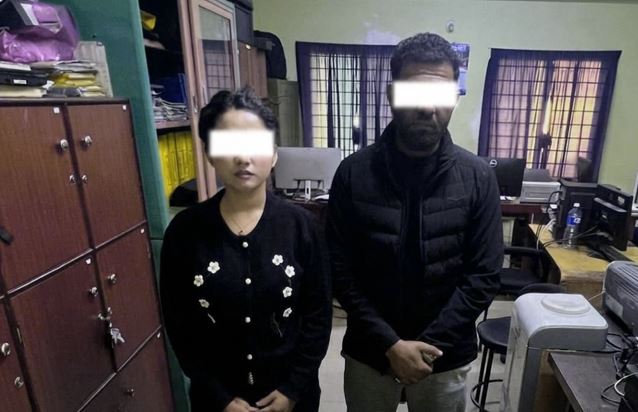
The Snowline Hotel sits in the middle of Thamel, the quarter of Kathmandu where backpackers change money in shopfronts and nobody asks questions. At around one o’clock on Wednesday afternoon, police did exactly that. Inside a room, they say, they found a Maldivian man and a twenty-year-old Nepali woman, and more cash than either could account for.
The man was Yugith Ibrahim. The woman was Sneha Rimal of Bisouni, Chitwan. Officers confiscated 5,050,000 Nepali rupees, 4,215 Omani rials and 55 UAE dirhams between them. By Thursday afternoon, that money still had no story attached to it. “They have not been able to explain the source of the funds,” Dan Bahadur Thapa, spokesperson and Superintendent of Police at the Kathmandu District Police Office, told reporters. The pair, he said, claimed they intended to marry. Police have not found evidence to support it. Preparations are underway to refer the case to the Department of Money Laundering Investigation.
Here is the part that makes it a story rather than a police blotter. Three months earlier, Yugith Ibrahim had been set free by a court in Sri Lanka after eight years in custody, most of it under a sentence of death.
The chain of events began on the evening of 22 May 2018, at Bandaranaike International Airport. Customs officers found twelve packets wrapped in carbon paper in luggage near the Emirates counter. Inside them, allegedly, was 1.296 kilograms of heroin. The bags were his. The Negombo High Court convicted him of possession and sentenced him to death.
For eight years, the case sat with him — and he sat with it. Sri Lanka has not executed anyone since 1976, which is a fact of limited comfort to the men who live on its death rows.
The turn came on 31 August this year, when Sri Lanka’s Court of Appeal — justices Amal Ranaraja and Dr Sumudu Premachandra — set aside the conviction in its entirety and ordered his release.
The bench did not rule that an innocent man had been framed. It ruled something quieter and, in its way, more damning: that the state had not done its job. The WhatsApp messages police relied on to identify the suspect had never been presented in court. The weight of the drugs did not reconcile, a discrepancy of 17.44 grammes. The chain of custody had gaps. Statements had been recorded late. Criminal intent, the judges found, was never proven beyond reasonable doubt — and after roughly eight years, a retrial would be unjust.
He walked free. By every account, that should have been the end of it.
Now comes Wednesday in Thamel, and a different kind of arithmetic: a suitcase of mixed currency, a charge not yet laid, and a department whose entire remit is finding out where money comes from. Nothing has been proven. In Nepal he is an arrested man, not a convicted one, and the last time a court in the region was asked to convict him, it declined — loudly, and on the record.
That is the caution the case demands, and it cuts both ways. An acquittal on procedural grounds is not a finding of innocence; a bundle of unexplained cash is not proof of anything except that someone wanted it moved quietly. What is certain is smaller and stranger. A young man from Ga. Vilingili spent eight years waiting to be executed for something a court decided the state never proved. He had three months of being nobody’s case file.
Now he has lawyers again, in a country where he owes no history at all — only an explanation.