News Desk
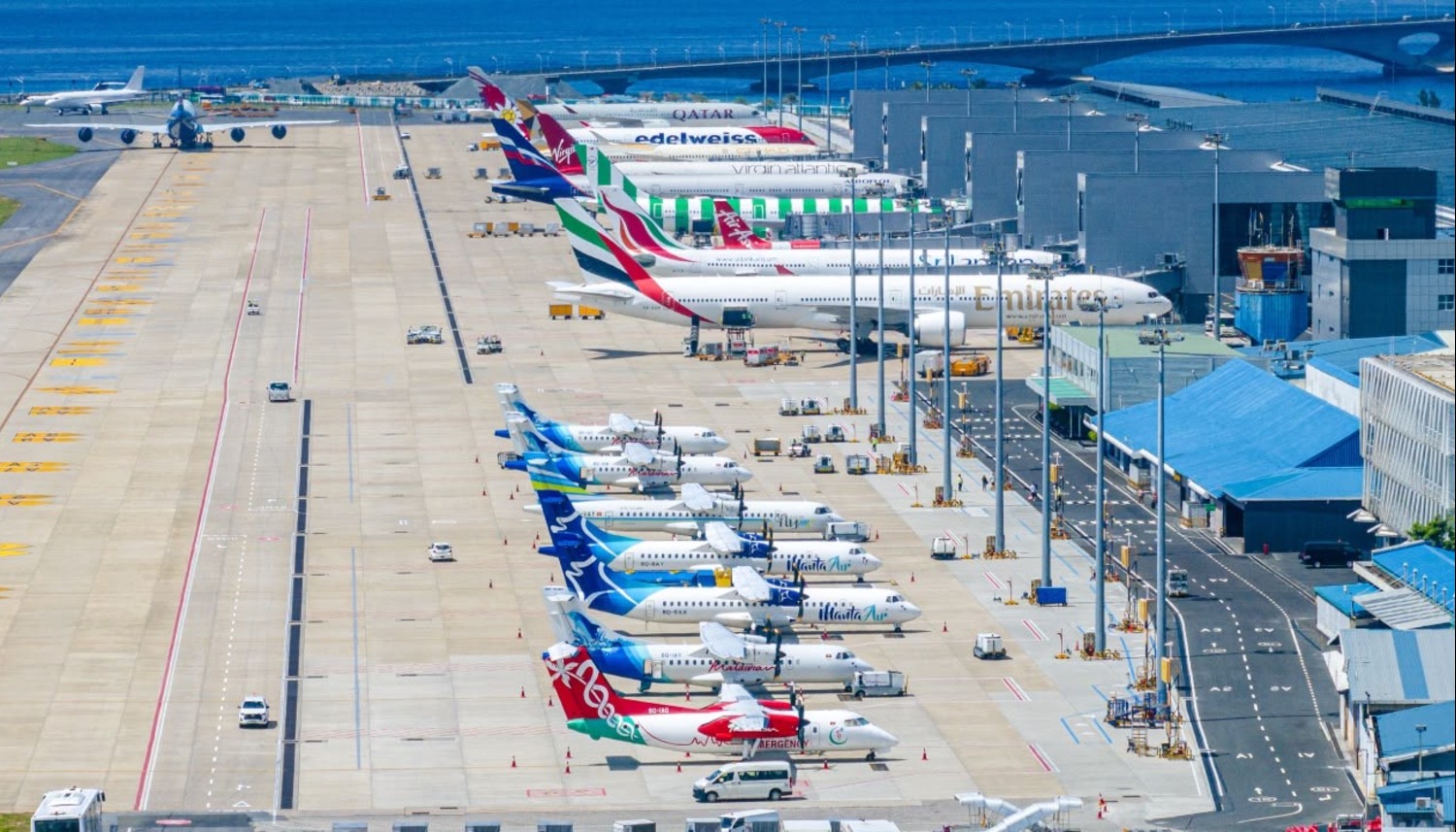
The company that runs the Maldives’ only major international gateway has pledged the rights to its runway, taxiways and apron as security for fresh bank loans, according to its latest audit report. The step sits awkwardly beside years of criticism, from the ranks of President Dr Mohamed Muizzu’s own side, of governments that borrowed against state assets.
The Maldives Airports Company Limited, or MACL, which operates Velana International Airport, borrowed $56 million from the Bank of Maldives in four tranches during 2025, the audit by the Auditor General’s Office says. The first, of $30 million, was secured against leasehold rights to land on Hulhulé island. The next three, totalling $26 million, were backed by leasehold rights over the runway, taxiway and apron under a master agreement signed earlier in the year.
The audit describes the loans as five-year facilities repayable on demand, which means the bank could in principle call in the full amount at any time. MACL’s dollar borrowing from the bank rose by 92 per cent to $112 million, of which $104 million was drawn after President Muizzu took office, the report says. The company also borrowed $15 million from Maldives Islamic Bank, pledging treasury bonds it holds.
MACL’s total debt now stands at 16.64 billion rufiyaa, about $1.08 billion, up from 13.4 billion a year earlier. That is roughly 15 times the 1.1 billion rufiyaa net profit the company reported for 2024, the most recent profit figure available, which means it would take about 15 years of profit at that level to clear the debt, before any new borrowing or interest.
Part of the increase reflects obligations taken on through a new subsidiary set up to carry out land reclamation projects, including Giraavarufalhu. Roughly 97 per cent of the debt is in foreign currency. This year the company faces 1.46 billion rufiyaa in principal repayments and 693.3 million in interest, and it needs more than $100 million a year in hard currency to cover debt service and operations. It ended the audited year with $13.5 million in cash.
The company is not unprofitable. It reported a net profit of 1.1 billion rufiyaa for 2024, the previous audited year. But the 2025 report warns that the pledge of Hulhulé’s leasehold rights, together with the company’s obligations from reclamation work, could expose both MACL and the state to significant financial risk. Many of the older airport loans also carry sovereign guarantees from the Finance Ministry, so the state would be called on if the company could not pay.
The practice of securing airport loans against leasehold rights is not new, and it began under President Abdulla Yameen, whose government borrowed heavily from foreign lenders to expand the airport. The audit says the foreign loans for the new runway, terminal and fuel farm are secured against the leasehold rights to Hulhulé land and the buildings on it, with sovereign guarantees from the Finance Ministry. A $47 million China Development Bank loan for the seaplane terminal, signed in July 2018, months before President Yameen left office, was also secured against leasehold rights. What is new is the use of short-notice domestic loans, and the political context.
In 2020 and 2021, when the government of Ibrahim Mohamed Solih prepared a sukuk, an Islamic bond, tied to Dharumavantha Hospital, opposition figures attacked the plan. Mohamed Jameel, a former vice president, said the government was trying to sell the hospital because it was bankrupt. Mohamed Hussain Shareef, then a vice president of President Muizzu’s People’s National Congress, was summoned by police over a leaked letter about the arrangement. He is now the government’s chief spokesperson, a post he took up in April. The Finance Ministry said the hospital would not be sold or mortgaged, only transferred to a wholly state-owned vehicle for the purposes of the bond.
President Muizzu has since made the argument his own. After the government repaid the sukuk this year, he said that mortgaged buildings, including the Finance Ministry’s, had been saved. In his Independence Day address in July, he said state assets, including Dharumavantha Hospital, had been tied up in past financial arrangements and that his government had freed them. The majority leader, Ibrahim Falah, told Majlis the previous administration had left office after “mortgaging the nation’s independence.”
The government has a defence available. The sukuk was a sovereign bond, while MACL’s loans are commercial borrowing by a state company that earns hard currency. President Muizzu’s government has also said it inherited an economy in poor shape. Critics will answer that the principle, not the legal structure, was what the earlier objections were about.
“When we took charge, the economy was in a deep abyss—trapped in a state of subjugation. We set out to liberate it from that dependence. We paid off the Sukuk and settled numerous other loans, freeing our key national assets in the process. From Dharumavantha Hospital to similar vital institutions, we have rescued them from pledge and bondage, and we continue our work to build a resilient economy.”
President Dr Mohamed Muizzu, speaking at the official Independence Day function, 26 July 2026
The opposition has begun to say so. Speaking at a campaign event in Dhidhdhoo, in Haa Alif Atoll, Fayyaz Ismail, a former chairperson of the Maldivian Democratic Party and a declared candidate in its presidential primary, said the current term had done the Maldives its worst social and economic damage in recent times. “Our economy has, in truth, been set back by about 20 or 30 years,” he said, adding that the effects would become clear over the coming months and years. He did not refer to the airport.
The audit’s own warning was narrower, and specific: MACL’s billions of rufiyaa in obligations could expose both the company and the state to significant financial risk.