 News Desk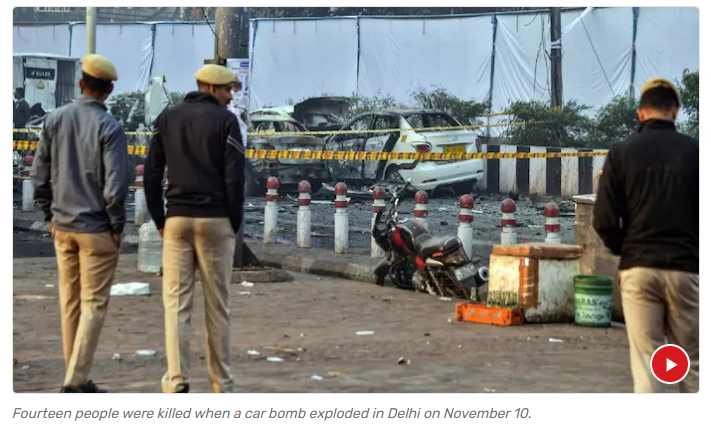
The Delhi Red Fort blast and the earlier Pahalgam attack were acts of terrorism that deserve clear acknowledgment. Yet the way they are narrated in Indian media reveals a deeper problem. Coverage has leaned heavily on equating Hamas — a Palestinian group engaged in a decades-long struggle against occupation and what many describe as genocidal force — with militancy inside India. For a country that positions itself as a leader of the Global South, this conflation is telling. It reflects how Islamophobia is shaping public discourse, turning complex international struggles into shorthand for domestic suspicion of Muslims.
India Today’s reporting framed the arrests and early National Investigation Agency findings around “Hamas-style” tactics, including alleged plans to weaponize drones as rocket-bombs and shift to car IEDs when the drone scheme faltered. A companion piece asserted a growing “Jaish-Hamas nexus,” tracing ideological cues from October 7, 2023, and suggesting Pakistan as a “new ground” for Hamas operatives, despite India not officially listing Hamas as a terrorist organization.
Pakistan’s enduring role in cross-border militancy cannot be ignored. For decades, groups nurtured in its soil have carried out attacks in India, from Kashmir to Delhi, leaving behind a trail of shattered lives and deepened mistrust. These networks thrive on political patronage and intelligence complicity, and their actions have repeatedly undermined regional stability. It is vital to underscore that terrorism is not a defense of Islam but a betrayal of it. The faith’s core values of justice, compassion, and dignity stand in direct opposition to indiscriminate violence. Terrorism must therefore be condemned categorically and unconditionally, without equivocation or selective outrage, whether its perpetrators claim religious justification or geopolitical grievance.
How media framing shapes public perception
In its broader analysis, India Today claims visual and tactical parallels between the Pahalgam attack and October 7, and quotes Israeli and American voices to reinforce the analogy, while noting that India has not designated Hamas as terrorist even as top brass now name it alongside Jaish and Lashkar. These editorial choices matter. They present alleged operational details alongside sweeping geopolitical inference in ways that dehumanize Muslims, casting them in a negative light at a time when communities are already forced to prove daily that they are the ‘good guys’ even as they endure violence, lynchings, demolitions, and arrests carried out extrajudicially.
Al Jazeera’s post-blast analysis highlights a parallel dynamic: a likely intensification of crackdowns and a surge in anti-Muslimism and Islamophobic sentiment, even as the government avoided publicly blaming Pakistan at first. The outlets like India Today situates the Red Fort blast inside a new doctrine that treats terror as war, and tracks mass detentions and demolitions that advocates describe as collective punishment, changes that reverberate throughout the community.
Documented rise in anti-Muslim rhetoric
The texture of public discourse has hardened. A 2024 mapping by India Hate Lab, reported by Al Jazeera, found India averaged nearly two anti-Muslim hate speech events per day in 2023, with 75 percent occurring in BJP-ruled jurisdictions, and peaks aligning with campaign seasons. It identified VHP and Bajrang Dal as major organizers and noted a normalization of dehumanizing language and calls to violence in those spaces. Academic work on the Indian media environment describes a systematic spread of Islamophobic narratives and factually inaccurate content, driven by political actors and amplified online, contributing to social polarization and recurrent violence against Muslims. These patterns predate the Red Fort blast, but they shape how such events are framed and understood.
A media and social media snapshot in late 2023 and 2024 shows Indian right-wing networks leveraging the Israel-Hamas war to amplify Islamophobic talking points, positioning global conflict as domestic proof points and blurring boundaries between foreign militancy and Indian Muslim citizenship.
Quotes reflecting escalation and pushback
- “There are similarities between the Pahalgam attack and what happened on October 7.” Israel’s Ambassador to India, Reuven Azar, in India Today’s comparative framing.
- “Our analysis shows that anti-Muslim hate speech has been normalised and become part of India’s socio-political sphere.” Raqib Hameed Naik, India Hate Lab founder, on nationwide trends.
- “In hours of crisis, we need unity and solidarity among citizens more than ever. Those who use such despicable incidents for their ideological or political gains must be called out.” Jamaat-e-Islami Hind President Syed Sadatullah Husaini, urging transparent investigation and warning media against scapegoating.
- “A disturbing trend has emerged on social media… right-wing extremist groups have leveraged the conflict to perpetuate Islamophobic narratives.” Siasat daily’s assessment of post–October 7 discourse in India.